
Govt seeks ‘careful balance’ in White Paper: Teo
SINGAPORE — As the Republic mulls over its population strategy for the decades ahead, two possible scenarios could emerge: One, without any immigration, businesses will find it tougher to hire workers amid a shrinking workforce. New jobs, especially for the young, will also be hard to come by and there may also not be enough people to look after the elderly.
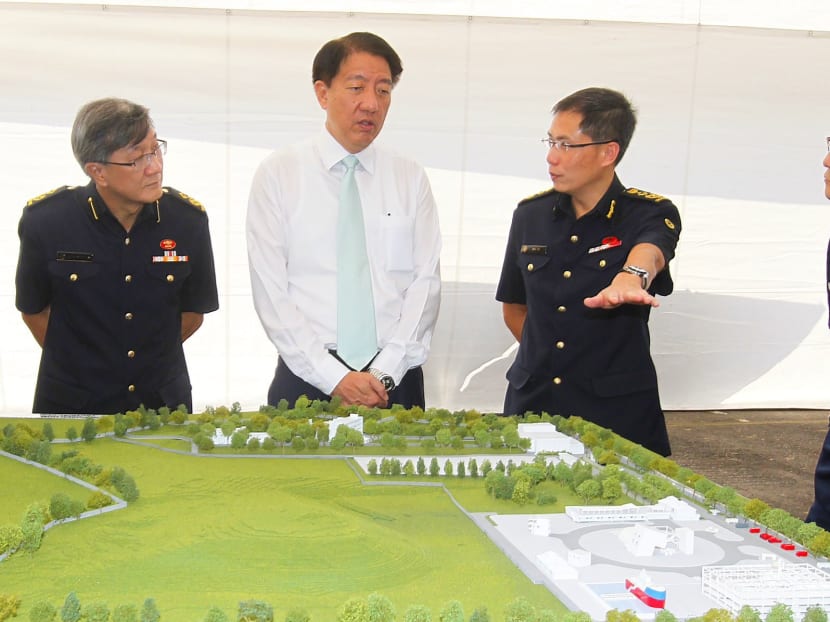
DPM Teo Chee Hean at the symbolic Groundbreaking Ceremony for the Home Team Tactical Centre located at Mandai Road on Jan 31, 2013. Photo: Ernest Chua.

SINGAPORE — As the Republic mulls over its population strategy for the decades ahead, two possible scenarios could emerge: One, without any immigration, businesses will find it tougher to hire workers amid a shrinking workforce. New jobs, especially for the young, will also be hard to come by and there may also not be enough people to look after the elderly.
Two, continue growing the workforce at the same rate as the last three decades — with a sizeable number of imported labour — and cause huge pressure beyond what the country’s infrastructure can cope with.
Outlining these possible scenarios yesterday, Deputy Prime Minister Teo Chee Hean — who oversees the National Population and Talent Division — explained that the population projections unveiled in the White Paper on Monday was aimed at achieving a “careful balance” between the two scenarios, “neither of which would actually produce for us desirable outcomes”.
The White Paper projects that by 2030, the population could be between 6.5 million and 6.9 million, figures that have unsettled Singaporeans.
Speaking to reporters yesterday at the sidelines of a groundbreaking ceremony for the Home Team Tactical Centre in Mandai, Mr Teo noted that it was “understandable” that much of the public discussion had focused on the population headline numbers.
He cited Singaporeans’ concerns about competition for jobs, an influx of foreigners and how the infrastructure can cope “particularly so right now, when we are facing infrastructural constraints in housing and transport”.
Nevertheless, he reiterated that while the Government prepares for possible population trajectories, it is “placing a lot of priority” on addressing these immediate concerns.
“For example, we are putting in a lot more buses in the next five years, and we are opening one new segment of MRT line every year over the next five years,” he said.
He added: “Let me be quite clear, the White Paper focuses on the interests and benefits of Singaporeans.”
Mr Teo cited the White Paper’s proposal to reduce the growth rate of the workforce — by as much as one-third by 2030 — as a “major shift”.
A productivity-driven growth, instead of being driven mainly by increases in the workforce, can hopefully “bring better lives to Singaporeans, good jobs and good wages”, he added.
How not to compromise quality of life
Speaking at a separate event, National Development Minister Khaw Boon Wan reiterated that it is possible to have a good quality of life, in spite of a larger population.
He also reassured that housing prices will be kept stable, as he will continue the policy of unpegging new flat prices with Housing and Development Board (HDB) resale flat prices — which he started when he took over the portfolio in 2011 — for “as long as the property market remains hot”.
Speaking to reporters at the HDB Hub — where he was mingling with home hunters — Mr Khaw said Singaporeans are asking “good questions”, such as how the Government can be sure that the quality of life will be maintained or improved when the population grows.
“Actually ... it’s possible. You can have larger population, and yet better quality of life, but conditions must be right,” he said.
Long-term planning and the building of infrastructure ahead of demand are key, while good designs will also ensure towns are liveable despite having to accommodate a larger population, he added. Technological advances and evolving lifestyles choices — such as cycling to work — will also make a difference, he continued.
Mr Khaw said: “The figure, 6.9 million, looks aggressive, but we need an aggressive projection so that we can prepare for the worst. The worst is if we plan for the best, and then the worst comes, (or else) it will be under-provision, as what has happened in the last few years.”
Reiterating that the island can accommodate more people, he said: “This is not to say that we don’t have current problems. We have ... but we are addressing those as fast as we can, and they will be resolved.”
Asking Singaporeans to give the Government “some time” to rectify the current infrastructure issues, Mr Khaw added: “But even as we resolve current problems, our eyes must be on the future.”
Related topics
populationStay in the know. Anytime. Anywhere.

Subscribe to our newsletter for the top features, insights and must reads delivered straight to your inbox.
By clicking subscribe, I agree for my personal data to be used to send me TODAY newsletters, promotional offers and for research and analysis.






