
Govt to simplify Covid-19 protocols which can be ‘confusing, frustrating’ to public: Ong Ye Kung
SINGAPORE — The Government will review and streamline its Covid-19 healthcare, testing and isolation protocols so that they will be simple enough for residents to comply with, said Health Minister Ong Ye Kung on Saturday (Oct 2).
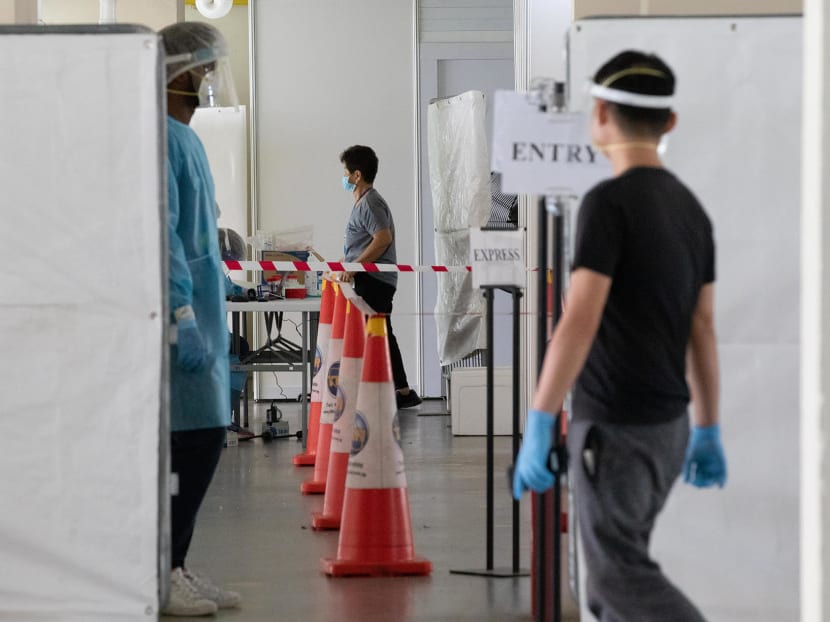
The Government will review and streamline its Covid-19 healthcare, testing and isolation protocols so that they will be simple enough for residents to comply with, said Health Minister Ong Ye Kung on Saturday (Oct 2).



- Government will review and streamline protocols for Covid-19 healthcare so that it will be simple enough for people to comply with
- Health Minister Ong Ye Kung acknowledged that there are many protocols and it could be complex for the man on the street
- Among the protocols under review is whether there is still value in continuing with polymerase chain reaction testing for asymptomatic patients
SINGAPORE — The Government will review and streamline its Covid-19 healthcare, testing and isolation protocols so that they will be simple enough for residents to comply with, said Health Minister Ong Ye Kung on Saturday (Oct 2).
Speaking during a press conference by the task force in charge of Singapore’s response to the pandemic, Mr Ong acknowledged that the various protocols, such as Quarantine Orders, Health Risk Warnings, Health Risk Alerts and Rostered Routine Testing can be “quite a bit of alphabet soup”.
Mr Ong said that these protocols were designed during a time when the Government was trying to “snuff out” every Covid-19 cluster.
However, Singapore is in “a totally different position” now that it is trying to ride safely through the latest transmission wave of the coronavirus and live with Covid-19.
These protocols are many and complex for the man on the street, said Mr Ong.
“To them, it is confusing, and even frustrating,” he added.
He noted that people may not truly understand or remember the protocols they need to comply with and this was an issue that needed to be addressed.
“If people don't understand, they can’t do their part to exercise personal responsibility, much less help others.
“It also contributes to an overall apprehension that Covid-19 is a very serious disease, when actually for vaccinated people, it has become a mild disease,” he added.
He said that the task force is reviewing all protocols and will present them soon.
“We want to make it simple and as easy to remember as possible so that everyone can do our part in our fight against Covid-19,” said the co-chair of the task force.
When asked during the press conference, if the Government will stop testing of asymptomatic patients as part of its streamlining efforts, the Ministry of Health’s (MOH) director of medical services Dr Kenneth Mak said that this was one of the areas the ministry is reviewing.
Dr Mak pointed out that many protocols have already been “lightened up”.
For example, asymptomatic persons who test positive on their antigen rapid tests no longer need to go to the hospital or get a polymerase chain reaction (PCR) test at a clinic.
Instead, such individuals can self-isolate and monitor their health at home. If they test negative on their antigen rapid test after three days, they may resume their activities, said Dr Mak.
However, in settings where people come into close contact with vulnerable people such as those in nursing homes or hospital patients, it is still important for those who test positive on an antigen rapid test to do a PCR test as well, said Dr Mak.
“However as we said, we are looking to simplify our protocols and processes and we will relook, even in these few cases, whether there is value in continuing with PCR testing and once we have made some decisions about what the changes are, we’ll make the announcements in due course,” said Dr Mak.
.embed-container { position: relative; padding-bottom: 56.25%; height: 0; overflow: hidden; max-width: 100%; } .embed-container iframe, .embed-container object, .embed-container embed { position: absolute; top: 0; left: 0; width: 100%; height: 100%; }MOH WILL REVIEW MAP OF AREAS FREQUENTED BY COVID-19 CASES
Responding to questions from the media during the press conference, Mr Ong acknowledged that a recent map published by MOH which shows areas in Singapore frequented by Covid-19 cases had caused alarm among some members of the public.
The map was first published on the ministry’s website on Friday and classifies areas into five bands or colour scales.Mr Ong explained that the ministry had published the map after members of the public wrote in to ask for the location of Covid-19 cases to regulate their activities and movement.
“From MOH’s perspective and the ministerial task force as well, if we can as far as possible give people the information, the tools and procedures so that everyone can take their own action to play their part. I think a map like that...can help individuals taking their own initiative to regulate their movements,” said Mr Ong.
“Let’s give the initiative a try and we will take feedback and if we need to adjust the practice, we will do so.”
Related topics
Covid-19 coronavirus MOH Covid-19 testingStay in the know. Anytime. Anywhere.

Subscribe to our newsletter for the top features, insights and must reads delivered straight to your inbox.
By clicking subscribe, I agree for my personal data to be used to send me TODAY newsletters, promotional offers and for research and analysis.






