
Hardening of attitudes by US, China caused by ‘mutual lack of strategic trust’, says PM Lee
SINGAPORE — There is a growing bipartisan consensus in the United States that China has taken advantage of it for far too long, and that China has overtaken or will soon overtake the US, said Prime Minister Lee Hsien Loong on Friday (May 31).
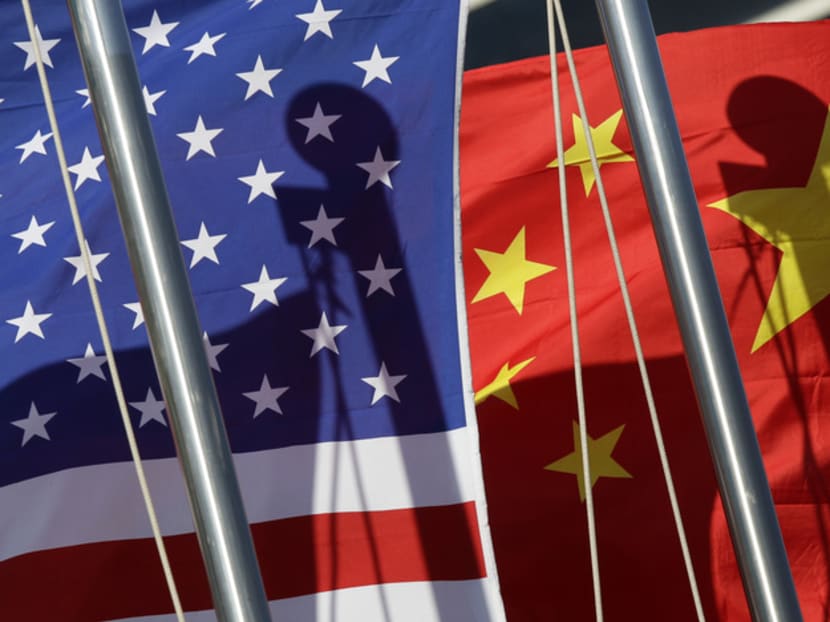
Prime Minister Lee Hsien Loong warned of hardening attitudes on both the part of China and the United States, in his keynote address at the Shanri-La Dialogue on Friday (May 31).

SINGAPORE — There is a growing bipartisan consensus in the United States that China has taken advantage of it for far too long, and that China has overtaken or will soon overtake the US, said Prime Minister Lee Hsien Loong on Friday (May 31).
In contrast, some in China feel that the US is trying to thwart its legitimate ambitions, and they reject what they see as US efforts to impose its political system and values on China, Mr Lee added.
These sentiments, worryingly, indicate a “hardening” of attitudes on both sides, he said.
Mr Lee pointed out a fundamental problem between the world’s two largest economies: A mutual lack of strategic trust.
“This bodes ill for any compromise or peaceful accommodation,” Mr Lee said in his keynote address on the opening day of the Shangri-La Dialogue, an annual security summit, where he spoke at length on the escalating US-China tensions over the ongoing trade battle.
“But to go down the present path would be a serious mistake on both sides. There is no strategic inevitability about a US-China face-off. But at the same time, if such a face-off does happen, it will be nothing like the Cold War.”
Stressing the need to avoid hostility and instability, Mr Lee said there is “no irreconcilable ideological divide” between the two superpowers.
Though China may be “communist in political structure”, he noted that it has adopted market principles in many areas.
Unlike the former Soviet Union, which sought to “overturn the world order”, China has benefited from, and by and large worked within, the framework of existing multilateral institutions, Mr Lee pointed out.
China, he added, is also not attempting to export communism to other countries.
“Indeed, it is often criticised for being too willing to do business with countries and leaders regardless of their reputation or standing, citing non-interference in the internal affairs of other countries,” Mr Lee noted.
And unlike the Soviet Union, whose economic links outside the Soviet bloc “were neglible”, Mr Lee noted that China has extensive economic and trade links with the rest of the world. It is a “major node” in the world economy, as it has become the largest trading partner for all of the US’ allies in Asia including Japan and Australia.
Mr Lee said: “They all hope that the US and China will resolve their differences. They want to be friends with both: to nurture security and economic ties with the US, as they grow their business links with China.”
Should a “new Cold War” arise, Mr Lee warned that there can “be no clear division between friend and foe”. Neither is it possible to create the equivalents of a North Atlantic Treaty Organisation (NATO) or Warsaw Pact, with a hard line drawn through Asia, or down the middle of the Pacific Ocean.
“On the other hand, if there is indeed a conflict between the US and China, where will it end?” Mr Lee asked.
“The Cold War ended with the total collapse of the sclerotic planned economies of the Soviet Union and Eastern European countries, under the pressure of enormous defence spending. Even then, it took 40 years. It is highly improbable that the vigorous Chinese economy will collapse in the same way.”
On the other hand, China cannot take down the US, which Mr Lee said is still by far the strongest country in the world.
The US economy remains the most innovative and powerful, he added, with military capabilities that far exceed anyone else’s.
“Americans worry about China catching up with the US, but although China may be ahead in some fields, it will be many years before China can equal the US,” said Mr Lee.
“And contrary to what some people in China think, the US is not a declining power, nor is it withdrawing from the world. In fact, the US has made clear its intention to compete robustly, though in a different mode than before.”
AVOID CONFLICT AT ALL COST
Though a conflict might not break out, a prolonged period of tension and uncertainty “would be extremely damaging”, said Mr Lee.
Without the full participation of the US and China as well as other countries, he noted that serious international problems like nuclear non-proliferation, the situation on the Korean peninsula and climate change cannot be addressed.
Economically, countries will take a hit too. And the loss “will not just be a percentage point or two of world GDP, but the huge benefits of globalised markets and production chains, and the sharing of knowledge and breakthroughs that enable all countries to progress faster together”, said Mr Lee.
As such, going down the path of conflict and enmity should be avoided at all costs.
Though security and defence establishments have a duty “to think the unthinkable and plan for worst case scenarios”, Mr Lee argued that “it is the responsibility of political leaders to find solutions to head off these extreme outcomes”.
Still, he acknowledged that this might be difficult since political leaders on both sides face powerful domestic pressures.
The political mood is the US is “deeply divided and disgruntled”, with large segments of Americans having lost confidence in globalisation and multilateralism.
And as the 2020 presidential election approaches, these attitudes will “surely deepen”, said Mr Lee, as neither the Republicans nor Democrats “will want to risk being accused of being ‘soft’ on China”.
He added: “Whether President (Donald) Trump is re-elected, or another Republican or Democrat wins, these sentiments will not go away.
It is a similar case for China. The orientation of the Chinese leadership is primarily domestic, said Mr Lee, and they have major issues to deal with at home such as the unevenly distributed growth, significant rural poverty, an ageing population and rising expectations for a better quality of life.
Both sides “are sensitive about being perceived as weak”, he noted.
The US, out of political necessity, “wants to show that it has come out ahead in any deal”.
For China, because of its long history with the West, its leaders cannot be seen as succumbing to Western pressure to accept an “unequal” treaty. Mr Lee cited the way that a feeble China was forced to accept the decisions of the big powers at the Versailles Peace Conference in 1919.
In a speech that had a sobering undertone, Mr Lee said: “This zero-sum dynamic makes it very hard to construct an agreement that is politically acceptable to both parties.”
He added: “But ultimately it is in the interests of both the US and China to reach such an accommodation, and to persuade their domestic publics to accept it. They both need to keep their relationship steady, so that both can focus on their respective pressing domestic priorities, and not be distracted by troubled relations with the other.”
Related topics
China US Lee Hsien Loong Shangri-La Dialogue US-China trade warStay in the know. Anytime. Anywhere.

Subscribe to our newsletter for the top features, insights and must reads delivered straight to your inbox.
By clicking subscribe, I agree for my personal data to be used to send me TODAY newsletters, promotional offers and for research and analysis.






