
Itching for relief
Is eczema contagious? Can stress cause it to flare up?


Eczema or atopic dermatitis is the cause of itchy, dry, thickened skin that may appear red or brown. And it is more common than you think.
According to the National Skin Centre, eczema affects one in 10 adults in Singapore. Citing the Department of Paediatrics at National University of Singapore’s Yong Loo Lin School of Medicine, Dr Eileen Tan from Eileen Tan Skin, Laser and Hair Transplant Clinic says that one in five children of school-going age also has eczema.
Find out what the misconceptions are to better understand eczema.
Myth: If it’s an itchy rash, it’s eczema.
You’ll need a doctor’s diagnosis to confirm that it’s eczema. According to Dr Tan, eczema can be acute or chronic, though there may be overlaps. Acute eczema can appear as wet, open sores, while chronic eczema may come with skin thickening, cracks and dryness.
Fact: Stress causes eczema to flare up.
Generally, eczema results from an over-reactive immune system and a damaged skin barrier. “The over-reactive immune system causes skin inflammation when triggered by an allergen or irritant. This leads to red, itchy and painful skin,” said Dr Tan.
According to WebMD, eczema is common in families with a history of other allergies or asthma. Some people may have flare-ups when exposed to certain substances like rough materials, household products like soap or detergent, and animal dander.
The website also cited upper respiratory infections, colds, stress, and even feeling too warm or cold as triggers.
Myth: Eczema is contagious.
Eczema may make skin look red and crusty, and create a discharge. But it is not contagious, said Dr Tan. However, if the redness spreads, and there is inflammation, pus and pain, it may have become a bacterial infection and that is contagious, she said.
Myth: Only steroidal products help.
Not necessarily. Using moisturisers with active ingredients such as ceramides and lipids that mimic the natural skin lipid layer can help to restore the damaged skin barrier, said Dr Tan.
She added that ingredients like palmitamide MEA (PEA) also have anti-irritant properties to soothe itchy skin.
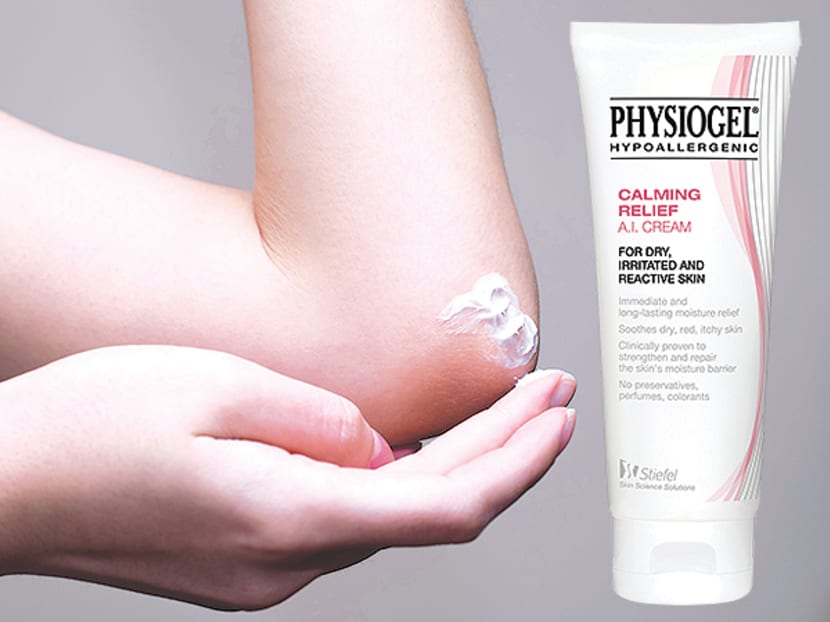
Physiogel’s Calming Relief A.I. Cream (S$29.90) has PEA to help reduce symptoms of dryness, itchiness, redness, and is free of fragrances, preservatives and colourants. Being non-steroidal also makes it suitable for long-term use.
The cream is a lipid-based moisturiser containing Biomimic Technology that works by mimicking the structure and composition of skin’s protective lipid barrier to protect against irritants that aggravate dry and reactive skin.
Calming Relief A.I. Cream is available at leading pharmacies.
Visit facebook.com/physiogelsg for details.
Created by Mediacorp Brand Studio Productions.
Stay in the know. Anytime. Anywhere.

Subscribe to our newsletter for the top features, insights and must reads delivered straight to your inbox.
By clicking subscribe, I agree for my personal data to be used to send me TODAY newsletters, promotional offers and for research and analysis.






