
Hearing-impaired barista can now draw hearts, thanks to bosses who reshape job
SINGAPORE — Like an accomplished barista, Mr Melvin Sii expertly manoeuvres a silver pitcher with his left hand as he pours milk into a cup of latte, drawing the shape of a heart.
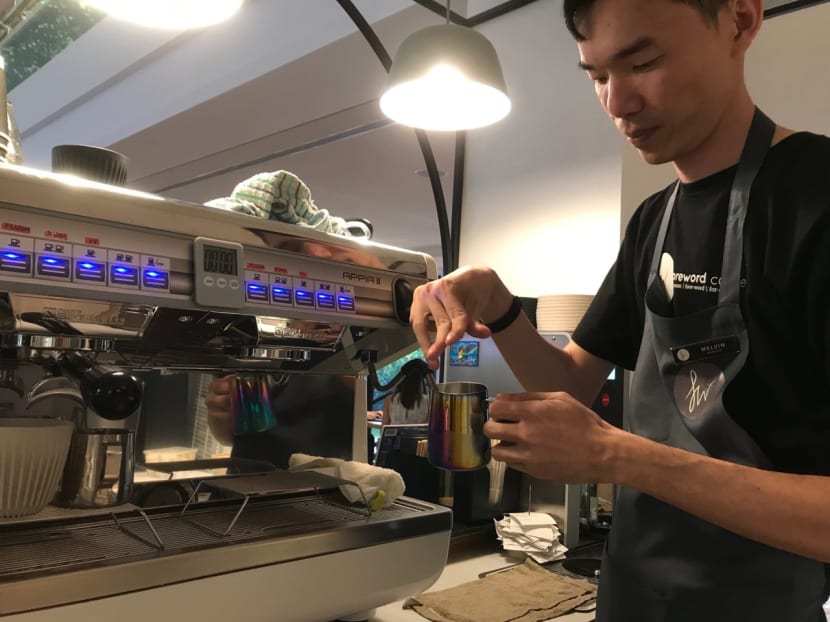
Mr Melvin Sii, an assistant outlet manager at Foreword Coffee’s Dhoby Ghaut outlet, using an automatic milk frother.



SINGAPORE — Like an accomplished barista, Mr Melvin Sii expertly manoeuvres a silver pitcher with his left hand as he pours milk into a cup of latte, drawing the shape of a heart.
“I can do heart shapes but I would need more practice to do flowers,” the 37-year-old who has a hearing disability said. He is the assistant outlet manager of Foreword Coffee’s newest branch at Temasek Shophouse opposite Dhoby Ghaut MRT Station.
Just a year ago, Mr Sii was finding it difficult to use the knobs on the coffee machine and milk frothers, when he first started working with the social enterprise cafe.
That is because he suffers from a weak right hand.
When the cafe's directors, Mr Lim Wei Jie and Mr Nadi Chan, found out about this, they decided to get an automatic milk frother and a new coffee machine, one that uses a switch that can be flipped easily.
Foreword Coffee was one of the case studies featured in a guide that was launched on Monday (June 17). The resource aims to help employers redesign jobs to cater to people with disabilities.
Called the Job Redesign Guide for Inclusive Employers, it provides companies with information on what job redesign is and how to implement it.
The guide was developed by the Ministry of Manpower (MOM) and SG Enable, a government-linked agency that supports disabled people. There are other case studies of organisations that have successfully redesigned jobs, specifically for employees with special needs.
Mr Chan, 25, told TODAY: “There are many individual challenges that each person might experience, so we need tailored solutions for each one of them.”
Through “patience, creativity and empathy”, he said that his team will always try to “think of various simpler ways to circumvent a problem”.
Some solutions that the company has come up with include splitting up the cafe’s operations into four stations and according to difficulty level. This allows employees to man one station at a time, rather than having to learn the whole process at one go.
LEARNING SIGN LANGUAGE
Mr Sii, who used to work at a mobile-phone shop for 13 years, was recommended to Foreword Coffee by a friend.
He said that he felt isolated and did not communicate much in his previous job, but has since been able to interact more with his colleagues at Foreword Coffee, some of whom have also started to learn sign language.
Another member of the service crew, Ms Carmen Tan, had trouble at first working as a cashier.
The 23-year-old, who has autism, said: “I had difficulty using the buttons, but after practising, I can remember how to use them. They (the two directors) helped me, too.”
Having worked in two other jobs before, Ms Tan said that her year working at Foreword Coffee has been the most enjoyable.
From January 2016 to March this year, almost 750 companies have hired more than 2,000 people with special needs.
In launching the guide, Mr Zaqy Mohamad, Minister of State for Manpower, expressed his hope that more firms will look at redesigning jobs to “help people with special needs be employable and help the community to uplift themselves”.
Referring to Foreword Coffee and others that have joined the movement, he said: “Hopefully, others can look at these examples and say, ‘Yeah, we’ve a successful business and we can incorporate some of these processes’.”
CORRECTION: An earlier version of this story stated that from January to March this year, almost 750 companies had hired more than 2,000 people with special needs. This is incorrect. The period being referred to was actually January 2016 to March this year. We are sorry for the error.
Related topics
Foreword Coffee people with disabilities inclusivity job redesign Ministry of ManpowerStay in the know. Anytime. Anywhere.

Subscribe to our newsletter for the top features, insights and must reads delivered straight to your inbox.
By clicking subscribe, I agree for my personal data to be used to send me TODAY newsletters, promotional offers and for research and analysis.






