
Hearing for MBS suit against patron opens
SINGAPORE — Lawyers today sparred over whether a casino patron needed to maintain a deposit account of at least S$100,000 to be deemed a “premium player”, in Marina Bay Sands’ (MBS) first-of-its-kind suit against a patron for non-payment of debt.
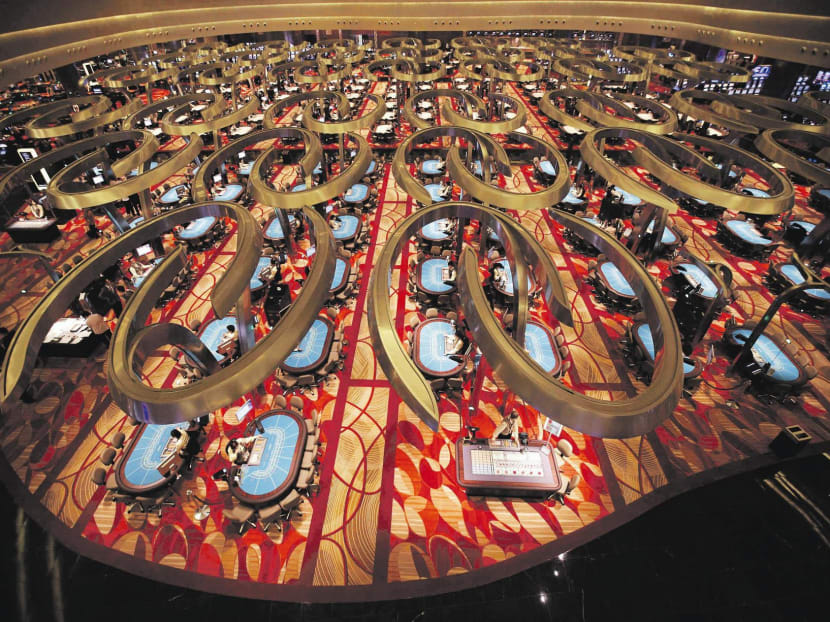
Main gambling floor of MBS casino in Singapore. Photo: Reuters

SINGAPORE — Lawyers today sparred over whether a casino patron needed to maintain a deposit account of at least S$100,000 to be deemed a “premium player”, in Marina Bay Sands’ (MBS) first-of-its-kind suit against a patron for non-payment of debt.
MBS is suing Lester Ong Boon Lin for not paying S$240,868 owed to the integrated resort (IR) in a credit extension dating back to May 2010. Mr Ong does not dispute applying for credit, but claims that the IR did not comply with the law in extending the credit, thus nullifying it.
Under the Casino Control Act (CCA), credit extensions can only be provided to Singaporeans and permanent residents (PR) who are premium players – defined as a patron “who maintains a deposit account with the casino operator with a credit balance of not less than S$100,000 before the commencement of play by him in the casino.”
In court today, Mr Ong’s lawyer Sunil Singh Panoo argued that Mr Ong could not be considered a premium player — and could not be extended credit by the IR — as Mr Ong did not “maintain” any deposit account. According to Mr Ong’s account of events, he had handed over $S100,000 - borrowed from an individual named “Mike” - to the MBS Casino Cage on May 1, and withdrawn chips of the same value minutes later.
The law indicates “an actual deposit or payment into the deposit account” must be made to qualify someone as a premium player, and not simply an exchange for chips, Mr Singh said.
He added that a patron must keep the deposit account at the same level of S$100,000 before each play, to remain a premium player.
However, MBS’s Executive Director of Finance Oncu Cifteler, 38, taking the stand today, said the IR has always defined the duration of a premium player’s status as one year, with a credit balance of not less than S$100,000 before the commencement of play.
MBS’ lawyer, Mr S Suressh, contesting Mr Ong’s intepretation of the law, argued that Mr Ong became a premium player for one year once he deposited S$100,000 with the casino. There is also no requirement under the law that the S$100,000 has to be deposited for a minimum period, he added.
“The act of withdrawing chips from the deposit account, which the patron would have to do in order to play, would always mean that there would be less than S$100,000 in the deposit account when the patron first placed the bet,” he said.
The different tax rates on casino operators’ revenue from premium and other players also indicates a one-year duration of a player’s status, he added.
Mr Ong is also contending that he was “wrongly solicited” for credit by MBS, and therefore his debt was not enforceable as the IR did not comply with procedures approved the Casino Regulatory Authority.
He claimed that he was approached by an IR employee or a marketing host employed by the IR, to apply for credit. He declined initially, but later agreed, and was approved for a credit line of S$250,000 on May 3 2010, even though he did not have S$100,000 maintained in his deposit account that day.
When MBS claimed the amount of S$240,868 from Mr Ong later – after crediting him with commissions of S$9,132 based on his play – Mr Ong did not repay the money. The cheque he had provided as security was also dishonoured.
MBS disputes his argument, saying that there is no provision in the CCA which renders credit agreements unenforceable, if the credit was granted to a Singaporean or PR.
It also submitted that Mr Ong’s allegations of being solicited are “totally unsubstantiated”, noting that the marketing host has not been identified in Mr Ong’s evidence.
The trial continues tomorrow with Mr Ong taking the stand.
Stay in the know. Anytime. Anywhere.

Subscribe to our newsletter for the top features, insights and must reads delivered straight to your inbox.
By clicking subscribe, I agree for my personal data to be used to send me TODAY newsletters, promotional offers and for research and analysis.






