
Hello, that angry tweet may have its uses
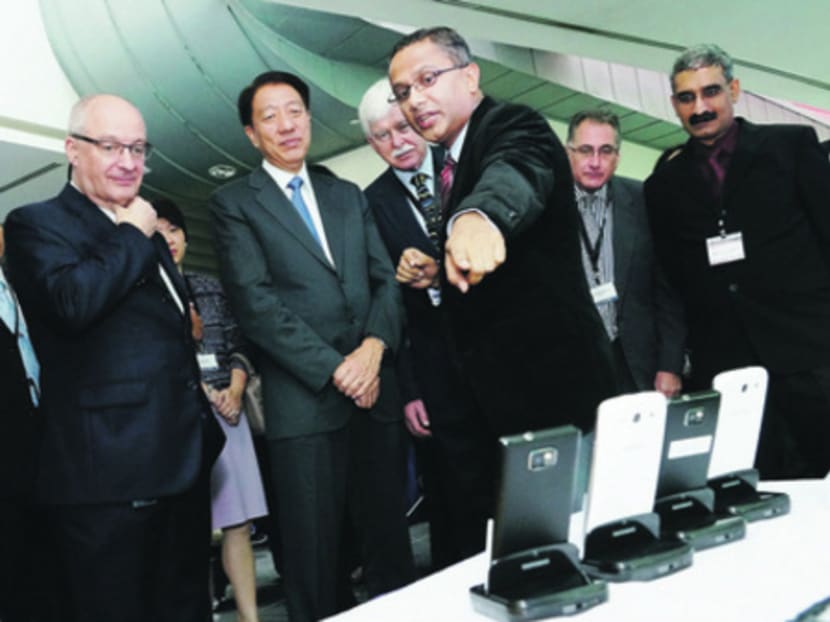
LiveLabs Director, SMU Assoc Prof Archan Misra explaining to Deputy Prime Minister Teo Chee Hean (second from left) how data would be collected from the mobile devices. PHOTO COURTESY SMU

SINGAPORE — Based on tweets sent by mobile phone users during a day out at Sentosa, information such as whether they are feeling happy, sad or disgusted can be retrieved in real time.
The moods of these StarHub subscribers were analysed using, say an angry tweet about the long queues at the monorail or a happy tweet from having a good time at Universal Studios, under a prototype developed by the telco and Nanyang Polytechnic (NYP). Without identifying any individual by name or mobile number, data analysts then grouped users according to their moods. They were also able to band users according to their age group, gender and race — giving an idea of the preferences of different customers’ profiles.
Such data will help businesses identify customers’ problems and rectify them quickly, said NYP Project Manager Kwa Siew Kuan. “It will allow businesses to make informed decisions and customers will also benefit by the improvements made,” she added.
This project is part of two innovation platforms, LiveLabs and SmartHub, launched yesterday by Deputy Prime Minister Teo Chee Hean.
LiveLabs, which will be helmed by the Singapore Management University (SMU), will generate insights about customers through their mobile devices. SmartHub will be led by StarHub to analyse data collected from its subscribers. These two initiatives will receive S$50 million investment from the National Research Foundation, StarHub and SMU.
Speaking at the launch, Mr Teo, who is also chairman of the foundation, noted that analytics help “organisations to identify and understand patterns drawn from the vast amounts of data”.
He added: “Organisations can then use these findings to make better decisions, to draw finer customer segmentation, or to develop new products and services that are more closely tailored to users’ needs.”
This will, in turn, benefit consumers who can then enjoy products and services more customised to their needs, while allowing companies to benefit in terms of cost savings or increased revenues.
“Ultimately, we hope that Singapore can play a useful role for companies that are keen to develop greater insight into social and consumer behaviour in the region, through the use of business analytics,” said Mr Teo.
He also stressed the need for data privacy, citing the importance of the coming “Do Not Call” registry that will act as necessary safeguards to facilitate big data analytics.
StarHub Chief Technology Officer Mock Pak Lum yesterday also assured the confidentiality of customer information, adding that consumers can choose to opt out of such data analyses. He said that data provided to researchers will be anonymous and be in bulk, based broadly according to demographics, rather than according to individuals’ details.
Besides boosting customer-business relations, data analyses can also help city planners enhance their existing transport infrastructure.
In a StarHub-IBM collaboration that is in the pipeline, researchers are hoping to understand travel patterns of groups of StarHub users — such as the time slot they travel in and where they travel to. This will enable transport authorities to better prepare contingency plans.
For instance during a train breakdown, the number of people possibly stranded could be predicted and resources would then be allocated more efficiently.
Stay in the know. Anytime. Anywhere.

Subscribe to our newsletter for the top features, insights and must reads delivered straight to your inbox.
By clicking subscribe, I agree for my personal data to be used to send me TODAY newsletters, promotional offers and for research and analysis.






