
High Court sets new sentencing benchmarks for NS dodgers
SINGAPORE — New sentencing benchmarks for National Service (NS) defaulters have been set by the High Court, with a coram of judges ruling that offenders should not be treated more leniently because they voluntarily surrendered themselves or performed exceptionally well during enlistment.
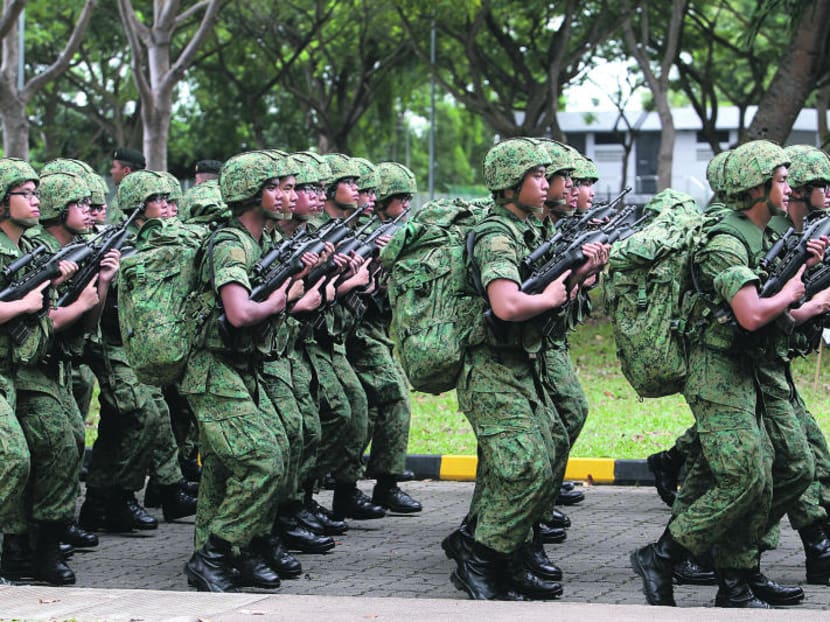
The starting point for the punishment to be imposed on any Singaporean man who evades NS for 23 years or longer should be the statutory maximum of 36 months’ jail. TODAY file photo

SINGAPORE — New sentencing benchmarks for National Service (NS) defaulters have been set by the High Court, with a coram of judges ruling that offenders should not be treated more leniently because they voluntarily surrendered themselves or performed exceptionally well during enlistment.
In a 57-page written grounds of decision issued on Tuesday (July 25), a three-judge panel — comprising Chief Justice Sundaresh Menon, Judge of Appeal Chao Hick Tin and Justice See Kee Oon — spelt out the “starting point” of the penalties for four categories of NS dodgers, based on the length of the default period.
Singaporean men who evade NS for between 17 and 23 years or longer face the statutory maximum of 36 months jail, as these individuals have “evaded the entirety of their NS obligations”, the judges said.
The new sentencing benchmarks overhaul those set by Justice Chan Seng Onn in February last year, and came after the court had in April this year allowed the prosecution’s appeal for heavier sentences against three men who evaded their NS obligations. The trio included two brothers — Sakthikanseh Chidambaram, 26 and Vandana Kumar Chidambaram, 24 — as well as Ang Lee Thye, 44.
Sakthikanseh’s jail term was increased from three weeks to 10 weeks after he failed to report for NS for about five-and-a-half years. His brother, Vandana, who was initially fined S$6,000 for the same offence after evading NS for about three-and-a-half years, was sentenced to seven weeks’ jail.
Ang’s jail term was increased from 24 months to 33 months after he completely evaded his NS obligations. He had remained outside of Singapore without a valid exit permit for 23.5 years — the longest possible default period under the Enlistment Act — and timed his return to the country after he turned 40, when he could no longer serve NS.
Explaining the new benchmarks that they have set, the judges said the sentence to be meted out to an NS defaulter would not increase linearly with the length of his period of default. Rather, the rate of increase in the sentence would be amplified with longer periods of default, to “reflect the decline in a person’s physical fitness with age and to create a progressive disincentive for NS defaulters to delay their return to resolve their offences”.
The custodial threshold would be crossed when one defaults for two years, with a starting point jail sentence of two months. Each additional year of default would see the sentence increase by half a month.
For those who default for seven to 10 years, jail terms start at five months, with an increase of one month for each additional year of default.
Those who evade NS for 11 to 16 years could be sentenced to 14 to 22 months’ jail, with two months’ imprisonment added for each year of default.
Jail terms of 24 months to the maximum 36 months would apply to defaulters of 17 to 23 or more years.
The judges noted that these were the starting points for sentencing and judges should consider aggravating and mitigating factors thereafter.
In comparison, the old sentencing benchmarks were tiered to three scenarios: Whether an offender was arrested or surrendered, if he claimed trial, and how he performed during NS.
But the coram of judges said they “saw no logic why the longer the period of default, the greater should be the mitigating value given when the NS defaulter voluntarily surrendered”.
They also disagreed that between half a month and two months’ discount — with higher discounts for those who returned to serve when they were younger — to the sentence should be given for exceptional performance in NS.
The judges added: “The standard of performance of an NS defaulter who returned to serve NS should not, as a general rule, be a relevant consideration for the purpose of sentencing.”
They reiterated the fundamental principle that “a sentence serves to punish the offender for the wrong he has done and the harm he has occasioned in committing the offence”.
The judges pointed out: “Exceptional NS performance, which happens after the conduct constituting the offence, reduces neither the defaulter’s culpability nor the harm he had caused by his offence.”
The judges also noted that NS defaulters harm the operational readiness of the armed forces, as well as the morale of fellow citizens who have made personal sacrifices to serve their NS obligations when called upon to do so. Their conduct can even cause growing resentment and the loss of public support for NS, “threatening the ability of our armed forces to ensure Singapore’s national security”.
“Each and every member of the Singapore public would then become a victim,” the judges added.
In response to queries, the Ministry of Defence referred to its statement in April, issued after the court raised the sentences for Sakthikanseh, Vandana and Ang. The ministry had reiterated that it “takes a firm stand on those who commit offences under the Enlistment Act”.
It added: “If we allow Singapore citizens who are overseas to avoid NS or to choose when they want to serve NS, we are not being fair to the vast majority of our national servicemen who serve their country dutifully, and the institution of NS will be undermined.”
Stay in the know. Anytime. Anywhere.

Subscribe to our newsletter for the top features, insights and must reads delivered straight to your inbox.
By clicking subscribe, I agree for my personal data to be used to send me TODAY newsletters, promotional offers and for research and analysis.






