
Higher subsidies for child, infant care
SINGAPORE — From April, about 120,000 lower- and middle-income Singaporean households can enjoy higher subsidies for child and infant care services, as the Government moves to address the rising cost of such services, which has been cited as being one of the factors contributing to the Republic’s low birth rate.
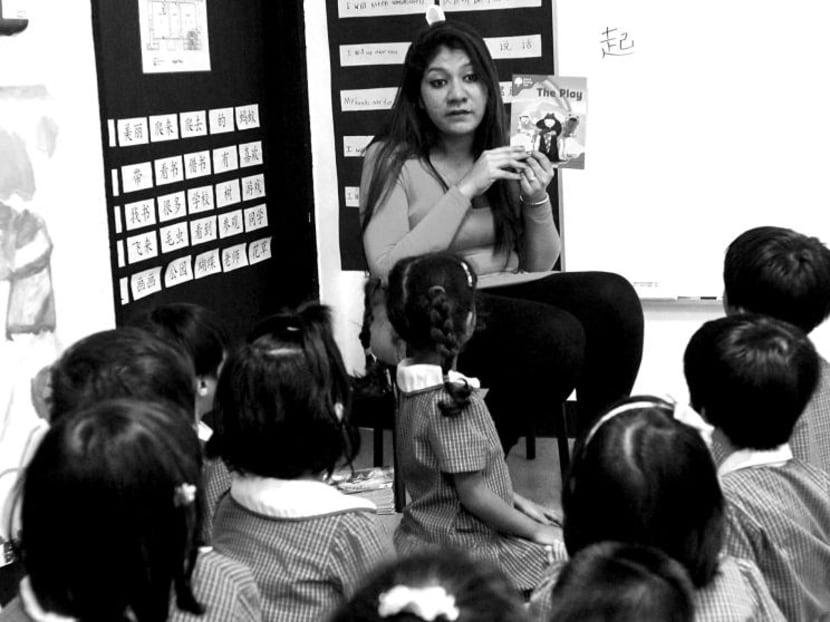
Children at YWCA Outram Child Development Centre on Jan 23, 2013. Photo: Ernest Chua

SINGAPORE — From April, about 120,000 lower- and middle-income Singaporean households can enjoy higher subsidies for child and infant care services, as the Government moves to address the rising cost of such services, which has been cited as being one of the factors contributing to the Republic’s low birth rate.
Yesterday, the Ministry of Social and Family Development announced an additional subsidy for child and infant care services for households with gross monthly income of S$7,500 and below. The additional subsidy — which is on top of the S$300 basic subsidy given for Singaporean children whose mothers work at least 56 hours a month — will offset the monthly fees of full-time childcare services by between S$100 and S$440, depending on monthly household income.
For full-day infant care programme, the additional subsidy will be between S$200 and S$540. This comes on top of the existing S$600 basic subsidy. The additional subsidy will replace the Centre-Based Financial Assistance Scheme for Child Care (CFAC), which provides childcare-related financial assistance for families earning S$3,500 and below.
For families which require more financial support, the Government will continue to provide other forms of assistance, such as a one-time start-up grant of up to S$1,000 per child to help with the initial cost of placing a child in a centre. The grant covers items such as the deposit, uniforms, registration fee and insurance charges.
Apart from increasing subsidies, the Government will also expand the number of “good quality, affordable” childcare and infant care places for lower- and middle-income families by increasing the number of anchor operators, and providing them with greater support. In a posting on Facebook, Prime Minister Lee Hsien Loong said the initiatives will “give parents with young children greater peace of mind, and hopefully encourage couples to have more children”.
In her speech at the Workers’ Party rally last Saturday, Ms Lee Li Lian noted that childcare fees have, on average, increased by 34 per cent between 2007 and last year — from roughly S$680 a month for a full-day child and infant care programme, to about S$914 a month now.
Following the announcement yesterday, the total subsidy for full-day childcare programme for households earning S$2,500 and below monthly, for instance, will increase by almost five fold to S$740 since 2008, when the subsidy for this group was S$150. For those with household monthly income of between S$4,001 and S$4,500, for example, the increase will be from S$150 to S$520 over the same period.
With the new initiatives, anchor operator NTUC First Campus said more than 60 per cent of parents with children at its childcare arm, My First Skool, can expect to pay lower fees.
On concerns that higher subsidies would result in operators increasing fees, Acting Minister for Social and Family Development Chan Chun Sing noted “the risk will be much higher if we have applied a universal subsidy across the board”. Nevertheless, he said the Government will closely monitor this.
Speaking on the sidelines of a visit to the YWCA Outram Child Development Centre, Mr Chan said that on average, families spend between 3 and 7 per cent of their household income on childcare fees. With the “extra help”, households at the lowest income level will have access to childcare for S$10 or less, he said.
Only basic programmes will be eligible for subsidies. Mr Chan said: “In every society, there will always be some parents with the means ... but we want to ensure that all Singaporean children have access to a quality programme that will establish a good foundation for their future development.”
Sales engineer Adrian Tan, 37, whose monthly gross family income is between S$7,000 and S$8,000, said the subsidies would “lighten the burden” and the money saved could be used for enrichment lessons for his children.
Stay in the know. Anytime. Anywhere.

Subscribe to our newsletter for the top features, insights and must reads delivered straight to your inbox.
By clicking subscribe, I agree for my personal data to be used to send me TODAY newsletters, promotional offers and for research and analysis.






