
Inflation ‘may accelerate’ on Iraq-driven oil price shock
SINGAPORE — Consumer prices rose at a faster pace last month due to higher Certificate of Entitlement (COE) premiums, but while the pick-up was slightly above market expectations, analysts warn inflation could accelerate more quickly if tensions in Iraq drive up oil prices while the domestic labour market remains tight.
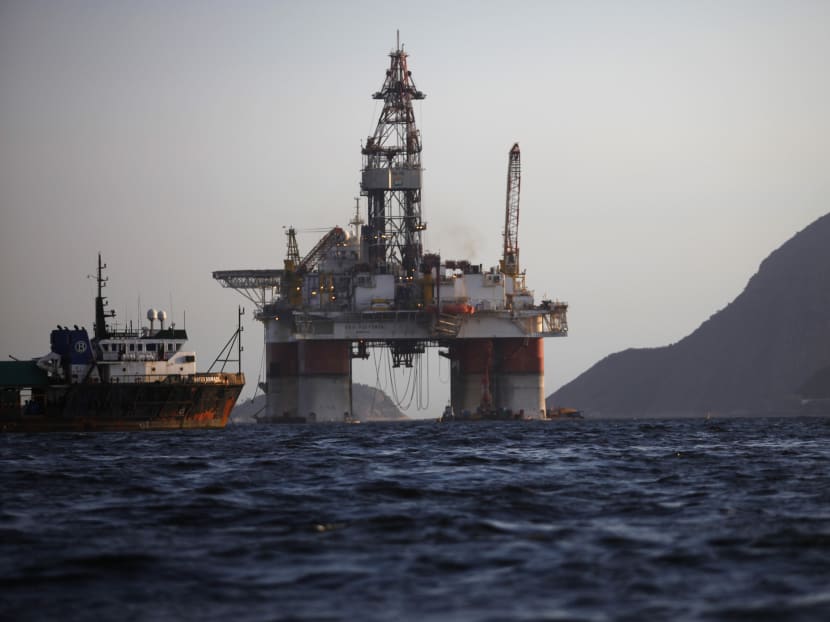
Benchmark Brent crude for August delivery jumped US$0.63 to US$115.44 a barrel yesterday. PHOTO: BLOOMBERG

SINGAPORE — Consumer prices rose at a faster pace last month due to higher Certificate of Entitlement (COE) premiums, but while the pick-up was slightly above market expectations, analysts warn inflation could accelerate more quickly if tensions in Iraq drive up oil prices while the domestic labour market remains tight.
Concerns of an oil price shock are rising globally as sectarian conflicts escalate in Iraq, the world’s seventh-largest crude producer. And Singapore will not be immune to that shock, ANZ economist Daniel Wilson said.
“Since oil prices in Singapore are free-floating, a higher oil price will certainly pass through to consumer prices,” Mr Wilson told TODAY. “Our research shows that a 30 per cent increase in oil prices to the 15-year average, which is around US$100 (S$125) per barrel, will lead to an additional 1 per cent jump in Singapore’s headline inflation over six quarters.”
UOB economist Francis Tan said: “During the most recent case when the oil price jumped from US$58.14 in December 2006 to US$140 in May 2008, Singapore’s inflation saw an 8.1 per cent increase. So the situation in Iraq will be the one unpredictable element in our inflationary outlook.”
Benchmark Brent crude for August delivery jumped 63 US cents to US$115.44 a barrel in London during afternoon trade yesterday, close to last Thursday’s US$115.71, the highest since Sept 9 last year. Meanwhile, benchmark August US crude rose 34 cents to US$107.17 per barrel in electronic trading on the New York Mercantile Exchange.
OCBC economist Selena Ling was more sanguine about the oil price impact, saying: “We’re not looking at a scenario where oil prices will go up to the US$140 levels due to healthy supply elsewhere. The United States is picking up production, while the Organization of the Petroleum Exporting Countries is likely to sustain the capacity to compensate for the disruptions from Iraq.”
The Monetary Authority of Singapore (MAS) and Ministry of Trade and Industry (MTI) expect only modest external cost pressures because of the ample supply buffers in major commodity markets.
“Domestic cost pressures, particularly stemming from a tight labour market, are likely to remain the primary source of inflation,” the MAS and MTI said yesterday in a joint statement as they reported the Consumer Price Index (CPI) rose the most since March last year to 2.7 per cent last month.
The reading was slightly above the economists’ median forecast of 2.6 per cent and 2.5 per cent in April. Private road transport costs climbed 8.1 per cent last month, up from 5.7 per cent in April due to a steep increase in COE premiums.
“This is hardly surprising as we had a very low base last year when measures to curb car-financing were implemented and COE premiums as well as car sales came down. The low base effect may continue until March next year,” said Mr Tan.
Most other major categories such as accommodation, food and services saw inflation moderating slightly last month.
“Such a marginal drop doesn’t change the big picture. Be on the lookout for the tight labour market passing the higher wages to consumer prices, particularly to food and services costs,” Mr Tan said.
Core inflation — which excludes private road transport and accommodation costs — fell to 2.2 per cent last month from 2.3 per cent in April, the MAS and MTI said, but the pace of the sequential increase picked up.
Credit Suisse analyst Michael Wan said: “The on-quarter core inflation rate has jumped from 1.9 per cent in March this year to 2.8 per cent last month. I expect core inflation to keep rising to just below 3 per cent towards the year-end.”
The MAS and MTI reiterated their 2 to 3 per cent forecast for core inflation and 1.5 to 2.5 per cent forecast for all-items inflation this year.
Stay in the know. Anytime. Anywhere.

Subscribe to our newsletter for the top features, insights and must reads delivered straight to your inbox.
By clicking subscribe, I agree for my personal data to be used to send me TODAY newsletters, promotional offers and for research and analysis.






