
Initiatives to help students develop potential rolled out
SINGAPORE — Pledging to bring out the best in every child, Education Minister Heng Swee Keat yesterday unveiled a slew of initiatives that seek to develop each student’s potential to the fullest — regardless of family background, where a child’s interests lie and whether he or she has special needs.






SINGAPORE — Pledging to bring out the best in every child, Education Minister Heng Swee Keat yesterday unveiled a slew of initiatives that seek to develop each student’s potential to the fullest — regardless of family background, where a child’s interests lie and whether he or she has special needs.
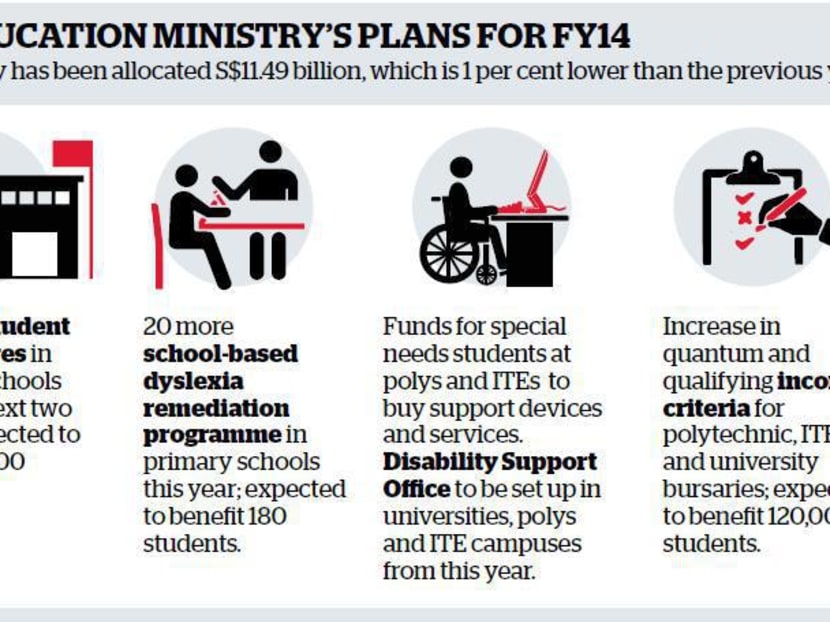
Among other things, the selection process of the Direct School Admission scheme will be broadened to take into consideration a student’s personal attributes. To better support children from low-income families, there will be more student care centres in primary schools, while bursaries will be enhanced at the tertiary level.
For students with special needs, dyslexia remediation will be provided at 20 more primary schools. At higher learning institutes, Disability Support Offices will be set up and a Special Education Needs fund will be created to alleviate the cost of assistive technology devices and support services for polytechnic and Institute of Technical Education students. The fund is expected to cost the Government S$2 million initially and almost S$1 million annually thereafter.
Mr Heng also spoke passionately about his belief, “every school a good school”. The tagline was coined by him after he took office three years ago, and he acknowledged that there are cynics who scoff at how different schools are producing varying results.
He said: “Is it right to judge a school with more than 1,000 students, as ‘good’ or ‘not good’, on the basis of whether it can produce identical academic grades as another school?”
He added: “‘Every school a good school’ does not mean every school (is) the same school; it does mean every school (is) good in its own way.”
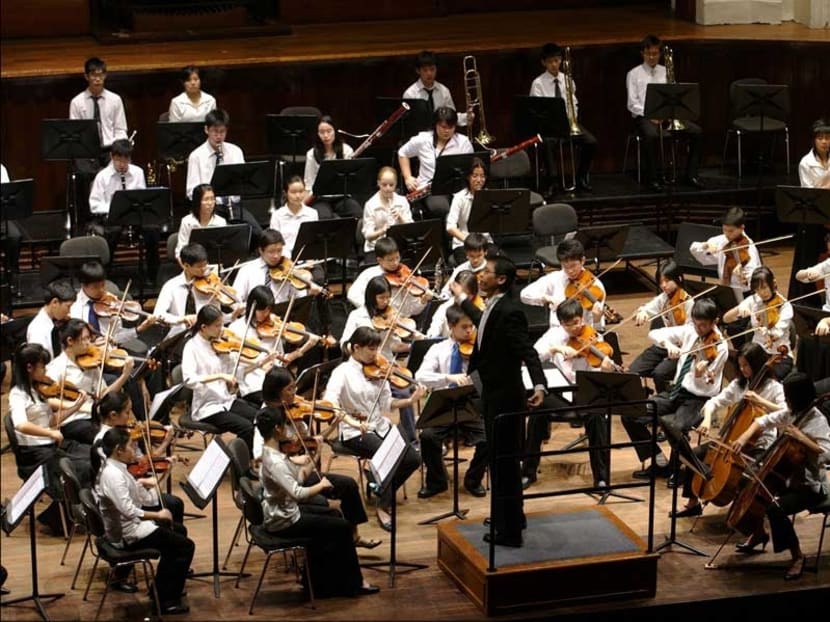
He cited the example of National Institute of Education academic Leonard Tan. Dr Tan, who came from a low-income family, discovered his love for music in primary school and went on to join the Music Elective Programme in junior college. “By bringing out the best in every child, our society progresses. Leonard’s story illustrates that good schools can be places of discovery and nurture our students and bring out the best in them,” said Mr Heng.
Urging parents to hone their children’s talents in other aspects — apart from doing well academically — he noted how craftsmanship allows a student to acquire deep skills which will be further sharpened through lifelong learning and professional upgrading.
“Education is not a timed obstacle race, to collect qualifications in the fastest possible time. Rather, our children’s education is a journey of discovering their strengths, building their compass and their navigation skills,” he said.
The Applied Study in Polytechnics and ITE Review (APSIRE), headed by Senior Minister of State for Law and Education Indranee Rajah, aims to do just that.
Giving an update on the committee’s work in her speech, Ms Indranee said it is considering how to enhance internships and provide a strong base for students to be a skilled worker or entrepreneur.
The committee is also looking at professional certifications to ensure progression opportunities as well as support for students who are at risk of dropping out, she said.
Responding to Nominated Member of Parliament Janice Koh’s call for more art education in schools, she noted that the Ministry of Education (MOE) has increased the recruitment of art and music teachers, among other efforts.
To help academically weaker students at the primary level, Mr Heng said the ministry is ramping up learning support programmes. The Government currently invests 20 per cent more on these students — compared to their peers — over the course of their primary education. By 2017, this will go up to 40 per cent.
He added that with specialised schools such as NorthLight and Assumption Pathway — which cater to those who failed their Primary School Leaving Examination — the attrition rates have fallen to between 10 and 15 per cent, down from 60 per cent in the past.
The specialised normal technical schools such as Crest Secondary and Spectra Secondary have also been seeing almost full attendance rates. “Whatever a child’s starting point in terms of learning, there is support to help bring out the best in him,” Mr Heng said.
On students with special needs, Mr Heng stressed the MOE’s commitment to provide for them. He cited the example of Pioneer Junior College student Amanda Chong, who has suffered from glaucoma since she was three and lost her sight at the end of her first year in JC. Ms Chong went on to score 3As and 2Bs at her A-level examination.
Commending Ms Chong’s spirit and performance, he said: “We must do more to support our children, so that needs do not mean limits and that we can bring out their very best.”
For the MOE to bring out the best in every child, it has to work with parents, Mr Heng reiterated.
“My sincerest hope is that each child can reach his best and go on to be a pioneer in his own way, inspiring others and passing on his best to generations to come.”
Related topics
Budget 2014Stay in the know. Anytime. Anywhere.

Subscribe to our newsletter for the top features, insights and must reads delivered straight to your inbox.
By clicking subscribe, I agree for my personal data to be used to send me TODAY newsletters, promotional offers and for research and analysis.






