
Apps, e-books and movie streaming among services subject to GST from 2020: Iras draft guide
SINGAPORE — The proposed Goods and Services Tax (GST) on businesses providing digital services will cover a broad swath of e-services that range from downloadable digital content such as mobile applications, e-books and movies, to subscription based media including news, magazines, streaming of TV shows, music and online gaming.
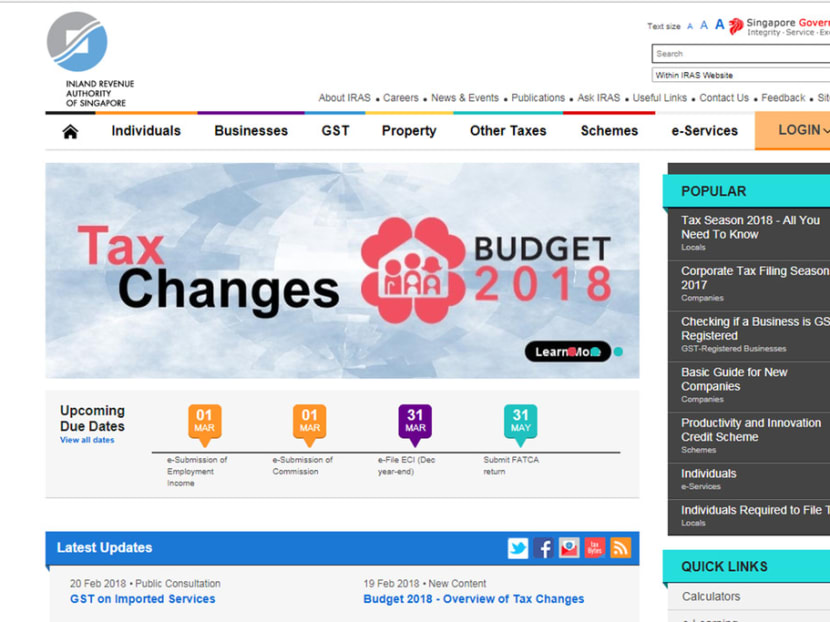
IRAS’ consultation paper on GST for e-services and apps lists newspaper subscription, e-books, gaming, and music among items that could be liable for tax. Screenshot taken from IRAS website

SINGAPORE — The proposed Goods and Services Tax (GST) on businesses providing digital services will cover a broad swath of e-services that range from downloadable digital content such as mobile applications, e-books and movies, to subscription based media including news, magazines, streaming of TV shows, music and online gaming.
Other services that could fall under the registration system include software programmes such as security software, website filters and firewalls, as well as electronic data management systems such as cloud storage services.
These were the examples provided in the Inland Revenue Authority of Singapore's (Iras) consultation paper published on Tuesday (Feb 20), a day after Finance Minister Heng Swee Keat's Budget announcement in Parliament that the Government will impose GST on businesses that provide digital services from Jan 1, 2020. The 36-page e-tax draft guide also explained the application and operational details of the overseas vendor registration system, as well as details on the scope of services, the administration of the GST, and what it means for customers.
According to the draft guide, other digital services that are subject to GST include the supply of customised search engine services, listing fees for merchants who list their items online for sale, and supply of online courses.
Under the current GST rules, a supply of services is subject to GST if it is provided by a supplier in Singapore, which means that services supplied by those outside of the country fall outside the scope, said Iras. For example, an individual based in Singapore who subscribes to cable TV services from a local service provider is charged GST on the subscription fee. But if he or she switches to a provider based overseas, the individual avoids paying GST even though he or she consumes a similar service.
Under the new GST on imported e-services, the registration of overseas vendors will apply to those whose annual global turnover exceeds S$1 million, and if the sale of digital services to consumers in Singapore exceeds S$100,000.
With the implementation of the new system, companies that fall within the requirements will have to charge and account for GST. For instance, a Germany-based company that provides accommodation services online will have to pay GST for the fees charged for services rendered to facilitate a Singapore-based customer's accommodation booking.
Operators of electronic marketplaces that provide e-services, and charge commission and services fees to suppliers and customers are also subject to GST. For example, a mobile application store which sells apps from developers worldwide and locally will have to pay GST if its digital services exceeds S$100,000, and global annual turnover is more than S$1 million.
If a mobile application store is established in Singapore and sells apps from both local and overseas developers, and the sum of its total taxable and value of digital services to Singapore customers exceeds S$1 million for combined turnover, it is liable for GST once the rules come into play.
WHAT THE EXPERTS SAY
A tax on imported services is implemented in many jurisdictions, including Australia, the European Union (EU), Japan and New Zealand. In 2015, consumers in Japan started paying an eight per cent consumption tax for all overseas online buys. The rate was increased to 10 per cent this year. Australia will roll out such a tax this year, while Malaysia is considering such a move.
Experts told TODAY that while the implementation of GST on digital services will likely crimp consumer's spending, or lead to reduced purchases, it is unlikely to dampen the growth of Singapore's digital economy.
Mr Adrian Lee, Gartner's research director said: "Digital service providers will face increased operational costs for compliance with the new tax regime. Service providers will need to ramp up to handle GST reconciliation with Iras once they cross the $100,000 threshold."
For cases where there is no viable replacement service, such as Grab or Uber providing alternatives to public transport, consumers might reduce and/or lower-value purchases, added Mr Lee. He said: "I do not think consumers will stop buying online. They will simply choose to spend more prudently."
Mr Lam Kok Shang, head of indirect tax services at KPMG Singapore said that the purpose of taxing e-commerce is not meant to raise revenue for the Government but to level the playing field.
Another expert, Mr Koh Soo How, Asia Pacific Indirect Taxes Leader, PwC Singapore, felt differently, as he noted that the e-commerce market here is expected to grow to more than S$7 billion by 2025 with cross-border transactions (both imported and exported services) making up about 55 per cent of that market.
Mr Koh said that the proposed e-commerce tax will allow Singapore to broaden the scope of GST, and provide a new and sustainable revenue pipeline for the Government which will grow as quickly as the e-commerce market. For example, the Organisation for Economic Co-operation and Development reported that the EU, which implemented the tax changes in 2015, collected more than €3 billion in its first year of implementing the new rules.
WHAT THE PLAYERS THINK
Ride hailing firms Grab and Uber, and music streaming service Spotify are some of the major online companies that could be affected by the new GST rules.
Responding to queries, a Grab spokesperson said the company is "very supportive" of the changes. "It helps level the playing field for locally-registered companies that pay GST vis-a-vis foreign-registered counterparts that do not," said the spokesperson.
"This is also fair as GST should be paid to the country where economic activity is generated, regardless of where a company is based. It is only right to contribute to our host country's economy and pay our fair share of GST to support nation-building efforts."
Grab added that it is currently GST compliant and will continue to do so. The company collects commission from Grab rides facilitated through its app and pays the current seven per cent GST to Iras on a quarterly basis, said the firm.
Grab's spokesperson said that the company has been providing regular inputs on how digital taxes can level the playing field for businesses in Singapore even ahead of the Budget announcement.
An Uber spokesperson said Iras has sought the company's input on the application of GST to imported digital services, and that they "have been providing comments".
Spotify declined to comment on the matter.
Aside from its proposed new GST rules, Iras also published another consultation paper on Tuesday to provide details on GST for business-to-business imported digital services. It included details on the reverse charge mechanism, clarity on how it works, as well as the scope of the imported services.
Iras is seeking feedback on its overseas vendor registration regime to ensure smooth implementation of the system in Jan 2020. A summary of responses to the feedback on the draft guide will be provided by the end of May.
Stay in the know. Anytime. Anywhere.

Subscribe to our newsletter for the top features, insights and must reads delivered straight to your inbox.
By clicking subscribe, I agree for my personal data to be used to send me TODAY newsletters, promotional offers and for research and analysis.






