
Jail term, higher fines set to kick in for illegal massage operators
SINGAPORE — Proposed changes to impose harsher penalties against unlicensed massage establishments were passed in Parliament on Monday (Nov 6), with several Members of Parliament (MPs) supporting the enhanced Bill. They also wanted greater clarity on enforcement actions, especially for such businesses located in residential areas.
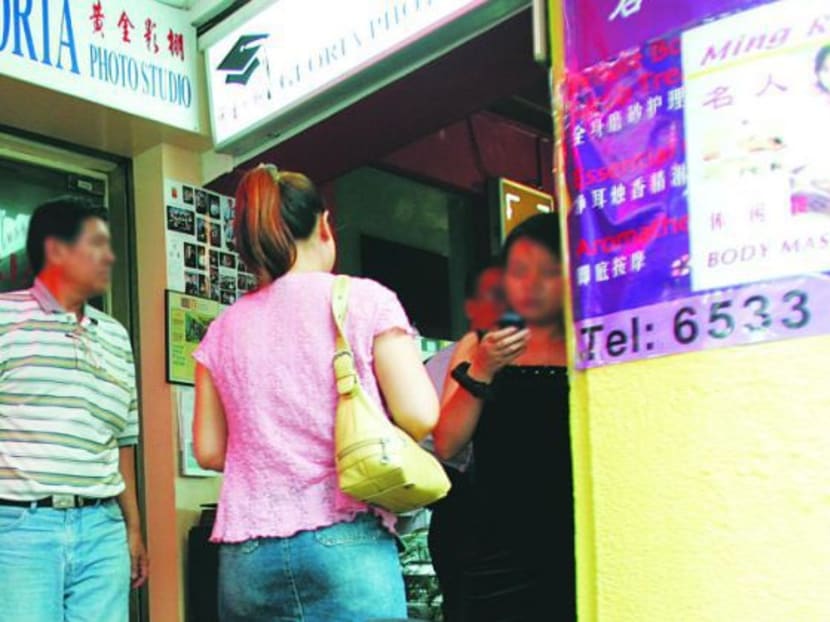
Proposed changes to impose harsher penalties against unlicensed massage establishments were passed in Parliament. TODAY file photo

SINGAPORE — Proposed changes to impose harsher penalties against unlicensed massage establishments were passed in Parliament on Monday (Nov 6), with several Members of Parliament (MPs) supporting the enhanced Bill. They also wanted greater clarity on enforcement actions, especially for such businesses located in residential areas.
Under the revised Massage Establishments Act, the penalty for unlicensed operators will be a maximum fine of S$10,000 (up from S$1,000), or a maximum jail term of two years, or both. Previously, there was no jail term.
Mrs Josephine Teo, Second Minister for Home Affairs, stressed that the enhanced laws were more than just about “raising fines”.
“We are adopting a suite of measures… that would give the extra teeth necessary to clamp down on unlicensed massage establishments,” she said at the second reading of the Bill on Monday.
The new legislation broadens the authority of the police, allowing them to shut down an unlicensed venue if illegal activities are still being carried out there while the operator is undergoing criminal proceedings.
Irresponsible landlords will also be taken to task if they knowingly lease their premises to unlicensed operators.
Several MPs were concerned about the high concentration of massage establishments in residential areas.
Ms Foo Mee Har, MP for West Coast GRC, said: “The proliferation of (massage) outlets in our (public housing) and residential estates is of significant concern for many residents. For example, one can spot five massage establishments in a row in just one block in a HDB (Housing and Development Board) neighbourhood.”
She, as well as Dr Fatimah Lateef, MP for Geylang Serai, urged the Home Affairs Ministry to consider limiting the number of establishments operating in a particular trade radius.
DIIFCULT TO IMPOSE LIMIT OR QUOTA
Mrs Teo acknowledged their concern over potential vice-activities being situated in residential areas and near schools, but said that it is difficult to set a limit on the number of establishments that could be run in a neighbourhood.
“To impose a limit or a quota, you need a number, and (this number) will be arbitrary. Each neighbourhood has different characteristics… whatever number is set, it could still be too high for some areas... Unless the number is zero,” she explained.
Ms Teo also said that there could be arguments over how big the trade radius ought to be for a limit to be applied. “For example, in the same 200m radius, some neighbourhoods could have a lot of residential units, while in others, it could be sparse.”
Mr Murali Pillai, MP for Bukit Batok, and Dr Lateef asked if a demerit point system could be considered.
Ms Teo said that the revised legislation is “stricter” than a demerit point system. “In a demerit point system, the licence infringements are less reprehensible and the offender is given several chances to avoid more serious consequences,” she pointed out.
On the other hand, the law allows for the “immediate revocation of licences”, even on the first offence. “One strike and you could be out,” she said.
Under the amendments, establishments providing “low-risk” massage activities such as manicure and pedicure salons, as well as places that provide massages for babies or “fish spa” treatments, will no longer require a licence.
Mr Melvin Yong (Tanjong Pagar GRC), Mr Alex Yam (Marsiling-Yew Tee GRC) and Mr Louis Ng (Nee Soon GRC) were among many MPs who are concerned that these “low-risk” businesses might become fronts for illicit massage or vice activities.
CHECKS ON LICENCE-HOLDERS
In response, Ms Teo said: “If a business purports to be providing low-risk services like manicure and pedicure, but is in effect offering massage services, it will have to apply for a licence. If it fails to do so, the business will be treated no differently from any other unlicensed massage establishment operators, and (will be) penalised.”
To curb the problem of illegal operators intending to operate vice activities and applying for a licence through a third party, such as a family member or friend with no criminal record, police will now have the authority to do background checks of applicants hoping to run a massage establishment.
Ms Teo said that the police would “carefully screen the background of the applicant and other persons with influence over the business”. This includes their family members and circle of friends.
If any relevant person is assessed to be not fit and proper, the police will reject the application, she added.
Recognising that enforcing the bill will not be a “walk in the park”, Ms Teo said that working closely with industry trade associations and advertising regulatory bodies would be needed.
She also mentioned that the Home Affairs Ministry has consulted and obtained the support of the Spa Association Singapore, the Spa & Wellness Association of Singapore, and the Real Estate Developers’ Association of Singapore for this Bill.
Stay in the know. Anytime. Anywhere.

Subscribe to our newsletter for the top features, insights and must reads delivered straight to your inbox.
By clicking subscribe, I agree for my personal data to be used to send me TODAY newsletters, promotional offers and for research and analysis.