
Jailed 3 times, former drug abuser now finds strength in volunteer work
SINGAPORE — They were arguing over the price of heroin when Ms Nadiatul Wahidah hit her customer on the head with a bread knife, almost killing him.

Ms Nadiatul Wahidah, a former drug abuser, is now a mentor for at-risk youths at Beautiful People, a voluntary welfare organisation.



SINGAPORE — They were arguing over the price of heroin when Ms Nadiatul Wahidah hit her customer on the head with a bread knife, almost killing him.
She was caught, and so in 2010, the then-20-year-old found herself sentenced to one year and eight months in a Reformative Training Centre (RTC), a rehabilitation centre for offenders aged 16 to 20.
It was not to be the first time that Ms Nadiatul would find herself behind bars, but beneath her three convictions was a common thread — drugs, which she had dabbled with since secondary school.
Initially a star pupil at a school in the north-east region who had topped several subjects all the way to Secondary 4, she said pressure from parents and teachers to excel in her studies caused her to lose interest.
“I felt like there’s no point (in studying). You’re not appreciated no matter how much you studied,” she told TODAY.
She ended up failing several subjects in Secondary 4 and when she moved to Secondary 5, things started going downhill from there.
She would skip classes and hang out with other school dropouts at void decks around her school, and she soon picked up smoking.
Later, glue-sniffing, too. “It was smelly and my lips were numb. I also started having hallucinations,” recounted Ms Nadiatul. She never went back to glue-sniffing after that, but then she discovered drugs.
HER FIRST DRUG
It started when she fell out with her family. She left her home in Punggol and moved in with her friends in the Geylang area, where she got involved with gangs.
One night she was hanging out in the back alleys of Geylang, with friends, gangsters and pimps, and she was curious why they were “shaking their legs and grinding their teeth”.
They offered her an ecstasy pill, and the effect was immediate.
“From my legs up to my head, I totally lost control. All I remember is shaking my head while listening to music,” said Ms Nadiatul. “You don’t feel anything and you’re in your own world.”
From then on, popping ecstasy became a daily affair. She soon progressed to other drugs such as heroin, cannabis and methamphetamine, also known as Ice.
To fund her lifestyle, she sold contraband cigarettes, weapons and drugs.
Then came that altercation with the customer that landed Ms Nadiatul in an RTC.
However, her time in RTC turned out to be a blessing in disguise. She reconnected with her family and also sat for the A-Level Economics subject, emerging among the top scorers in her inmate cohort with an A grade.
After her release, she found work as a telemarketer with HSBC Bank.
Then, just as things were looking up, Ms Nadiatul got embroiled in another family dispute which resulted in her leaving her house and her job, just six months after her release.
She returned to her friend’s home in Geylang and went back to her old habits.
She was arrested again in 2013 for doing drugs and sent to the Drug Rehabilitation Centre in Changi Women’s Prison.
She was released a year later, but got nabbed again in 2016 for drugs and loan-sharking. This time, she was thrown into Changi Women’s Prison for two years and four months.
THE TURNING POINT
The third arrest proved to be the turning point for her.
After her release, she dropped by the Singapore Anti-Narcotics Association (Sana) in Sengkang where she met a counsellor who asked if she wanted to join their support programmes for ex-offenders.
Ms Nadiatul agreed and sat in for a meeting where she met others like her. One of them was a former drug trafficker who was doing charity work. It made Ms Nadiatul develop a desire to contribute to society, too.
She is currently a mentor for at-risk youths at Beautiful People, a voluntary welfare organisation.
Things are also looking up at work; Ms Nadiatul was recently promoted from warehouse associate to operations supervisor at online grocery store RedMart.
She said that her new environment has given her the strength to stay away from drugs.
“The more I realise I can contribute to society, that’s where the strength to change comes from,” she said.
For young people who are taking drugs, Ms Nadiatul said that they must think about their future and the lifestyle they want as they grow older.
“You have to think about the consequences of your actions on your future,” she said.
“There will always be stress, but you can direct that stress to other activities.”
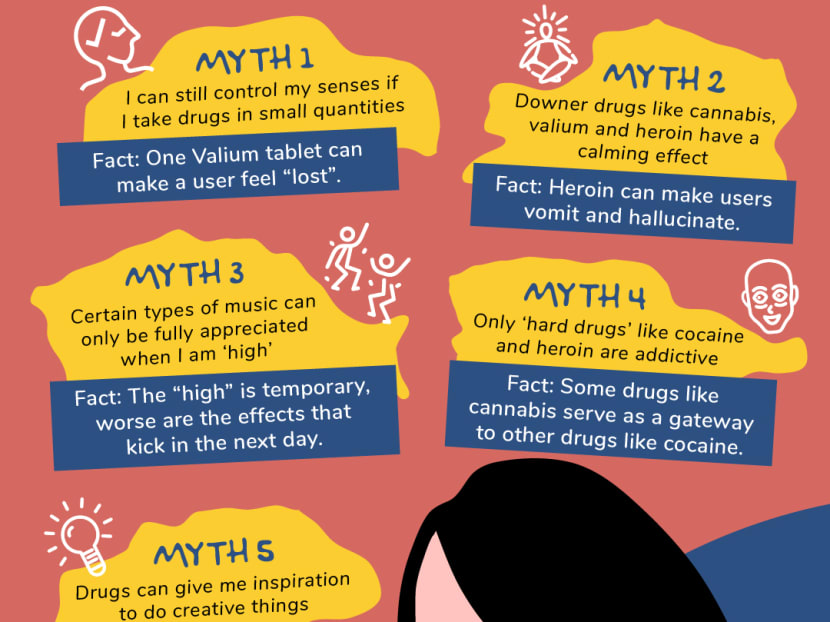
MYTHS ABOUT DRUGS
Based on figures from the Central Narcotics Bureau, 3,524 drug abusers were arrested last year, a six-year high.
Of these, 42 per cent were new drug users, with three in five under age 30.
The youth might have certain misconceptions about drug abuse, and Ms Nadiatul is certainly in a position to set the record straight.
Here are some common myths:
MYTH 1: I can still control my senses if I take drugs in small quantities
Ms Nadiatul said that different people will react differently to different drugs. For her, consuming one Valium tablet was enough to make her feel “lost”.
“Some people don’t feel anything, but for me, I felt the kick,” Ms Nadiatul said. “I started to get involved in fights and I could not stop myself.”
MYTH 2: Downer drugs like cannabis, valium and heroin have a calming effect
Not true, Ms Nadiatul said. In the case of heroin, it did not calm her down at all; it simply made her vomit and hallucinate.
Medical evidence has also shown that the side effects of taking such drugs include impaired memory, impaired coordination, reduced inhibitions, lethargy and drowsiness.
Downer drugs tend to affect one’s central nervous system – the brain and the spinal cord. Abusers of the drug will find their mental functions reduced while their physical development may be restricted in certain ways.
MYTH 3: Certain types of music can only be fully appreciated when I am ‘high’
Ms Nadiatul said the “high” that she gets from drugs such as Ice and ecstasy is only temporary.
Worse are the negative effects that kick in within the next day. For instance, she would lose her appetite, be unable to sleep and become temperamental.
MYTH 4: Only ‘hard drugs’ like cocaine and heroin are addictive
It is a misnomer to label drugs as “hard” or “soft”, as each drug comes with its own set of harmfulness.
Some drugs like cannabis also serve as a gateway to other drugs like cocaine. In Ms Nadiatul’s case, she started out with ecstasy before moving on to other drugs such as heroin, cannabis and Ice. Cannabis is also popularly referred to as marijuana, weed, pot or ganja.
Repeated drug use can lead to brain changes that challenge an addicted person’s self-control and interfere with his ability to resist intense urges to take drugs. These brain changes can be persistent.
As a person continues to use drugs, the brain adapts by reducing the ability of cells in the reward circuit to respond to it. This reduces the “high” that the person feels compared to when he first took the drug.
He might take more of the drug to try to achieve the same “high”.
MYTH 5: Drugs can give me inspiration to do creative things
Psychedelic drugs have often been linked to creativity. These include LSD, ketamine and magic mushrooms. But studies have shown otherwise.
LSD, for example, is a potent and illegal hallucinogen that blurs the line between perception and imagination. It affects the cognitive function of the user — impairing his ability to organise his thoughts and appreciate relationships between concepts or ideas due to the hallucinations caused by the drug.
Moreover, misperception stemming from the belief that “drugs lead to creativity” has led to the death of many talented individuals, including great musicians.
MYTH 6: Prescription drugs are safe, because doctors prescribe them
Prescribed medication does also have active ingredients that could be controlled substances. If used without proper medical supervision, it could lead to addiction and cause side effects. When taken in excess, it could lead to severe physical and psychological effects, even death.
Prescription drugs can also be abused, as seen in the United States with the opiate epidemic. That was when opioid drugs such as morphine and heroin were being increasingly prescribed for pain management and resulted in a rise in opioid use throughout the subsequent years.
From 1999 to 2017, almost 400,000 people died in the US from drug overdoses that involved prescription and illicit opioids.
MYTH 7: Cannabis is safe, that’s why more countries are legalising it
The legality of cannabis is being challenged on two fronts: One pertaining to its medical use and the other to its recreational use.
Some countries have legalised medicinal cannabis in view of its purported ability to treat certain diseases, such as severe epilepsy. However, the use of cannabis as medicine has not been rigorously tested.
In certain countries, cannabis for recreational use has also been decriminalised or legalised.
Many proponents of decriminalising cannabis have argued that doing so would reduce costs of maintaining the criminal justice and law enforcement systems.
Those in favour of legalising it said that governments could generate income from taxes.
Whether the drug can be considered safe for consumption is a different matter altogether. Users have been known to suffer withdrawal symptoms such as anxiety, tension, sleeping difficulties, impaired learning and poor memory.
MYTH 8: It’s cool to take drugs, since some international celebrities do it
It’s not uncommon to hear of celebrities who indulge in drug abuse but there are many others who have spoken out against drug use.
Liverpool footballer Mohamed Salah appeared in an anti-drug campaign in 2018, targeting Egyptian youth and encouraging them to stay clear of drugs. His “Just Say No” campaign was credited with a 400 per cent increase in calls to the national drug rehab hotline within three days.
In India, Bollywood actors including Soha Ali Khan, Kunal Kemmu and Sanjay Dutt backed the #DrugFreeIndia campaign started by producer Mahaveer Jain.
This article is written in partnership with the National Council Against Drug Abuse (NCADA). This year’s anti-drug campaign is titled HIGH and is anchored on Singapore’s first interactive film by the same name. The film, directed by Royston Tan and produced in collaboration with NCADA, is available on the microsite http://high.sg/.
Related topics
drug drug abuse National Council Against Drug Abuse Royston TanStay in the know. Anytime. Anywhere.

Subscribe to our newsletter for the top features, insights and must reads delivered straight to your inbox.
By clicking subscribe, I agree for my personal data to be used to send me TODAY newsletters, promotional offers and for research and analysis.






