
Job vacancies surge to highest in 10 years
SINGAPORE — The number of job vacancies surged to a record high of 65,600 in December — the highest in nearly a decade — amid tight foreign labour supply and strong demand. The unemployment rate stood at 2.9 per cent, unchanged from 2013, revealed the Ministry of Manpower’s (MOM) Labour Market 2014 report released yesterday.
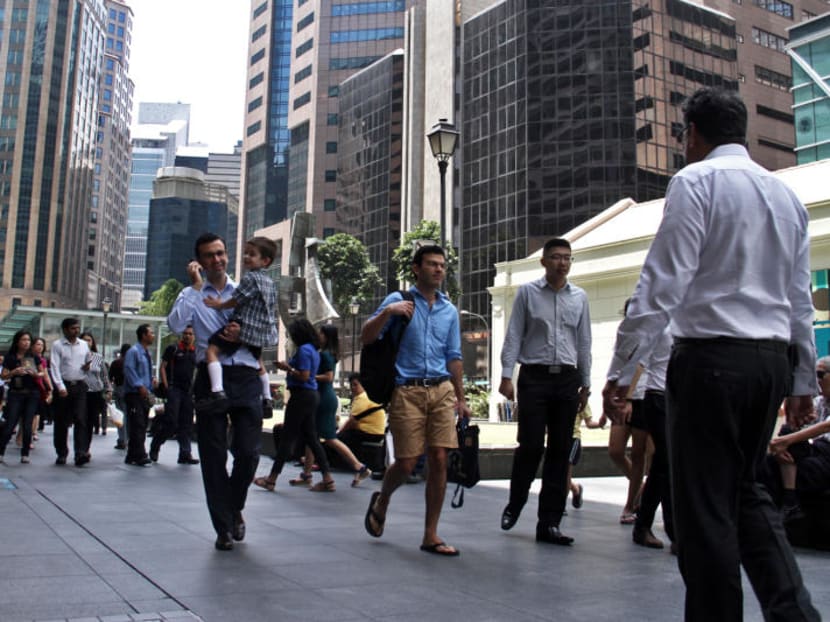
TODAY file photo


SINGAPORE — The number of job vacancies surged to a record high of 65,600 in December — the highest in nearly a decade — amid tight foreign labour supply and strong demand. The unemployment rate stood at 2.9 per cent, unchanged from 2013, revealed the Ministry of Manpower’s (MOM) Labour Market 2014 report released yesterday.
While job openings were available across all skill levels in December, about 28,600 — or 47 per cent of all vacancies — were for professionals, managers, executives and technicians (PMETs). This was followed by clerical service and sales workers (28 per cent), and production, transport operators, cleaners and labourers (25 per cent).
Singapore’s total employment grew by 122,100 for the whole of last year, slightly lower than the 131,300 in 2013.
The local workforce grew faster, with 96,000 locals joining the market, compared with 82,900 in 2013. On the other hand, foreign employment growth has moderated, with 26,000 foreigners, excluding foreign domestic workers, joining the workforce, compared with 48,400 in 2013.
Vacancy and unemployment figures in the report have been seasonally adjusted.
Labour demand will remain high this year, with the services sector being a major contributor of employment growth, said the MOM. The continuing tight labour supply is likely to result in an upward pressure on wages in labour-intensive sectors such as construction, retail and food service, it added.
The MOM yesterday echoed Manpower Minister Tan Chuan-Jin’s earlier remarks that local employment growth is likely to taper significantly in the last few years of the decade, to an average of 20,000 per annum.
“Our demographic realities mean that for the second half of this decade, the growth in the working-age population will slow,” it said.
The ministry also said foreign manpower policies will remain tight to maintain growth at a sustainable pace, given Singapore’s physical and social constraints. Firms will need to focus on raising the quality of their workforce as a key source of growth, productivity and competitiveness, it said.
Labour productivity took a hit last year, declining by 0.8 per cent as employment gains continued to outstrip growth in the gross domestic product.
The decline is caused by falling productivity across most sectors, and a rise in the employment share of “less productive” and “domestically-oriented” sectors, such as food and beverage, and construction, said the MOM.
Economists told TODAY that the record, seasonally-adjusted job vacancy number is not a cause for worry, given Singapore’s relatively stable job vacancy rate. UOB economist Francis Tan said: “If the vacancy rate goes higher, it means that companies need people, but they can’t really find anyone. If vacancies rate go down, it may mean better job-matching or recession.”
Another economist, Mr Song Seng Wun, said the high vacancy number is a sign that businesses are still doing well in Singapore. “However, we have to be mindful that many of the businesses that are looking for people, are not (offering) the kind of jobs that Singaporeans may want to work in ... That is why some of the industry sectors have difficulty hiring.” While foreign manpower policies will remain tight, some vacancies will inevitably be filled by foreigners, given the country’s demographic trends, he added.
Stay in the know. Anytime. Anywhere.

Subscribe to our newsletter for the top features, insights and must reads delivered straight to your inbox.
By clicking subscribe, I agree for my personal data to be used to send me TODAY newsletters, promotional offers and for research and analysis.






