
Leap second: Clocks to read 07:59:60 on July 1
SINGAPORE — At exactly 07:59:59 am tomorrow (July 1), you will get one extra second to your day.
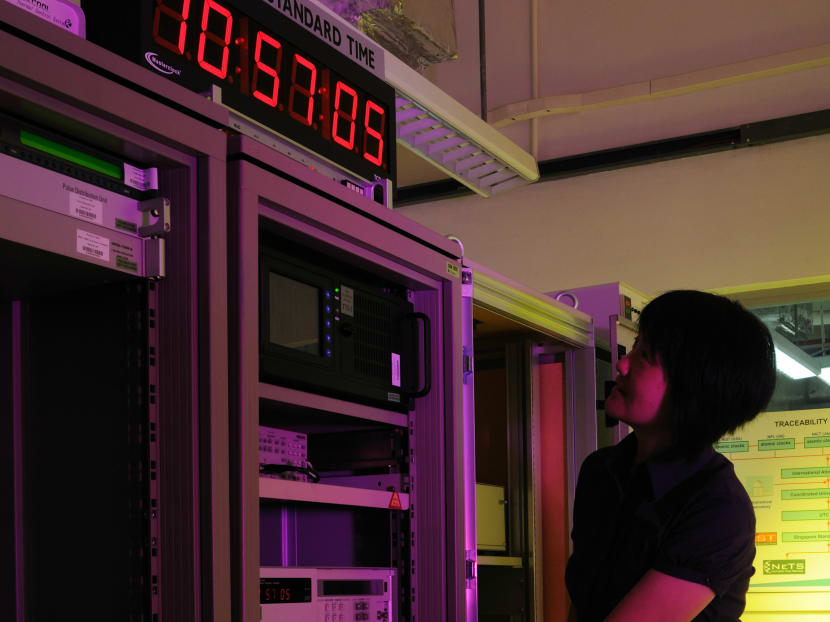
There will be an additional second added to the atomic clock on July 1, 2015. Photo: National Metrology Centre

SINGAPORE — At exactly 07:59:59 am tomorrow (July 1), you will get one extra second to your day.
The phenomenon, called a “leap second”, takes place every few years, where an additional second is inserted to the atomic clock, or UTC (Coordinated Universal Time). The addition, which is implemented every few years, prevents days from getting longer as the Earth’s rotation continually slows down due to factors such as the moon’s gravitational pull and earthquakes.
During the last leap second on June 30, 2012, more than 400 Qantas flights were delayed when the airline’s check-in system crashed, while websites such as Reddit, Mozilla and LinkedIn experienced glitches because the systems could not cope with the extra time.
This year, the leap second insertion is especially crucial to Asia as it takes place during working hours, unlike the early Sunday morning three years ago.
“In the past, leap seconds happened during weekends (and) holidays, so people were not working. ... This year, (the leap second) is expected to affect more financial sectors because it’s during (trading) time,” said Dr Liu Yan Ying, a metrologist at the National Metrology Centre of the Agency for Science, Technology and Research (A*STAR). The centre oversees the national measurement standards in Singapore.
The FIA, a trade organisation for the global futures, options and cleared swaps markets, had noted previously that this will be the first time the leap second has occurred during active trading hours in an environment where electronic and automated trading relies on sub-second precision.
MARKETS, COMPANIES PREPARE
To cope this year, some exchanges will end trading early or open late. Some stock markets are recalibrating their clocks ahead of time. The Singapore Exchange (SGX) said it will adjust its systems’ clock for the SGX Securities and Derivatives Markets between 3am and 5am on July 2 so as to “minimise the impact of the Leap Second insertion on trading”.
“Between 07:59:59 1 July 2015 Singapore time and the time when SGX adjusts its systems’ clock, SGX systems’ clock runs 1 second ahead of the UTC,” said SGX on its website.
Scientists introduced the atomic time scale in 1967, which is what the world’s time system and UTC is based on. But due to irregularities of the Earth’s rotation and the precision of atomic time, a mismatch between both time scales will occur. An extra second has to be inserted when the difference between two time scales exceed 0.9 second.
NMC’s Dr Liu noted that the frequency of leap second insertions would be higher in the future because of the slowdown in Earth’s rotation. This year’s leap second is the 26th since 1972, and the fourth since 2000. An organisation called the International Earth’s Rotation and the Reference System Service is responsible for calculating when an extra second is needed.
“There has been very serious debate within the time community in past years. Scientists want to abolish leap second insertion because it has caused so many unwanted issues but some people are against it,” added Dr Liu. There will be a vote on this in November by the International Telecommunication Union.
Organisations TODAY spoke to said they have prepared for the leap second and do not expect any disruption, just like their 2012 experience.
Ms Fen Peh of Group Strategic Marketing & Communications for DBS Bank said the bank is not expecting any customer impact this year as all the “systems are synced with the network clocks which will make the adjustment automatically”.
Mr Eugene Lau, Head, Group Technology Services, OCBC Bank said: “For the impending leap second occurrence happening on 1 July (Singapore time), we have also put in place measures to ensure the bank’s internal clocking system is synchronised.”
Singapore Airlines also said it has measures in place to ensure its systems will not be affected.
Qantas Airways, which was affected in 2012, said it is confident there will be no impact this year on its operations. The airline’s communications manager Thomas Woodward said it has “sought and received assurances” from Amadeus, its reservation system, that it has “taken action to make sure that the same problem does not happen again this year”,
Telcos M1 and StarHub also told TODAY they would not be affected, with the former saying it is “monitoring the situation closely”.
Meanwhile, since the last leap second, Google has used a technique it developed, called “leap smear”, where the servers’ system clocks are slowed down slightly over 20 hours until an entire leap second has been added.
Stay in the know. Anytime. Anywhere.

Subscribe to our newsletter for the top features, insights and must reads delivered straight to your inbox.
By clicking subscribe, I agree for my personal data to be used to send me TODAY newsletters, promotional offers and for research and analysis.






