
Low Thia Khiang, Ng Chee Meng cross swords over impending GST hike
SINGAPORE — Workers’ Party (WP) chief Low Thia Khiang and Cabinet Minister Ng Chee Meng locked horns on Wednesday (Feb 28), after the Opposition leader labelled the impending goods and services tax (GST) hike as a “real distraction” from a forward-looking Budget.
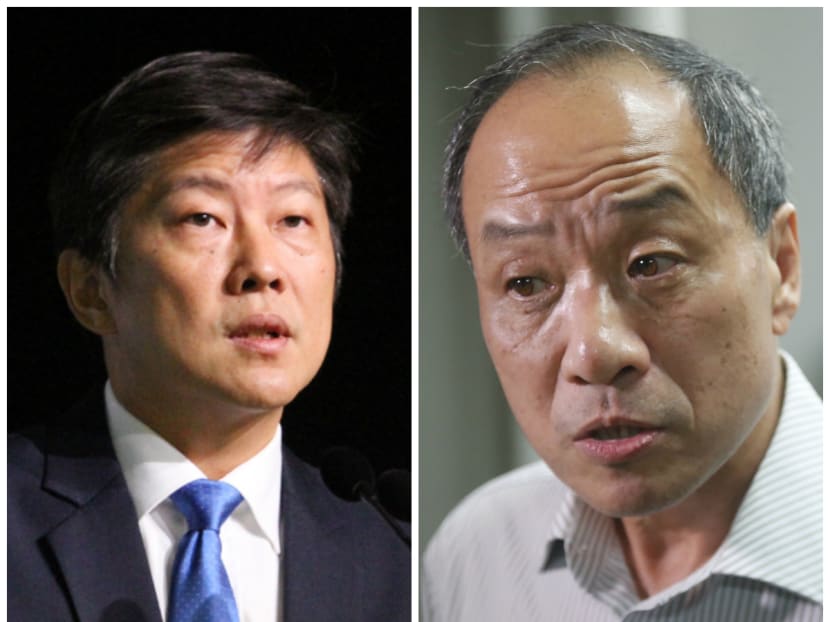
Education Minister (Schools) Ng Chee Meng (left) and Workers' Party chief Low Thia Khiang. TODAY file photos



SINGAPORE — Workers’ Party (WP) chief Low Thia Khiang and Cabinet Minister Ng Chee Meng locked horns on Wednesday (Feb 28), after the Opposition leader labelled the impending goods and services tax (GST) hike as a “real distraction” from a forward-looking Budget.
“I appreciate the Government’s vision statements and the articulation of how Singapore should strategically position itself in the new era. This is a forward-looking Budget to anchor Singapore firmly in the future and for the future,” said Mr Low on the second day of the parliamentary debate on Budget 2018.
But it was “unfortunate” that the Government was “looking forward too hastily for a future revenue stream” by announcing a GST hike prematurely, he said.
The GST is expected to rise to 9 per cent from the current 7 per cent sometime between 2021 and 2025.
“(It’s) a real distraction, causing the Government to lose its focus on getting buy-in for the vision (set out in the Budget) because it has to explain the future GST hike instead,” Mr Low said. “Do not let this opportunity to lead Singapore with this vision go to waste.”
His remarks drew a riposte from Mr Ng, who is Education Minister (Schools).
Mr Ng said he was baffled by WP’s view that finding ways to fund programmes outlined in the Budget was a distraction.
“I think it’s critical, I think it’s honest, I think it’s right that we outline to Singaporeans how we intend to chart Singapore’s future … in a sustainable manner,” said Mr Ng.
Budget 2018 has, among other things, outlined how Singaporeans can take care of the elderly, better prepare children for the future and prime businesses to help workers navigate dramatic economic changes and technological disruptions, he said.
“Yet … the Workers’ Party thinks that finding the ways to fund all these programmes is a distraction... I find it baffling,” he said.
Mr Low said the Government could have announced the GST hike “anytime”. “We’ve never said that the Government would have to fund everything… We’re questioning whether there are any other avenues to look at instead of raising GST because it affects a lot of people,” he said.
Mr Ng then brought up Mr Low’s remarks in the House last year that urged the Finance Minister to be “upfront with Singaporeans now” if a GST hike was being considered before the end of this decade. This is so that Singaporeans “are not blindsided by the Government as they were with the sudden 30-per-cent increase in water prices”, Mr Low had said last March.
Mr Ng said on Wednesday: “You can’t have the cake and eat it.”
Mr Low said he was not asking the Government to “hide” the planned GST hike. “It’s good to announce it beforehand, but the question is whether or not you need to announce it together with this Budget. That’s another issue,” he replied.
A day earlier, WP’s assistant secretary-general Pritam Singh said the party could not support the impending hike at this point, given the lack of details on how other forms of tax will add to the Government’s income. He called on the Government to tap revenue from land sales to fund recurrent spending.
Presently, land sales revenue is excluded from budgetary spending. Under the Constitution, state land and revenues from land sales form part of Singapore’s past reserves, which are invested.
Mr Singh, who is tipped as the frontrunner to succeed Mr Low as party chief, said the majority of the land here consists of leasehold properties of 99 years or less. As the largest landowner here, the Government should allow present generations to benefit from some percentage of land sales as “such land regenerates itself in value for future generations, providing successive governments with a recurring source of income”, he said.
Later in the debate, Member of Parliament Christopher de Souza from the ruling People’s Action Party said the hike was announced years in advance because of “stewardship, honesty and being upfront with the people”.
The country faces rising expenditure in areas like healthcare and security, and Mr de Souza said: “We cannot conceal from the people we serve that this revenue will be needed in three or more years. That is transparent politics.”
S'pore's 'first-mover' advantage in predicting China's rise 'now irrelevant'
While Singapore has reaped many benefits from rightly predicting China’s rise and being among the first states to share its know-how in economic development with the regional heavyweight, this edge is “now irrelevant”, said Workers’ Party chief Low Thia Khiang.
China is rapidly becoming an economic and military superpower as well as the centre of global capitalism – such as through its One Belt, One Road trade-and-infrastructure initiative, he said.
Singapore has to make itself “useful again” by fundamentally transforming its economy, said Mr Low.
“As a small city-state, this also means transforming our culture and human capital as well as our diplomatic relationships with the economic powers and interpersonal friendships between national leaders and citizens.”
While Singaporeans’ ability to speak English has helped bolster the Republic’s ties with the West over the last five decades, Mr Low said that in connecting with the Chinese, it has to go beyond learning the Chinese language.
“In China, speaking Mandarin is just the official language in official dealings. If one would like to connect better to the Chinese, not just rationally, but also affectionately, the language to use is local dialect,” said Mr Low, who was Chinese-educated and had graduated from the former Nanyang University.
Nevertheless, Mr Low noted concerns about the Asian giant’s intentions, especially under a single party’s rule. There are also worries over China’s policy and attitude towards weaker states.
“I’m worried that Singapore, if we’re not careful (and) fail in our economic strategy to become a global-Asia node, will become a pawn on the chessboard for Great Power games in South-east Asia,” he said.
Singapore thus needs to make itself relevant and useful to the future economy, and contribute to the region’s economic dynamism.
“But besides focusing on the economic opportunities, we should also have the new political scenario in mind, while anchoring Singapore as a global-Asia node,” he added. “It’s important that we see the political economy of the major shift, instead of just the economic challenges and opportunities.”
Stay in the know. Anytime. Anywhere.

Subscribe to our newsletter for the top features, insights and must reads delivered straight to your inbox.
By clicking subscribe, I agree for my personal data to be used to send me TODAY newsletters, promotional offers and for research and analysis.






