
LTA issues stricter rules on inward-facing cameras to protect commuters’ privacy
SINGAPORE — Taxis, private hire cars, and buses will have to seek the Land Transport Authority's (LTA) approval before installing inward-facing video cameras in their vehicles.
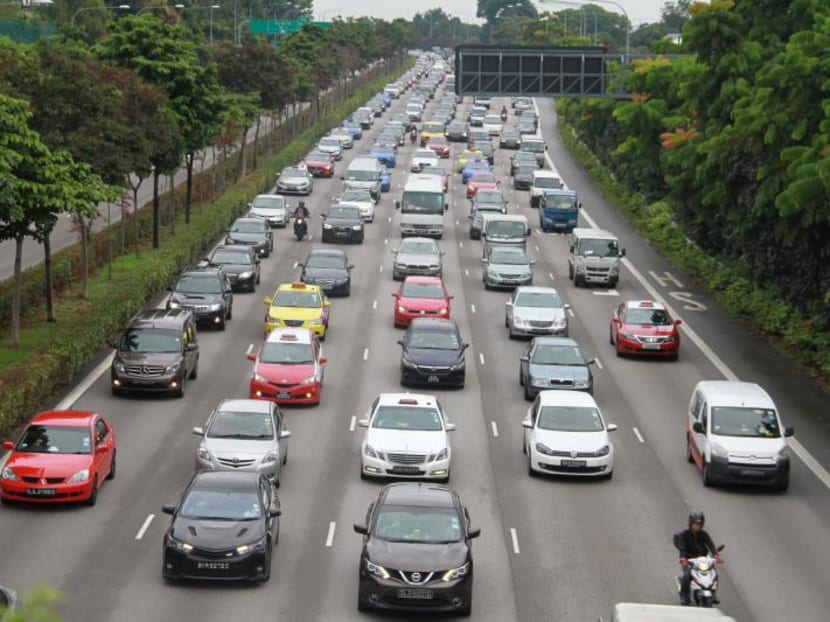
Slow moving traffic is seen during a rush hour jam along the CTE.

SINGAPORE — Taxis, private hire cars, and buses will have to seek the Land Transport Authority's (LTA) approval before installing inward-facing video cameras in their vehicles.
Releasing details of the new installation guidelines for such devices in a media release on Tuesday (May 22), the LTA said they complement the advisory guidelines issued by the Personal Data Protection Commission (PDPC) last month.
Set to take effect on June 22, the stricter set of rules are aimed at safeguarding commuter safety and personal data, the authority said.
Under the guidelines, these inward-facing recording devices have to be secured such that unauthorised people cannot get access to or download the data. For example, the memory card slot should be locked, and access to the micro USB port should be blocked.
They also must be installed in a fixed position and cannot be rotated to capture comprising visual records of passengers, nor must they have any audio recording function to prevent recording of passengers' conversations.
Last month, the PDPC issued advisory guidelines allowing taxi drivers and private-hire drivers to insist on the use of inward-facing video cameras to protect themselves against fare evaders and abusive passengers.
The move, which came after three years of lobbying by the National Taxi Association, had upset some commuters, who voiced privacy concerns.
Under the LTA guidelines, drivers are required to notify passengers to the presence of such cameras, such as through a "prominent notice" in the vehicle or through a booking confirmation.
The LTA rules, which are applicable to public buses, require owners of these public service vehicles to obtain its approval before installing such devices. However, these guidelines do not apply to omnibuses licensed to operate regular route services like SBS Transit and SMRT buses and private buses.
These devices can be installed only at LTA-approved installation centres to ensure that the inward-facing cameras are installed according to the manufacturer's and LTA's requirements, and to prevent them from being tampered with, the agency said.
Footage taken by these cameras must also have a clearly indicated date and time stamp, the vehicle's licence plate number, so as to facilitate investigations should there be a misuse of recorded footage.
Only government agencies and LTA-authorised "data controllers" such as taxi companies, will be allowed to access the recorded footage to support investigations and enforcement efforts, in cases such as fare evasion by commuters or alleged offences by the driver.
Drivers are also required to carry out periodic checks to ensure that their cameras have not been tampered with. They must report any sign of tampering or non-compliance with LTA's guidelines to LTA immediately.
Transport operators contacted by TODAY did not comment on whether they will be applying for LTA’s approval to install the cameras.
Responding to queries from TODAY, Ms Tammy Tan, group corporate communications officer for ComfortDelGro Corporation, said the company welcomes the “very clear guidelines” set by the LTA, and that it will “work with our drivers to ensure that they are met".
The company is one of Singapore’s major public transport operators which also handles SBS Transit, CityCab and the ComfortDelGro taxi service.
A spokesman from ride-hailing service Grab said that while the guidelines are important to protect the privacy of passengers, more can be done to simplify the requirements for the devices, which may be useful in situations such as fare evasion and disputes investigations.
"We hope to work closely with the authorities on the guidelines," the Grab spokesman added.
Meanwhile, Premier Taxi and TransCab said they are “still evaluating” whether they will submit a request to LTA to install the inward-facing video cameras. SMRT has declined to comment.
Under the Road Traffic Act, anyone convicted of offences relating to the unauthorised installation of inward-facing cameras and the unauthorised access of visual records could be fined up to S$1,000, or be jailed for a term not exceeding three months, or both.
In the case of a second or subsequent offence, the person could be fined up to S$2,000, or jailed for a term not exceeding 6 months, or both.
Taxi and private-hire car drivers could be issued 21 demerit points, which may lead to their vocational licence being revoked. Similarly, the LTA could revoke vocational licences of drivers of private private hire buses, excursion buses and school buses.
ADDITIONAL REPORTING BY LOW YOUJIN
Stay in the know. Anytime. Anywhere.

Subscribe to our newsletter for the top features, insights and must reads delivered straight to your inbox.
By clicking subscribe, I agree for my personal data to be used to send me TODAY newsletters, promotional offers and for research and analysis.






