
From Malay activist to politician; former PAP MP Sidek Saniff unveils memoir
SINGAPORE — In the 1980s, then Prime Minister Lee Kuan Yew wanted to disclose the breakdown of the Primary School Leaving Examination (PSLE) and GCE O-level results by ethnicity.
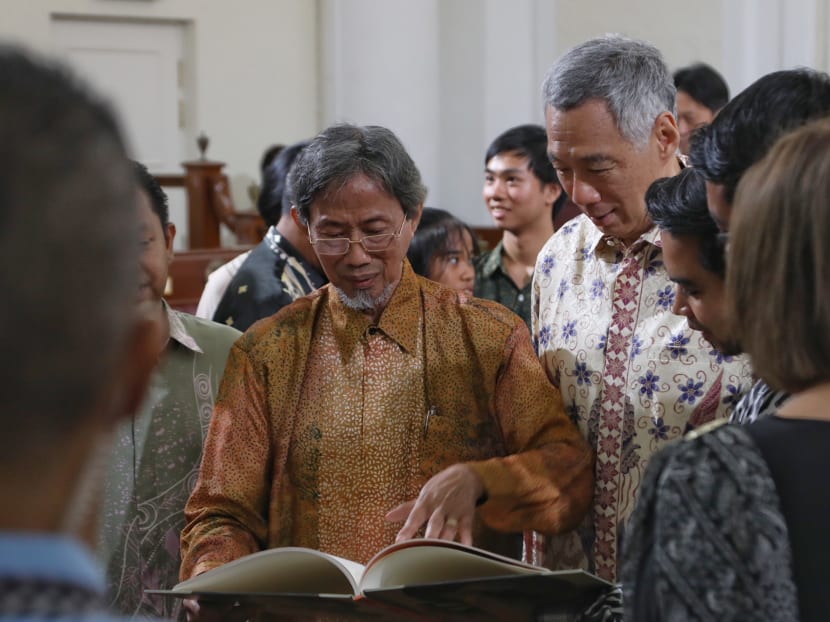
Book launch by former Minister Sidek Saniff at The Arts House, where PM Lee Hsien Loong was guest of honour.

SINGAPORE — In the 1980s, then Prime Minister Lee Kuan Yew wanted to disclose the breakdown of the Primary School Leaving Examination (PSLE) and GCE O-level results by ethnicity.
But knowing this would be a sensitive issue for the Malay community, he went to a guy who he knew could explain it to them – Mr Sidek Saniff.
Prime Minister Lee Hsien Loong was recounting the episode at the launch of Mr Sidek's autobiography, Sidek Saniff: Life Reflections at Eighty, at The Arts House at Old Parliament Lane on Tuesday (July 10).
He noted that the late Mr Lee, who died in 2015, could always rely on Mr Sidek – who was then senior parliamentary secretary at the Education Ministry – to "give his honest opinion, as well as to help make difficult decisions and explain them to the ground".
While Mr Sidek could have tasked a civil servant to do the job, he "decided to do it himself", said PM Lee.
"He believed that it was the right thing to do, and that it would eventually improve Malay students' academic performance", said PM Lee.
"At first, the Malay community felt awkward about the issue. But bringing the data out into the open enabled the community to acknowledge and tackle the problem, and helped to deliver the steady progress we have seen over the last decade."
PM Lee was speaking to an audience of about 80 people at the book launch, which included Mr Sidek's family, Deputy Prime Minister Tharman Shanmugaratnam, former ministers Dr Yaacob Ibrahim and Professor S Jayakumar, as well as former Malay Members of Parliament Yatiman Yusof and Zainul Abidin Rasheed.
Mr Sidek, now 80, was also the go-to-guy for former PM Goh Chok Tong, who also attended the launch.
At the second congress held by Malay self-help group Mendaki in 1989, Mr Goh – then first deputy PM – expressed hope that the community would accept the Government's new format for Tertiary Tuition Fee Subsidies (TTFS) based on family per capita income, Mr Sidek wrote in his book.
Prior to that, TTFS was given to all Malay students irrespective of family income level, and they were eligible for free university education.
In his book, Mr Sidek said he had to convince the Malay community on the merits of TTFS' new format. "I can tell you now that it was not an easy task… I faced waves of resistance from the Malay community," he noted.
Speaking to reporters at the event, Mr Sidek said that some Malays were "angry" that the government was trying to "tinker" with the Constitution, which recognises the special position of the Malays.
But he agreed with the Government's reasoning that it was unfair that the children of higher-income Malay families received free education, while children from poorer non-Malay families did not.
Furthermore, Mr Goh had pledged that any excess funds from the revised TTFS scheme would go to programmes to help the Malay community. The scheme would also be reviewed periodically to reflect Malay families' per capita income against inflation and cost of living.
"Anything that is sensitive, he (Mr Goh), will ask me to handle it," added Mr Sidek, with a smile.
Mr Goh said Mr Sidek was tasked to handle sensitive Malay issues as he had the trust of the Cabinet, and especially, the community.
Mr Goh said at the launch: "As a Prime Minister, he never doubted my sincerity in wanting to advance the interests of the Malay community. And I never doubted his ability to carry the ground once he was persuaded. So trust was very important.
"Without him being there… these issues were very difficult for us to get through to the Malay community. He played a very important part."
LESSONS FOR CURRENT AND FUTURE MALAY MPs
PM Lee noted that Mr Sidek represented a transition from the earlier PAP Malay MPs to the later ones. Most of those before him were journalists or unionists, but unlike them, Mr Sidek was not in a "politicised profession".
Mr Sidek's first language was Malay, like most of the previous Malay MPs, while those who became MPs later were more bilingual, said PM Lee.
He added: "With Sidek, the PAP started drawing from a larger talent pool for its candidates."
In his book, Mr Sidek acknowledged that Malays who joined the PAP were seen as traitors, which resulted in skepticism over PAP Malay MPs. He added: "Some took to looking across the Causeway for comparison – how their Malay brethren enjoy special provisions."
But now, such perception is "slowly receding", he told reporters.
He also had some advice for the current Malay MPs, who he noted are better educated and hold high-flying jobs, as he said they "must be on the ground" to better understand grassroots sentiments.
"You (current Malay MPs) must be honest about your beliefs," he said.
Mr Sidek said that he published his memoir only now because he wants to remind "my community of the importance of morality and 'adab' (proper Islamic behaviour)".
Mr Goh noted while current PAP Malay MPs cannot fall back "on the old style" of reaching out to the community as a different approach is needed for the new generation of Malays, there are values they can learn from their veteran colleagues.
He added: "So, what can they learn from the older MPs – humility, trust, sincerity."
LOOKING AHEAD
Though retired from politics, Mr Sidek shared his aspirations for the future in a book chapter titled, My Country, My Community.
Among them, he proposed creating a vice-president post from among eligible Chinese candidates to partner minority candidates vying for the Elected Presidency, saying that this "will put an end to the controversy over the 'minority only' presidential election".
Mr Sidek also suggested that the size of Group Representation Constituencies (GRCs) be reduced from the current maximum size of six MPs in a GRC to two, and that more single member constituencies be created instead. A committee could be formed to study this, he said.
"I believe the two MP/GRC system is the answer. The formula will nurture close co-operation between Chinese and non-Chinese MPs," said Mr Sidek in his book.
"I look forward to the day when political maturity blurs the dividing lines of race, language and religion, and that every MP is chosen on the basis of his or her proven record."
From Malay activist to PAP MP
Born in Tanjong Pagar on April 18, 1938, Mr Sidek was the second child of 13 children. His father worked as a clerk, and his mother was a housewife. Inspired by his math teacher, Mr Sidek, who was known in his village as the "boy who doesn't smile", became a teacher.
He was also a staunch Malay activist, or as PM Lee described him, "a firebrand, fighting for greater recognition of the Malay language and better salaries for Malay-stream teachers".
His battle for higher pay saw him leading five busloads of union members to a street demonstration in the 1960s, where they carried banners and placards criticising the Education Ministry for its inefficiency, said Mr Sidek in his book.
His entry into politics came as a surprise. Despite being critical of the Government which he felt "had not done enough to uplift the Malay community", Mr Lee wanted him to stand as a People's Action Party (PAP) candidate in the Kolam Ayer single member constituency for the 1976 general election.
Mr Sidek was concerned that joining the PAP might give an impression that he had "been bought" by the party. But advice from a senior teacher finally convinced him to join politics.
In a political career that spanned 25 years before he retired from politics in 2001, Mr Sidek rose to become senior minister of state for education and environment.
His proudest achievement was leading efforts to form Mendaki in 1984, with the aim of improving the livelihoods of the Malay community by emphasising the importance of education. "I always believe that social mobility can be achieved through education," he told reporters.
Stay in the know. Anytime. Anywhere.

Subscribe to our newsletter for the top features, insights and must reads delivered straight to your inbox.
By clicking subscribe, I agree for my personal data to be used to send me TODAY newsletters, promotional offers and for research and analysis.






