
‘Minimal change’, if any, to kindergarten syllabus
SINGAPORE — Changes, if any, to the curriculum of kindergartens here are likely to be minimal, educators from both chain pre-school operators and standalone kindergartens said yesterday.
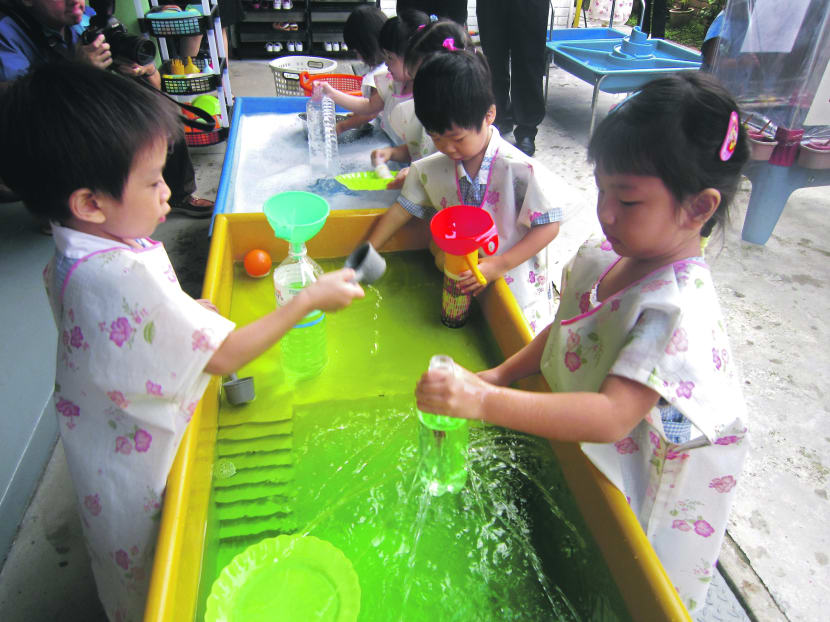
The updated kindergarten curriculum explicitly states learning goals expected by the end of K2 and emphasises the concept of learning through play. Photo: Ng Jing Yng

SINGAPORE — Changes, if any, to the curriculum of kindergartens here are likely to be minimal, educators from both chain pre-school operators and standalone kindergartens said yesterday.
They said they had been building on the learning domains suggested in the 2003 Ministry of Education (MOE) kindergarten curriculum framework, and hence would have met, or even surpassed, the learning goals listed in the refreshed framework released on Wednesday.
A kindergarten curriculum guide was also released in 2008, helping kindergartens here to further raise their standards, said educators.
But with the updated curriculum framework, explicitly stating learning goals expected by the end of Kindergarten-2 (K2) level and emphasising the concept of learning through play, pre-school operators said it would help to reaffirm their current practices. The framework will also serve as a guide for future curriculum reviews, they added.
The MOE’s updated curriculum framework encompasses six broad learning areas, aimed at setting a common standard among the 1,500 pre-schools here and bridging the gap between kindergarten and Primary 1. In numeracy, for instance, students should be able to count up to at least 10, do simple addition and recognise basic shapes.
PAP Community Foundation (PCF) Chief Executive Tay Swee Yee told TODAY that PCF kindergartens developed their curriculum based on the MOE’s guidelines, translating them into areas such as quality teaching and teacher-child interaction.
The PCF is one of the Republic’s two pre-school anchor operators — which receive government funds in exchange for providing affordable and quality childcare — and has 247 kindergartens spread across the island.
Adding that the PCF will study the updated framework “carefully”, Mr Tay said: “In the review and planning of our curriculum, we will be mindful of the new and updated elements of the framework and ensure alignment to achieve quality learning experiences for our PCF children”.
But as the PCF curriculum has “always been generally aligned” with the MOE’s guidelines, he felt that “changes, if any, will be minimal”.
NTUC First Campus, the second pre-school anchor operator here with over 110 childcare centres, has previously said it based its kindergarten-level curriculum on the MOE’s guidelines. The organisation, however, did not respond to media queries about the updated curriculum framework.
G8 Education Singapore’s Chief Executive Patricia Koh said the group’s 61 centres, including those under the Cherie Hearts brand, use a curriculum in line with the MOE’s framework but is also “enriching in many areas”.
“We are also introducing sports, technology, music and movement, robotics and mathematical games, besides the language learning which will prepare our children for lifelong skills,” she said. Nevertheless, the framework will serve to “level up” pre-schools which need improvements and provide directions for kindergarten operators, she added.
Educators from standalone kindergartens felt the framework, with its detailed goals and teaching examples, would be helpful for smaller pre-school players, which may not have resources to develop their own.
It also acts as a “common language” for pre-school educators, primary schools, and parents, said Mrs Elsie Tan-Chua, Principal of Living Sanctuary Kindergarten.
Mrs Tan-Chua pointed out that her K2 students may be able to count up to 20, but the MOE’s goal of rote counting up to 10 is not a matter of setting the bar too low. “It is about teaching the concept of counting and not just getting the child to memorise up to 100,” she said.
At Just Kids Learning Place, which has seven pre-school centres, Bukit Batok branch head Lurvin Lee said teachers use different types of advertisements to teach students to make comparisons and infer the purpose behind each advertisement. The framework helps to set the benchmark and teachers can tailor according to the needs of each cohort, she said. Additional reporting by Amanda Lee
Stay in the know. Anytime. Anywhere.

Subscribe to our newsletter for the top features, insights and must reads delivered straight to your inbox.
By clicking subscribe, I agree for my personal data to be used to send me TODAY newsletters, promotional offers and for research and analysis.






