
Mobile truck to train and test police officers via VR tech
SINGAPORE — Responding to a domestic incident where a man brandished a chopper, police officers shouted: “Calm down, sir. We are here to help you, sir. For your safety, put down the chopper right now.”
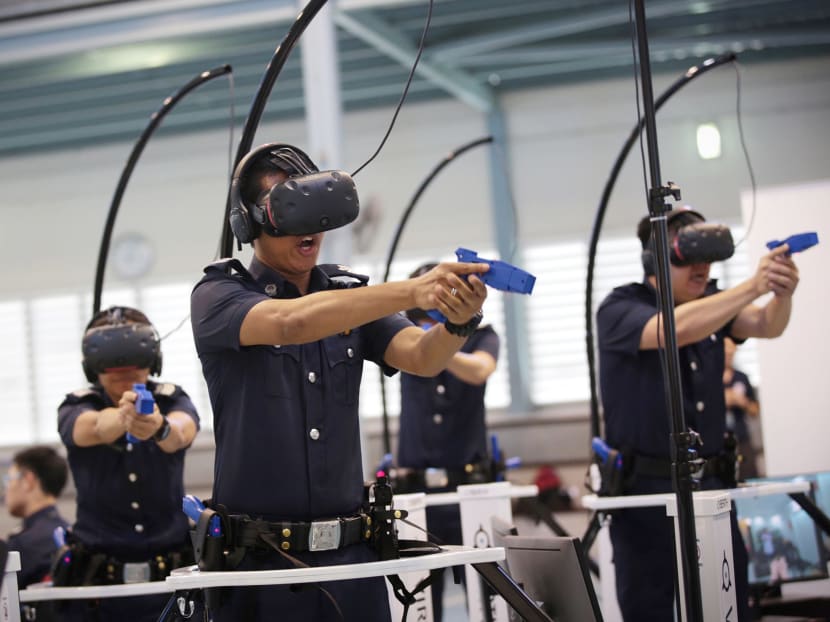
Police officers demonstrate the use of Virtual Reality training equipment during a media preview of the new Mobile Classroom (MobiC), which utilises Virtual Reality (VR) technologies to bring training to the frontline units, on June 12, 2017. Photo: Jason Quah



SINGAPORE — Responding to a domestic incident where a man brandished a chopper, police officers shouted: “Calm down, sir. We are here to help you, sir. For your safety, put down the chopper right now.”
In a split second, the man started charging forward with the weapon and the officers were compelled to act.
This was the scene playing out in a soundproofed truck, as the police gave the media a preview on Monday (June 12) of its new mobile classroom to train its officers.
Inside and across the length of the vehicle are two wide virtual reality (VR) panels. Two pairs of police officers can be put to the test in up to seven random scenarios, such as a gunman at a coffee shop or a domestic fight that quickly escalates into a knife attack. Two of the scenarios are terrorism-related.
Controlling the screen using VR-enabled weapons — which can be a revolver, a taser or a baton — the officers will be evaluated on their choice of weapon in response to the sudden incident.
Their reaction times will also be clocked, and how they use verbal commands to try to control the situation will be reviewed through a video playback system.
The truck also stores another platform that can be laid out in a space no larger than half a badminton court. It includes four collapsible virtualisers — omni-directional treadmills allowing users to move in a virtual world, so that more officers can concurrently undergo the same test as those on the truck.
At the Bedok Police Division where the technology is being tested, officers demonstrated how they could fail in a mission by using their weapon just a second too late.
The mobile classroom, which can be sent to any neighbourhood police centre, can train up to 16 officers at a time. This can be done in 15 minutes between their shift changes, to minimise operational downtime while ramping up training frequency. It cuts down the need to rely on yearly refresher courses as well.
The training solution was devised over six months by the Home Team Academy, with the Office of the Chief Science and Technology Officer and the Singapore Police Force.
The prototype truck will travel to the six police land divisions across Singapore for a six-month trial from September to train police personnel.
Ground response force officer Anderitte Lim, 22, who started training with the VR system three weeks ago, said he felt “the same stress and nerves” as he would on the ground.
He added that “it is not every day that domestic disputes turn violent”, but when this VR training is done before they begin their shifts, the scenarios remain fresh in their heads, “so we will know what to do on the spot”.
Home Team Academy’s chief executive T Raja Kumar said that the scenario-based VR training “hones instincts and judgment” and encourages officers to articulate why they made a certain decision over another, improving team coordination.
Stay in the know. Anytime. Anywhere.

Subscribe to our newsletter for the top features, insights and must reads delivered straight to your inbox.
By clicking subscribe, I agree for my personal data to be used to send me TODAY newsletters, promotional offers and for research and analysis.






