
MOE updates kindergarten curriculum
SINGAPORE — An updated kindergarten curriculum, encompassing six broad learning areas, was unveiled yesterday by the Ministry of Education (MOE) — in a move, educators say, will help raise standards and provide clarity on what would be expected of students at the end of Kindergarten 2 (K2).
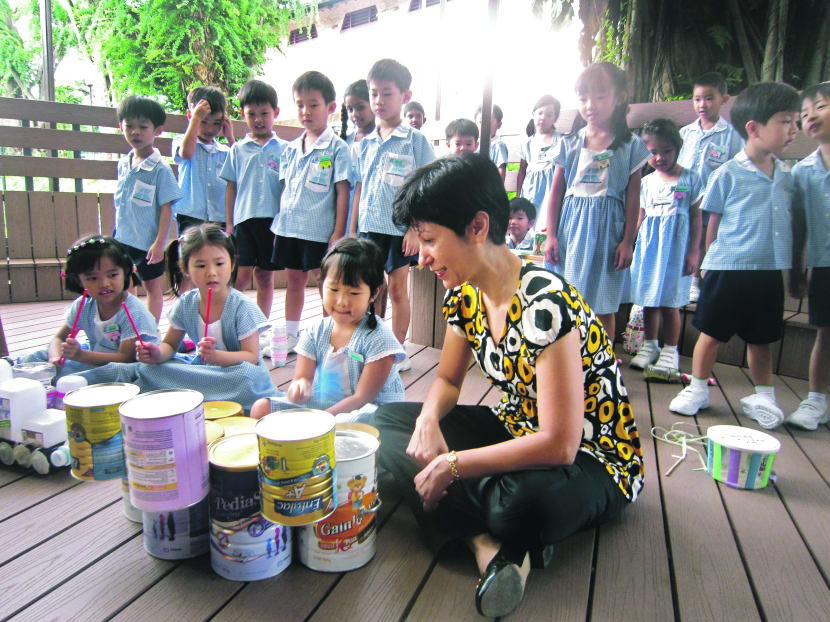
Senior Minister of State (Education and Law) Indranee Rajah at Ascension Kindergarten yesterday. Ms Indranee said the objective of the updated framework is to raise the overall standards of kindergartens. Photo: Ng Jing Yng

SINGAPORE — An updated kindergarten curriculum, encompassing six broad learning areas, was unveiled yesterday by the Ministry of Education (MOE) — in a move, educators say, will help raise standards and provide clarity on what would be expected of students at the end of Kindergarten 2 (K2).
Educators, however, noted that challenges remain in implementing the curriculum and convincing parents what would be sufficient for their children at the kindergarten level.
The updated framework is aimed at bridging the gap between kindergarten and Primary 1, detailing explicit learning outcomes by the end of K2. The 111-page document includes a renewed emphasis on teachers to improve kindergarten education through purposeful play and reflecting upon their teaching methods.
When asked how teaching and learning goals were decided, MOE said the framework — which was introduced in 2003 and witnessed its first revision this year — incorporated latest research in early education and feedback from educators. Asked how often it would be updated, MOE said it will continue to monitor educational developments and research to ensure teaching practices stay relevant.
MOE has also developed a parents’ guide, containing similar broad learning outcomes at kindergarten level. An educators’ guide and learning resources will be provided within two years to help kindergarten teachers implement this updated framework.
Speaking at yesterday’s launch, Senior Minister of State (Education and Law) Indranee Rajah said the objective is to raise the overall standards of kindergartens here. At the same time, it also serves to guide parents on the purpose of kindergarten education, which includes instilling social aspects — such as self-confidence —which goes beyond gaining numeracy and literacy skills, she added.
Kindergarten educators interviewed said the framework would help to manage parents’ expectations and raise capabilities of weaker students.
Educators also urged the Government to look into increasing the supply of trained kindergarten teachers to implement the framework effectively.
“Many parents tend to focus on cognitive development but MOE’s goals for early childhood education are holistic,” Senior Principal of St James’ Church Kindergartens Jacqueline Chung said. “This framework will hopefully give parents more assurance that their children will be adequately prepared for Primary 1.”
MacPherson PCF Centre Principal Patricia Low, however, pointed out not every child will be able to meet MOE’s learning goals by the end of K2, due to factors such as entering pre-school late. “Some children might have achieved beyond these goals at K2 but for the weaker students, it will set some kind of target for them to move towards,” she said.
Primary school educators believed that the updated framework will ease the transition from kindergarten to Primary 1. A teacher said 80 per cent of her Primary 1 children start school with knowledge exceeding the syllabus. As parents and kindergartens know what is expected, it will hopefully put paid to the “vicious circle” of striving for higher standards in Primary 1 year after year, she said.
Edgefield Primary School Principal Willy Tan felt that the framework provides greater alignment to primary school education, but the challenge lies in parents and kindergarten educators attempting various methods to ensure a holistic pre-school education. “The key here is a shift in mindset about the education for the little ones … from academic to holistic,” he said.
Stay in the know. Anytime. Anywhere.

Subscribe to our newsletter for the top features, insights and must reads delivered straight to your inbox.
By clicking subscribe, I agree for my personal data to be used to send me TODAY newsletters, promotional offers and for research and analysis.






