
MOE to deploy more AI in schools after success of Pri 5 maths tool
SINGAPORE — At Lakeside Primary School and Rosyth School, teachers can now quickly identify which students need more help in particular areas of mathematics with the support of artificial intelligence (AI) in classes.
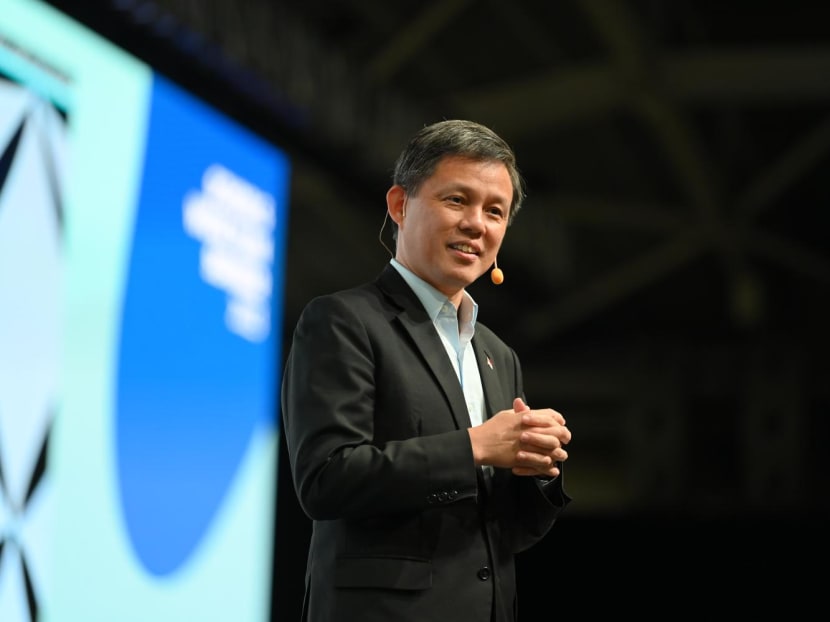
Education Minister Chan Chun Sing speaking on Sept 20, 2023.

- Education Minister Chan Chun Sing said that more AI tools will be introduced in schools under a national strategy
- This follows the success of a mathematics tool introduced in Primary 5, first as a pilot then across all schools from June
- A few teachers said that the AI tools help them target a student's individual needs and frees the teachers to devote more time to pupils


SINGAPORE — At Rosyth School, teachers can now quickly identify which students need more help in particular areas of mathematics with the support of artificial intelligence (AI) in classes.
Senior teacher Edmond Lee said it has helped to save valuable time when collating scores and understanding potential gaps in students' understanding before embarking on a topic.
“Instead of the traditional way of tabulating one by one, the system helps us so that it... saves us some time in gathering feedback (manually),” Mr Lee said.
In June, the Ministry of Education (MOE) launched the Adaptive Learning System for mathematics, for three topics covered at the Primary 5 level. That followed a pilot involving 33 schools that began last year.
Now, Education Minister Chan Chun Sing has announced that more AI tools will be made available in schools under the EdTech Masterplan 2030, also announced on Wednesday, which aims to harness the transformative potential of technology in teaching and learning.
The AI-enabled Adaptive Learning System uses machine learning to make customised learning recommendations for each student based on how the student responds to certain questions and activities.
This system is also integrated with the Singapore Student Learning Space, which is the national online learning platform for schools.
For schools, AI is used as a pre-learning tool, where students may try out some questions for a topic before it is taught in class.
Teachers may then use the feedback and data gathered by AI to ascertain which areas students have trouble with and tailor their lessons accordingly.
Mrs Finella Goh, principal of Lakeside Primary School, said: “What we really like about the use of AI is that it allows the students to move at a pace they are comfortable with.”
The system allows teachers to “meet students where they are” and adjust the pace of their lessons to suit them, she added.
Mrs Goh and Mr Lee were speaking to TODAY on the sidelines of the Schools Work Plan Seminar 2023 by the Ministry of Education.
At the event, Mr Chan flagged the plan to introduce more AI support in schools under Singapore's National AI Strategy.
With the variety of AI tools available, the teachers interviewed by TODAY also spoke about the ways that they will be teaching AI literacy to students.
Schools such as Anderson Serangoon Junior College have inculcated an AI literacy programme to introduce students to foundational learning in AI, in order to prepare them for an increasingly technology-enabled world.
This is done in partnership with AI Singapore, an agency launched by the National Research Foundation in 2017 to nurture AI talent here.
Through this programme, students were introduced to the basic theories underpinning the various AI models and the possible uses of AI.
In addition to the partnership with AI Singapore, Anderson Serangoon Junior College also developed the ICT Champions programme to deepen digital literacy and skills among interested students.
AI FREES UP TEACHERS TO DO MORE FOR STUDENTS
With AI, teachers can keep better track of student’s progress and move towards personalised learning.
Besides being a pre-learning tool, the AI-enabled Adaptive Learning System also helps students to reinforce concepts that they have learnt and to work through areas that teachers have not yet covered, Mr Lee of Rosyth School said.
Based on the student’s responses, the AI will “feed questions, practices, or resources for students to help guide them step by step for a particular topic”.
While teachers have been moving towards differentiated learning for years, Mrs Goh of Lakeside Primary School said that AI has allowed teachers to meet this goal at “a very high level”.
Now, it is more about students owning their learning and exploring the technology at a pace that they are comfortable with, she added.
Mr Lee emphasised that AI is truly a complementary tool that can help students with simple concepts, such as how to multiply decimals by hundreds.
The new AI system "can take over that and help reinforce our teaching”, he said.
“I think it doesn't take away the default that teachers will be around to deal with or to teach the mathematical problems,” he added. “When it comes to the difficult (problems), we really need to be in class and guide people through.”
Mrs Goh said: “We are not just mentoring groups of students. We are looking at individuals.”
More than tailored teaching, she hopes that AI will “free teachers to look at other things that information communication technology or ICT cannot do, such as the well-being of students and planning lessons that are more engaging.
“AI also allows teachers to use the analytics and respond to the student's needs. It's about responsive teaching and learning," she said.
"It's not about a lesson plan that I have prepared and therefore, I need to stick with it. So it allows for that.
“Many years ago, Prime Minister Lee Hsien Loong announced the 'Teach Less, Learn More' (initiative) with the use of AI; it actually allows us to do that.”
AI LITERACY STARTS FROM PRIMARY 2
With students being bombarded by AI tools online, Mr Chan Kok Hong, head of department for ICT of Lakeside Primary School, said that the school is “very careful in the selection of tools” and opts for "official AI tools offered by official bodies”.
It is about ensuring their students are exposed to AI technology from an early age and going through courses that are “safe and age-appropriate”, he added.
In 2021, Mr Chan Kok Hong enrolled his Infocomm Club students in some online courses offered by AI Singapore.
“In our school, we expose our children to coding from Pri 2. From when they are eight years old all the way till they are 12, they have a chance to do coding and have the chance to touch robotics, which is the engine behind how AI works,” he added.
Just like Lakeside Primary School, Rosyth School wants its students to be introduced to AI holistically and safely.
Mr Victor Chew, head of the ICT department at Rosyth School, said that the school has a new media literacy framework where teachers train their students in a “spiral up” approach.
This means that their skills are progressively built up until, in Pri 5, they are able to use adaptive learning to supplement classroom learning.
This also goes along with the introductory module for Pri 5 students on how AI can be used and its ethical considerations.
“(The pupils) would have come into contact with AI either through the media or their own family. So the key thing is to engage them, for us to have this conversation in class, which is why we weave cyber wellness lessons within the co-curricular activities curriculum,” Mr Chew said.
“These are opportunities for us to really make sure that as they grow in terms of their skills, they also grow in terms of their values.”
Related topics
artificial intelligence MOE Chan Chun Sing EducationStay in the know. Anytime. Anywhere.

Subscribe to our newsletter for the top features, insights and must reads delivered straight to your inbox.
By clicking subscribe, I agree for my personal data to be used to send me TODAY newsletters, promotional offers and for research and analysis.






