
More cost-cutting, no-pay leave for BreadTalk Group employees as Covid-19 crisis and control measures cripple company
SINGAPORE — In the midst of what it called its most challenging crisis since it started operations in 2000, BreadTalk Group is placing its more than 3,800 employees in Singapore on varying degrees of no-pay leave to save jobs and keep the company afloat.
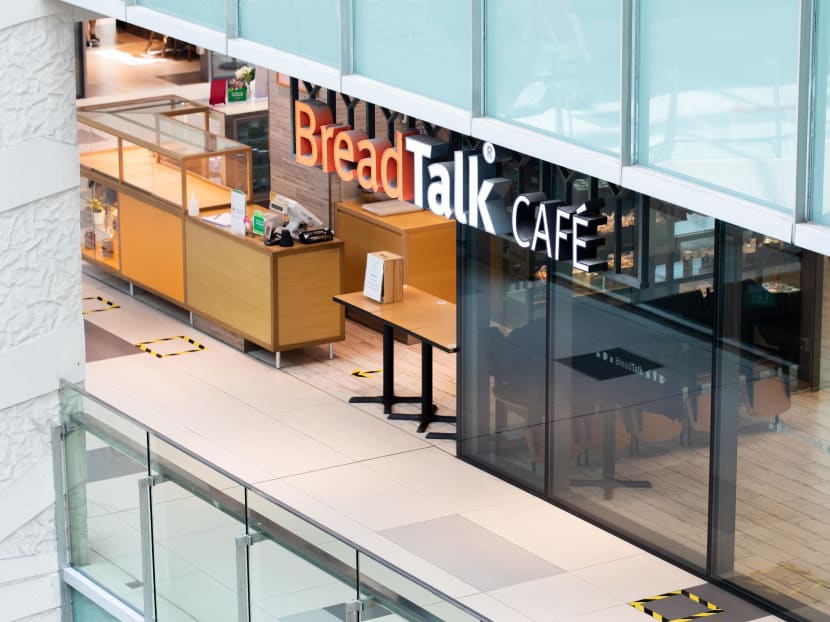

SINGAPORE — In the midst of what it called its most challenging crisis since it started operations in 2000, BreadTalk Group is placing its more than 3,800 employees in Singapore on varying degrees of no-pay leave to save jobs and keep the company afloat.
In a circular by group chairman and chief executive officer George Quek to the company’s staff members on April 17, a copy of which was seen by TODAY, he said that the company may be forced to downsize if the situation persists.
He added that daily revenues have plunged by 90 per cent in some areas since the circuit breaker measures took effect.
In response to TODAY’s queries, the company said that layoffs are not being considered for now and will only be deployed as a last resort.
HOW BUSINESS WENT SOUTH
Since the Covid-19 outbreak here in late January, followed by the Government initiating a circuit breaker in early April to June 1 to minimise business activities and restrict the movement of people to arrest the spread of the disease, BreadTalk has been pummelled by the crisis that came on the back of a global economic downturn.
Earlier in February, BreadTalk Group’s financial statements showed a net loss of $8.1 million in the last quarter of 2019 compared with a net profit of $8.9 million a year ago.
The group also reported a net loss of $5.2 million for the full year, a sharp turn from the net profit of $15.2 million a year ago.
Inside Retail Asia news site reported that same month that a small group of key Breadtalk Group stakeholders, including CEO Quek, have offered to acquire all the ordinary shares in the company and delist it in Singapore.
The group, including Dr Quek’s wife and existing shareholder Minor International, has formed a new company BTG Holding that aims to buy all the shares in BreadTalk.
Minor International is a Thailand-based food-and-beverage (F&B) and hotel operator that oversees food businesses such as The Coffee Club and Sizzler.
BTG Holding will be mostly owned by Dr Quek and related parties, with Minor International having about a quarter share.
On March 23, BreadTalk Group made a statement to the Singapore Exchange regarding wage cuts, where middle and senior management staff members across its operations in China, Hong Kong, Singapore and other Southeast Asian countries were affected.
For employees in mainland China and Hong Kong, they would have a pay cut of between 30 and 50 per cent from February to June.
Four days after the CEO’s April 17 circular to Singapore employees, the company’s offeror BTG Holding applied to delist the group from the Singapore Exchange.
WHY THE PAYCUTS AND NO-PAY LEAVE
Dr Quek said in the circular that despite the grants and the efforts to save costs and increase revenue, the challenges of the macro-environment are still crippling the group’s business.
He pointed out that salaries represent more than half of the cost of supporting its operations in Singapore.
In its reply to TODAY, the group said that 25 per cent of its outlets here are temporarily closed due to reasons such as mall closures, which has made it a challenge to manage manpower costs.
This has significantly reduced demand across BreadTalk Group’s F&B operations, which include bakeries under its name, Toast Box cafes, food-court chains Food Republic and Food Junction, Thye Moh Chan bakeries, as well as Din Tai Fung restaurants.
Around 300 employees at its headquarters are expected to take a minimum of four days of compulsory no-pay leave from April to June.
The no-pay leave arrangements will come on top of wage cuts of between 10 to 50 per cent for managerial and higher-ranking positions.
Staff members may also apply for voluntary no-pay leave.
The group said that up to 10 days of no-pay leave have been arranged for different staff members after they have cleared their annual leave, depending on the business needs of individual stakeholders within the company.
Dr Quek said in the circular that he himself had stopped taking salary since March, while management-level executives had taken a voluntary 50 per cent wage cut “in solidarity with employees”.
TODAY understands that this will continue until the circuit breaker ends, now set at June 1.
When approached, the Ministry of Manpower (MOM) said that BreadTalk Group has notified the ministry of its cost-saving measures in March and April.
MOM also said that it has received feedback and queries from the company’s employees and will be engaging the group to assess whether their cost-saving measures adhere to tripartite advisories.
WHAT IT’S DOING TO SUPPORT EMPLOYEES
BreadTalk Group told TODAY that it has kept its communication channels open to support its employees and “make special consideration” for those facing exceptional situations.
Courses for employees to upskill and cross-deployment work have been arranged, it said, adding that it is working closely with government agencies and associations to provide temporary relief for those affected.
Staff members were given their remaining bonus payout in April in recognition for their hard work last year.
WHAT EMPLOYEES SAY
Some employees are not taking it well. One from Food Junction who declined to be named said that staff members were not consulted about the no-pay leave arrangements and were given around 15 days to clear 10 days of no-pay leave in April.
“I think (there was around) two weeks for us to clear another eight days of unpaid leave. It was very difficult because our operations were still ongoing and we have around 12 outlets,” the 30-year-old said.
The Singaporean also empathised with her Malaysian colleagues, who would not qualify for any financial aid from the Government during this period.
Another Food Junction employee who also did not want to be identified said that while he understood the company’s decision to assign no-pay leave, he still felt that it was unfair.
“We are the ones who are on the ground, (it’s) very easy for us to get the virus and we get 10 days of unpaid leave and we get more pay deducted,” the 25-year-old said.
At Toast Box’s outlet in Tan Tock Seng Hospital, Mr Tew Boon Jun, 22, said that he had not been assigned any days of no-pay leave in April.
One employee at Thye Moh Chan who declined to be named said that her manager had consulted her before implementing no-pay leave arrangements at her branch.
While she had to take two days of no-pay leave in April, she knew of other colleagues who were asked to take more days.
BreadTalk Group told TODAY that it is grateful for its employees’ unity and support in helping the company pull through this challenging time and it remains optimistic.
“It is difficult to foresee when the Covid-19 pandemic will ease. Even then, we anticipate and are actively preparing for the likelihood of new consumption patterns.”
It added that it is already making recovery plans when conditions improve.
In the meantime, the group recognises that there are many vulnerable communities facing tougher situations and it will continue to extend its help wherever possible.
Related topics
Covid-19 coronavirus circuit breaker BreadTalk businessStay in the know. Anytime. Anywhere.

Subscribe to our newsletter for the top features, insights and must reads delivered straight to your inbox.
By clicking subscribe, I agree for my personal data to be used to send me TODAY newsletters, promotional offers and for research and analysis.






