
Most shared-bike users support ban, fines for errant riders: Poll
SINGAPORE — A huge majority of shared-bicycle users favour a penalty system to crack down on recalcitrant riders to get them to change their behaviour, based on a straw poll done by TODAY. Almost two-thirds of the 106 respondents said that riders should be banned from using rental bicycles from all bike-sharing companies after they have been caught parking their bikes indiscriminately for the third time.
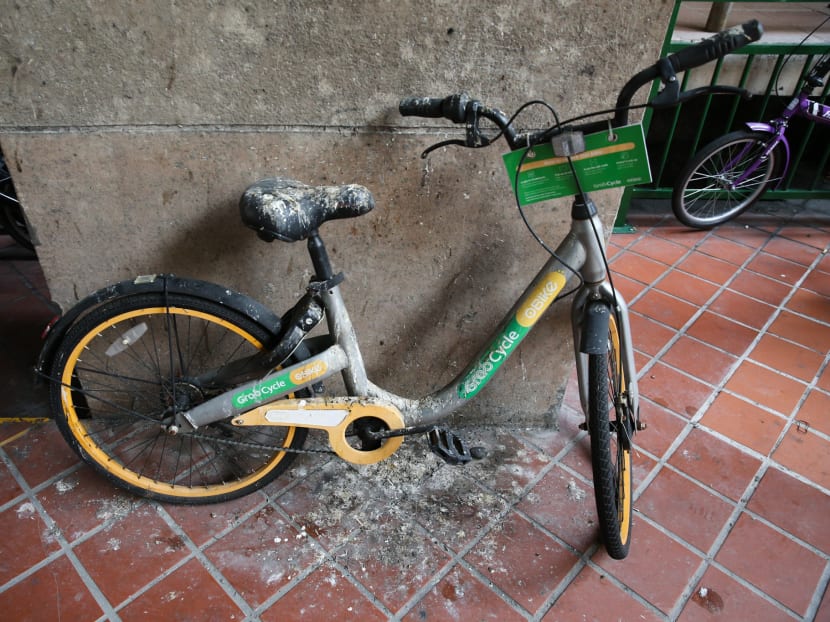
Almost two-thirds of the 106 respondents said that riders should be banned from using rental bicycles from all bike-sharing companies after they have been caught parking their bikes indiscriminately for the third time.

SINGAPORE — A huge majority of shared-bicycle users favour a penalty system to crack down on recalcitrant riders to get them to change their behaviour, based on a straw poll done by TODAY.
Almost two-thirds of the 106 respondents said that riders should be banned from using rental bicycles from all bike-sharing companies after they have been caught parking their bikes indiscriminately for the third time.
Eight out of every 10 respondents admitted that being fined and the prospect of being banned from using all bike-sharing services would compel them to park the bikes properly.
The majority of those polled (77.4 per cent) use a bike-sharing service once to twice a week, with the second largest group (16 per cent) using it three to five times a week.
The short survey aimed to find out commuters' responses towards new regulations that bike-sharing operators will have to put in place as part of licensing requirements. Under the amendments made to the Parking Places Act in Parliament in March, users caught parking shared-bikes indiscriminately three times a year will be banned from renting from all bike-sharing operators for up to a year.
Members of Parliament had proposed at the time to fine errant users to promote user-responsibility, apart from fining operators for failing to clear bicycles that are not parked properly.
About half of the shared-bicycle users who took TODAY's straw poll said that an appropriate fine should be S$20 or less.
Senior programme manager Ponnusamy Babu, 45, said that since the rental rate is 50 cents, a fine of around S$10 would suffice. He reasoned that bike-sharing services are relatively new to the population and people still need more time to adjust.
Banker Rizal Isnin, 29, also said that a fine is necessary but the amount should be higher, at S$50. "If you want to use the service, you have to be responsible enough to just park the bike properly. It's very easy to find a designated parking spot," he said.
There are cyclists, however, who do not believe in punishing users. One out of every five people polled by TODAY are of this group.
Naval officer David Oh, 25, said: "I don't think people should be fined for parking shared bicycles indiscriminately because it's not so much an offence as it is about etiquette. This isn't as serious as a car (being an obstruction)… if a bicycle blocks you, just move it aside or walk away. It wouldn't kill you."
Student Leo Swee Tze, 20, said that imposing fines may be too harsh. "There is a spot near my house that is not a legitimate parking area. However, most people will still park the bikes there in an organised manner which does not block anyone. I feel that with fines, people who try to be considerate will be needlessly punished," she said.
Mr Lance Lee, 25, who is self-employed, suggested that rewarding responsible riders may be more effective in getting them to park properly.
"I feel that fines might backfire on the (bike-sharing) company, because people might not be inclined to use their services if a fine is imposed."
His point on this, however, may not be of great concern.
More than half of those surveyed said that even if stricter rules are put out, such as imposing fines on riders for parking indiscriminately, they will not cut back on using bike-sharing services.
Full-time national serviceman Chua Yun Hui, 22, said that shared bicycles have become a necessity for him. "They're very convenient for when I need to go out and buy food… or in going back and forth to nearby places."
With a new licensing regime that mandates that operators take action against errant users and remove bikes that are not parked at designated lots, among other requirements, the authorities aim to tackle more successfully what has been a persistent problem since bike-sharing companies entered the market here at the start of last year.
The licences are expected to be awarded to operators by the fourth quarter of the year, with penalties for users still being worked out.
For those who took the TODAY poll, about 60 per cent said that in the past three months, they have not noticed the bike-sharing firms becoming stricter in requiring users to park at designated lots. ADDITIONAL REPORTING BY JUSTIN ONG GUANG-XI
FINE SYSTEMS CURRENTLY IN PLACE
As things stand, some bicycle-sharing operators already have penalties in place to deter irresponsible behaviour, albeit on a smaller scale.
SG Bike, for instance, has levied fines ranging between S$1 and S$5 since it began operations last August, depending on the seriousness of the case. For instance, users who do not park the bicycles at its geo-stations could be fined S$1. Taking its bicycles up to their Housing and Development Board flats could draw a fine of S$5.
Mr Sean Tay, its chief operating officer, said fines are meted out infrequently and the company “would rather give (errant users) a chance” if it could. The key was to make users aware of proper parking behaviour, he noted, adding that those who were fined showed an increased awareness of proper parking and requested more parking spots.
Anywheel, which has a user credit-score system, charges commuters higher fares — S$1 for every 30 minutes, instead of the usual 50 cents — if they fall below a certain threshold on a 100-point scale.
They could face a two-year ban if they fall below 40 credit points. Two users have been banned in Singapore thus far, said Anywheel chief executive Htay Aung.
Mobike has also carried out small-scale tests to mete out penalties such as deducted credit scores and fines to users, while ofo said it “remained diligent in communicating with users about how and where to end their shared-bike trips in appropriate locations”. KENNETH CHENG
Stay in the know. Anytime. Anywhere.

Subscribe to our newsletter for the top features, insights and must reads delivered straight to your inbox.
By clicking subscribe, I agree for my personal data to be used to send me TODAY newsletters, promotional offers and for research and analysis.






