
New book relives pivotal push for merger with Malaya
SINGAPORE — Amid the frequent strikes and protests of the 1960s, the governing People’s Action Party (PAP) was facing fierce opposition from the communists and their supporters, against the party’s proposal to merge with Malaya to gain full independence from the British.
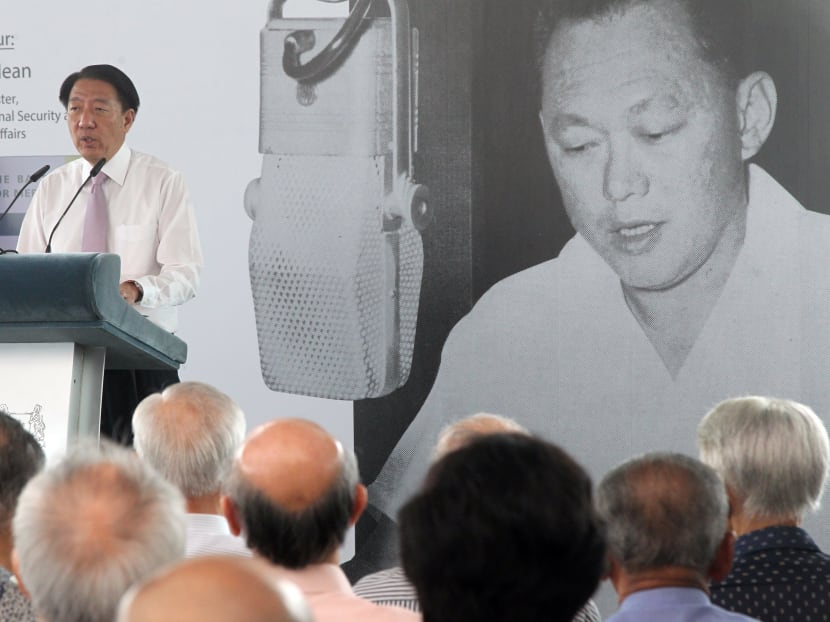
Deputy Prime Minister Teo Chee Hean gives a speech at the launch of the reprint of The Battle for Merger at The National Library on Oct 9, 2014. Photo: Ooi Boon Keong

SINGAPORE — Amid the frequent strikes and protests of the 1960s, the governing People’s Action Party (PAP) was facing fierce opposition from the communists and their supporters, against the party’s proposal to merge with Malaya to gain full independence from the British.
Deciding he needed to “expose the communists’ manoeuvrings” and persuade people that it was the PAP which would “hold the winning cards”, then-Prime Minister Lee Kuan Yew took to the airwaves with a series of 12 talks — each one delivered in English, Malay, and Mandarin — between Sep 13 and Oct 9, 1961, one year before the referendum on the merger.
This pivotal moment in Singapore’s history has been brought to the fore for a new generation with the reprint of The Battle for Merger, a compilation of Mr Lee’s talks, which was first published in 1962.
Speaking at the launch of the book yesterday, Deputy Prime Minister Teo Chee Hean said its re-publication provides a “reality check” for the revisionist views that have surfaced portraying the fight as “merely a peaceful and democratic disagreement” over the type of merger, rather than the fundamental agenda of the communists to seize power by subversion and armed revolution.
“I hope (the book) will awaken interest among younger Singaporeans in the events of this crucial period in our history, educate them into what actually happened, what the battle was about, and why it was so crucial that the right side won,” he said.
The communists were against merger because the quick end of British rule would make it harder for them to disguise their agenda to establish a communist regime as an anti-colonial struggle. They also knew a clampdown was forthcoming with the merger, as internal security would fall under the central government in Kuala Lumpur, which was anti-communist.
In a foreword written for the book, Mr Lee said there was a need at the time to make a compelling message, instead of “harrying people into merger”.
“PAP leaders saw firsthand the anti-merger agitation stirred up by the communists and their trade union proxies, following the pro-communists’ break with the PAP in July 1961,” he said. “Something had to be done to persuade the people there was a viable alternative: A non-communist, democratic socialist PAP in charge of a Singapore that was part of Malaysia.”
Radio was chosen as the delivery medium, as that was how most people got their news then. The 12 speeches were delivered over 36 broadcasts over less than a month.
“In between broadcasts, I was spent. I recovered my energy by sleeping on the studio floor in between the recordings,” said Mr Lee. If the young read the book and understand “what was at stake, why and how we stayed the course, then the reprint would have achieved something”, he said.
Mr Teo, who heard Mr Lee’s talks as a child, said they were “pivotal” during a time where the communists and non-communists in Singapore were caught in a dangerous battle.
“At the heart of this battle were two contrasting visions of how society should be ordered and how we should govern ourselves. It was not simply a fight to get rid of British colonial rule ... the communists and their allies had a larger agenda to impose a communist regime in Malaya and Singapore through all means, including subversion and ultimately, armed revolution,” said Mr Teo, who is also Coordinating Minister for National Security and Minister for Home Affairs.
Nonetheless, those who supported communism were neither crooks nor opportunists, only dedicated to their cause. “We should respect the personal conviction and determination of those who held different views then,” Mr Teo said, who also commended those who later turned away from communism, and contributed to Singapore’s nation-building.
“But we should, even more, acknowledge and give our respect and appreciation to the Singaporeans who had the courage and wisdom to reject the Communist Party of Malaya’s ideology and tactics,” said Mr Teo.
“Our pioneers’ spirit and their determination to rise above the hardships of the moment and to focus on making Singapore a better country for the next generation is an inspiration for all Singaporeans.”
In conjunction with the publication reprint, an exhibition for the Battle for Merger will be held at the National Library Building from Oct 9 to Nov 30, before moving to public libraries in Jurong, Ang Mo Kio, Woodlands and Tampines. Key exhibits include three original documents written by pro-communist left-wing politician Lim Chin Siong.
The book, which also contains notes to the key players and events in the merger and audio recordings of the talks in the three languages, is sold at major bookstores for S$32.50 and is also available at public libraries.
The talks can also be accessed at http://www.nas.gov.sg/archivesonline/public/audiovisual_records/TheBattleForMergerRadioTalks.htm
Stay in the know. Anytime. Anywhere.

Subscribe to our newsletter for the top features, insights and must reads delivered straight to your inbox.
By clicking subscribe, I agree for my personal data to be used to send me TODAY newsletters, promotional offers and for research and analysis.






