
New bus contracting model will return initiative to authorities
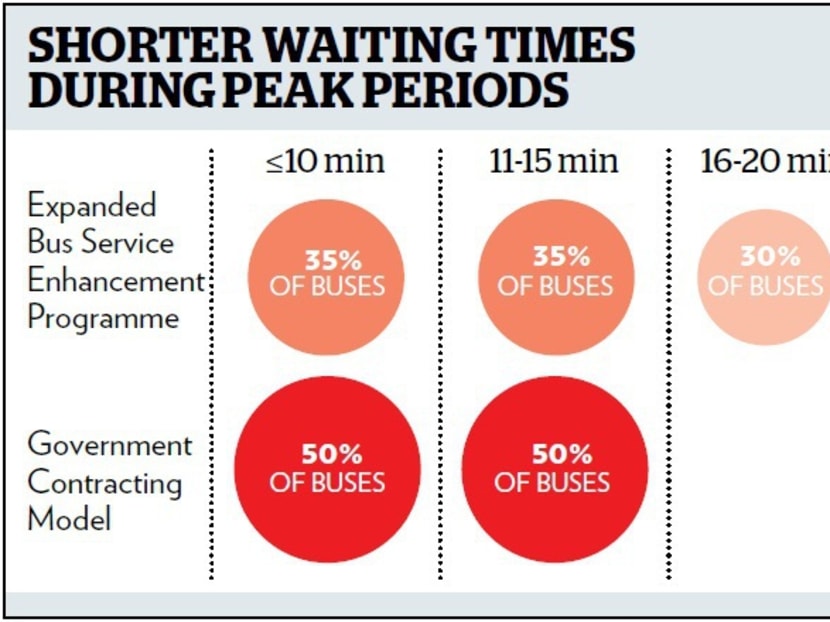
Waiting times.

SINGAPORE — With the Government calling the shots on service standards under the new bus contracting model announced yesterday, commuters can expect better services, but the knock-on effect on fares remains to be seen, said experts and Members of Parliament (MP).
To win contracts to run routes, operators are at the behest of the Government in terms of the level of reliability expected, they noted.
Dr Marcelo Ang, from the National University of Singapore’s (NUS) Department of Mechanical Engineering, explained that since the Government pays for the service it wants, “rather than giving operators free play”, services will improve.
Dr Lee Der Horng, a transport researcher from NUS, agreed, saying that with increasing travel demand and higher expectations of service, privatisation has become a handicap.
Currently, the players, whose bus operations have been making losses of late, can be slow to respond to calls for the opening of new routes if they deem the move to be a risk to their profit margin.
Dr Lee noted that the new model will hand the initiative back to the authorities.
Dr Paul Barter, an adjunct professor at the Lee Kuan Yew School of Public Policy, added that the current framework does not allow the Government to implement certain changes, such as simplifying the bus network, as companies will be taking on too much risk.
“We have a network of bus routes where ... routes converge and run along the same roads for quite some distance. It would be more efficient to have a much more streamlined network where we have less overlap between routes.”
The Government can also subsidise the cost of operations without facing criticism that it is subsidising shareholders and increase frequency of buses if it sees the need, added Dr Barter.
Dr Lily Neo, a member of the Government Parliamentary Committee (GPC) For Transport, added that there is more flexibility and the Land Transport Authority can better accommodate and deliver on residents’ requests.
MP Cedric Foo, who chairs the Transport GPC, said the new model, which allows bus operators to bid every five years or so, would generate “price discovery”.
“You will be able to tell what the marketing clearing prices to support such a (system are),” said Mr Foo. “So I think that’s much more superior in terms of government procurement process.”
MP Lim Biow Chuan, however, asked how bus fares will be affected, as a result.
How the Government decides to price fares could depend on the size of the operators’ bids, he noted.
Meanwhile, MPs from the People’s Action Party also felt the new public bus transport model goes in the opposite direction of nationalisation.
A debate on nationalising public transport was brought to a head in 2011 when Non-Constituency MP Gerald Giam of the Workers’ Party called for a government-owned non-profit National Transport Corp to run rail and bus services.
Transport Minister Lui Tuck Yew shot down the idea, saying it may lead to higher fares and a heftier burden on taxpayers.
Yesterday, Mr Foo reiterated that the new model will invite competition from the private sector for each of the package of routes that will be put up for tender.
This is better than nationalisation, where “there isn’t competition, so it doesn’t drive efficiency”, he said.
Mr Giam could not be reached for comment.
Dr Park Byung Joon, head of the urban transport management programme at SIM University, noted that although the new model will lead to more public money being invested in the public transport system, there will be better accountability than in the current system.
In the past, if the Government invested more money in the system, it was transferred simply to the individual companies, he said.
“We had no control over how that money was spent,” he said.
Stay in the know. Anytime. Anywhere.

Subscribe to our newsletter for the top features, insights and must reads delivered straight to your inbox.
By clicking subscribe, I agree for my personal data to be used to send me TODAY newsletters, promotional offers and for research and analysis.






