
New IPPT format to have fewer stations
SINGAPORE — Changes to the annual Individual Physical Proficiency Test (IPPT) for national servicemen could be announced within the next few months, with the Singapore Armed Forces (SAF) finalising plans to make the assessment simpler, including reducing the number of stations.
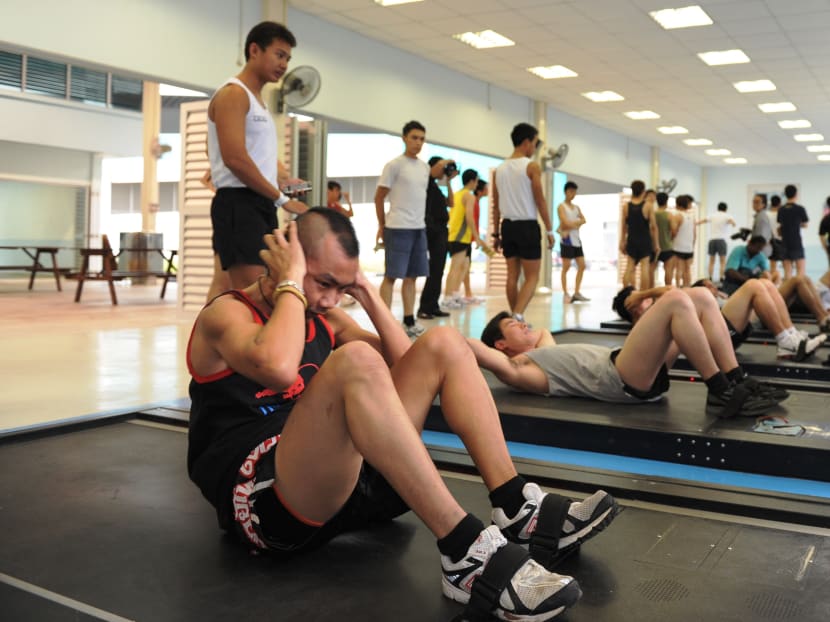
Operationally Ready National Servicemen taking the Individual Physical Proficiency Test. Photo: MINDEF


SINGAPORE — Changes to the annual Individual Physical Proficiency Test (IPPT) for national servicemen could be announced within the next few months, with the Singapore Armed Forces (SAF) finalising plans to make the assessment simpler, including reducing the number of stations.
To ease the transition and give national servicemen time to adjust, they will have the option of taking the new IPPT or the old one.
Speaking to the media last week ahead of SAF Day today, Defence Minister Ng Eng Hen noted that the Republic’s armed forces is among the few militaries that assess the physical fitness of soldiers via five stations. “Others use three, some more, but a majority among the militaries actually use simpler tests because it’s simpler to administer and simpler to train for.”
He added: “We are looking for a simpler format so that more NSmen can train in their own environment with types of exercises which are just simpler to do and also, more importantly, meet our goal of using the IPPT to incentivise, to encourage, to remind NSmen to be fit.”
Dr Ng stressed that IPPT is “not a be-all and end-all of fitness”. “It is a measure of fitness. So if we treat it that way, can there be simpler tests?” he said. Under the changes, there may also be “a bigger range in terms of what it means to be fit”, he added without elaborating.
However, the tweaks would not mean the IPPT will be easier to pass, Dr Ng said. The gold standards for the annual test will also not change.
“We want a fit SAF, we want fit NSmen. I mean that’s something which we must have so that we can have a fit military,” he said. “But I think in keeping with the national psyche and psyche of a younger generation, we also want to move away from it being seen as an imposition or a test to something which is a lifestyle.”
The IPPT, which was launched in 1979, is taken by some 116,000 SAF personnel annually. The test format, unchanged since 1982, requires servicemen to go through the five stations of sit-ups, standing broad jumps, pull-ups, a 4 x 10m shuttle run and a 2.4km run.
The United States Army’s physical fitness test, for example, consists of three stations — push-ups, sit-ups and a 3.2km run. In Israel, soldiers are assessed based on sit-ups, push-ups and a 2km run, while the Australian army tests pre-enlistees on push-ups, sit-ups and the shuttle run.
The imminent changes to the IPPT come after the Government accepted the Committee to Strengthen National Service’s recommendation to increase the time frame for NSmen to complete their 10 IPPT Preparatory Training sessions from nine months to 12 months.
Those who fail the IPPT can also spread out their 20 sessions of remedial training over a longer period. “Giving you more time won’t make you fitter if you don’t put in the effort. There must be an effort,” Dr Ng said.
NSmen TODAY spoke to welcomed the impending changes. Several said they hoped the standing broad jump station will be scrapped, arguing that it has all to do with technique rather than fitness.
Administrative officer Liang Xianghong, 33, who has been struggling to pass the station for the past five years, said he has observed that many others are able to pass all stations except the standing broad jump. “It is not because they are not fit. Maybe their technique is not good, or maybe they are not flexible enough,” he said.
Accounting executive Tan Chee Wei, 26, has no problem passing the standing broad jump but he also felt it should be dropped. Being able to run is more important for a soldier, compared with being able to jump, he said.
Nee Soon GRC Member of Parliament Lim Wee Kiak, who sits on the Government Parliamentary Committee for Defence and Foreign Affairs, lauded the move to make IPPT simpler.
He felt the 2.4km run is “a hurdle” for many NSmen trying to pass the IPPT, despite more Singaporeans taking up long-distance running to stay fit. “Maybe (SAF) can make the distance a bit longer, but relax the timing (requirements),” said Dr Lim.
Stay in the know. Anytime. Anywhere.

Subscribe to our newsletter for the top features, insights and must reads delivered straight to your inbox.
By clicking subscribe, I agree for my personal data to be used to send me TODAY newsletters, promotional offers and for research and analysis.






