
New system allows SAF field troops, HQ to exchange videos, photos securely
SINGAPORE — Soldiers from the Singapore Armed Forces (SAF) will be able to act more decisively against potential targets, thanks to a new vehicular mounted system that allows photos, videos, files and text messages to be transmitted between troops in the field and their commanders in the headquarters.
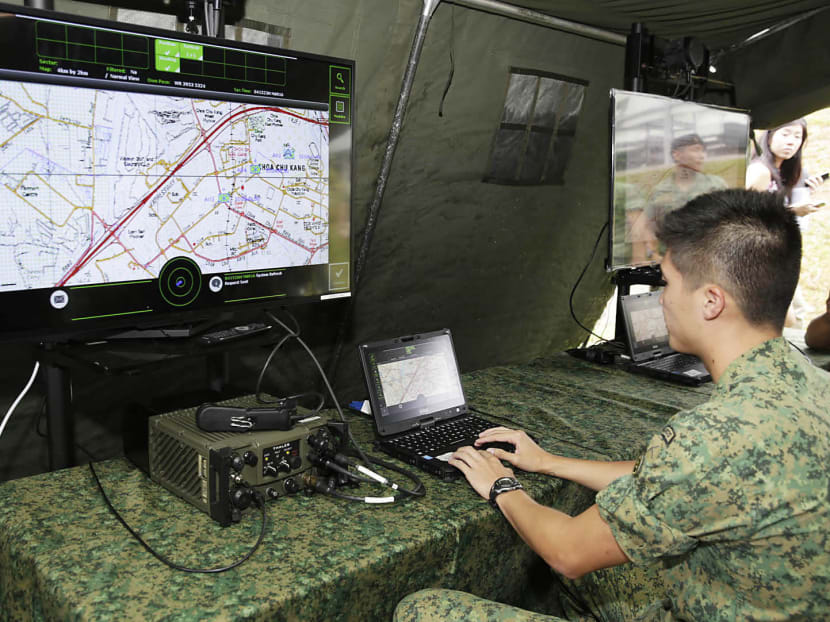
The Software Defined Radio vehicular mounted system gives headquarters greater situational awareness of the battlefield and improves the military’s command and control. Photo: Wee Teck Hian

SINGAPORE — Soldiers from the Singapore Armed Forces (SAF) will be able to act more decisively against potential targets, thanks to a new vehicular mounted system that allows photos, videos, files and text messages to be transmitted between troops in the field and their commanders in the headquarters.
Soldiers have been able to send data from one military headquarters to another since 2013, through the Army Battlefield Internet (ABI) network. But communications between field troops and headquarters have been limited to voice, until now.
By enhancing the ABI network with what the SAF calls the Software Defined Radio (SDR) vehicular mounted system, field troops and their headquarters can now exchange photos and videos securely, providing headquarters with increased situational awareness of the battlefield and improving the military’s command and control.
In addition, voice and data transmissions have now been merged into one unified radio, saving time and allowing decisions to be made much more quickly.
The SDR system was officially commissioned on Friday (March 4) as part of the Signal Formation’s 50th anniversary parade at the Stagmont Camp. The Signal Formation is responsible for providing communications and local networking on the battlefield.
Commenting on the system, Captain Prathap Latchmanan, officer commanding of the motorisation support company, said explaining the situation verbally can take more time, all while a battle is going on.
“Information on the battle will become irrelevant very quickly,” he said.
He also explained that the old system required him to switch between two radios.
“So when you eliminate (switching), it makes it quicker, less cumbersome, easier and faster,” he added.
The SDR system was created from a commercial off-the-shelf solution that the Army and the Defence Science and Technology Agency customised to meet SAF’s operational requirements.
As for the time taken to transmit photographs and videos, the Ministry of Defence said it would depend on factors like the resolution of the media and the duration of a video, as well as signal strength.
Active units in the armour, artillery, and engineer formations can expect to be equipped with the SDR this year, while the Signal Formation will roll out the new system progressively to other units over the next few years.
Speaking at the event, Minister for Defence Dr Ng Eng Hen said: “With the SDR, the tracking of our own forces and the marking of enemy targets and positions will be embedded within the images and videos. Our soldiers will therefore see more accurately, sooner, and target with greater precision.”
Stay in the know. Anytime. Anywhere.

Subscribe to our newsletter for the top features, insights and must reads delivered straight to your inbox.
By clicking subscribe, I agree for my personal data to be used to send me TODAY newsletters, promotional offers and for research and analysis.