
New temporary public order law for Little India passed
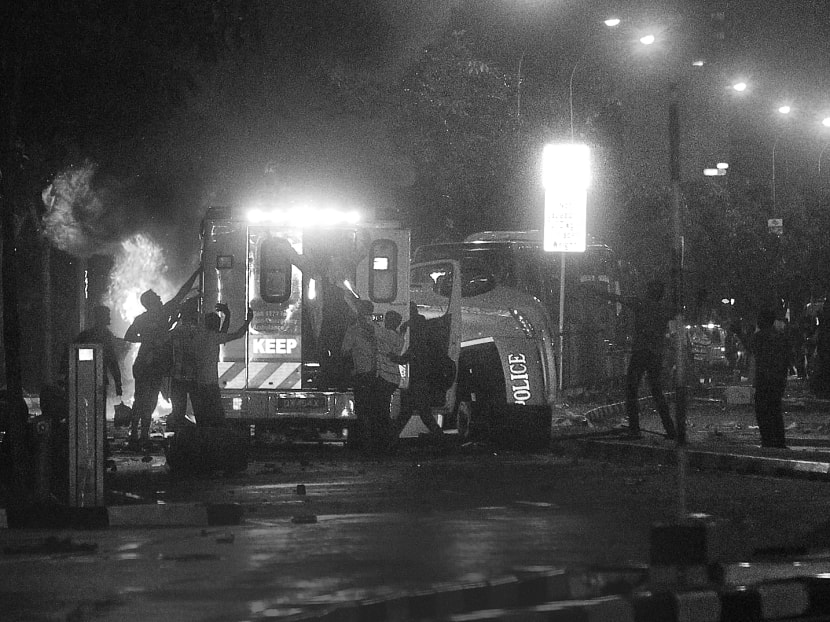
SINGAPORE — The laws governing a designated zone around Little India, passed yesterday after an impassioned four-hour debate, are far more limited than the existing ones invoked for the area since a riot broke out two months ago, said Second Home Affairs Minister S Iswaran in Parliament yesterday.
TODAY FILE PHOTO

SINGAPORE — The laws governing a designated zone around Little India, passed yesterday after an impassioned four-hour debate, are far more limited than the existing ones invoked for the area since a riot broke out two months ago, said Second Home Affairs Minister S Iswaran in Parliament yesterday.
In the face of concerns that it was a hurried, knee-jerk piece of legislation, Mr Iswaran stressed that this was hardly the case. The Public Order (Additional Temporary Measures) Bill is a case of a targeted and necessary response to a clear and present need on the ground, he said.
Police powers applied in Little India after the Dec 8 riot, sparked by a fatal accident involving Indian worker Sakthivel Kumaravelu, were largely derived from the Public Order (Preservation) Act (POPA), which was conceived for graver situations, such as a State of Emergency. It has required the Home Affairs Minister to proclaim a state of danger to public order in the area every weekend and public holiday since the riot and comes with broad powers such as to implement curfews, take control of property and the authorisation of lethal force to overcome resistance during arrest.
The new laws specific to Little India, which will apply for up to a year, provide focused powers to support security, traffic management and alcohol restriction measures in the area, said Mr Iswaran.
Bookended by Mr Iswaran’s opening and closing speeches, 16 Members of Parliament (MPs) rose to speak.
Six expressly opposed the Bill, among them Aljunied GRC MP Sylvia Lim and Nominated MP Eugene Tan, with some calling it a disproportionate response to the riot and a premature move that should come only after the Committee of Inquiry (COI) looking into the riot convened.
On why the law was proposed before the COI made their recommendations, Law Minister K Shanmugam told reporters after meeting Little India shopowners last night that the Government had a clear duty from Dec 8 to do everything necessary to make sure the risk of another incident is reduced.
The new laws are the Government’s assessment of what is necessary, he said, adding that it would be utterly irresponsible for any government to do nothing until the COI presented its findings.
Five MPs, including Dr Lam Pin Min (Sengkang West) and Ms Ellen Lee (Sembawang GRC), expressly supported the Bill, while the others did not make their stand explicit.
Those who supported the Bill said the significance of the riot should not be underestimated.
“If the incident has identified gaps in our legislative framework to prevent and deal with such threats, then it would be wrong and irresponsible of us not to act now,” said Bishan-Toa Payoh GRC MP Hri Kumar Nair, who added that it is important to deploy experienced police officers in the area.
Moulmein-Kallang GRC MP Denise Phua said residents of Little India, whose quality of life has been compromised as the area became more popular with migrant workers and tourists, have the right to a secure and peaceful living environment.
Mr Iswaran also addressed a clause in the Bill that allows the police and auxiliary police officers to strip-search a person in, or about to enter, Little India. He said the provision is adapted from the Public Order Act, which upholds law and order during events such as the National Day Parade, and that the police have established protocols to ensure the checks are conducted “purposefully, responsibly and professionally”.
In a statement issued after the debate, Commissioner of Police Ng Joo Hee said the police do not have unfettered discretion to perform intrusive checks. “Our police officers on the ground have demonstrated that they have carried out their duty in a reasonable manner and will continue to do so,” he added.
As for calls to continue law enforcement in Little India under existing legislation, Mr Iswaran said: “If you are prepared to accord the authorities the powers under the Public Order (Preservation) Act, then why are you reluctant to accord the powers ... as reflected in the Bill?”
He reiterated that the riot was Singapore’s worst instance of public disorder in more than 40 years.
“It might seem distant, even remote, in the calm of this Chamber. But it remains a stark reality for the residents and stakeholders in Little India, our officers who were involved in the incident and who continue their duties there and, indeed, for many Singaporeans and foreign workers,” he said.
It would be disastrous if such an incident recurred there, he said.
“By providing a safer law-and-order environment, the measures we have taken, in fact, serve to preserve and enhance the colour and vibrancy of Little India.”
Related topics
riotStay in the know. Anytime. Anywhere.

Subscribe to our newsletter for the top features, insights and must reads delivered straight to your inbox.
By clicking subscribe, I agree for my personal data to be used to send me TODAY newsletters, promotional offers and for research and analysis.






