
Ngiam Tong Dow helped S'pore become a business hub, contributions have enduring impact today: PM Lee, President Halimah
SINGAPORE — The Mass Rapid Transit (MRT) system, the Build-to-Order public housing scheme, the “go-getting culture” of the Economic Development Board (EDB) and DBS bank going regional. Ngiam Tong Dow had a hand in shaping and transforming these projects and agencies during his more than 40 years as a civil servant during Singapore’s nation-building years.
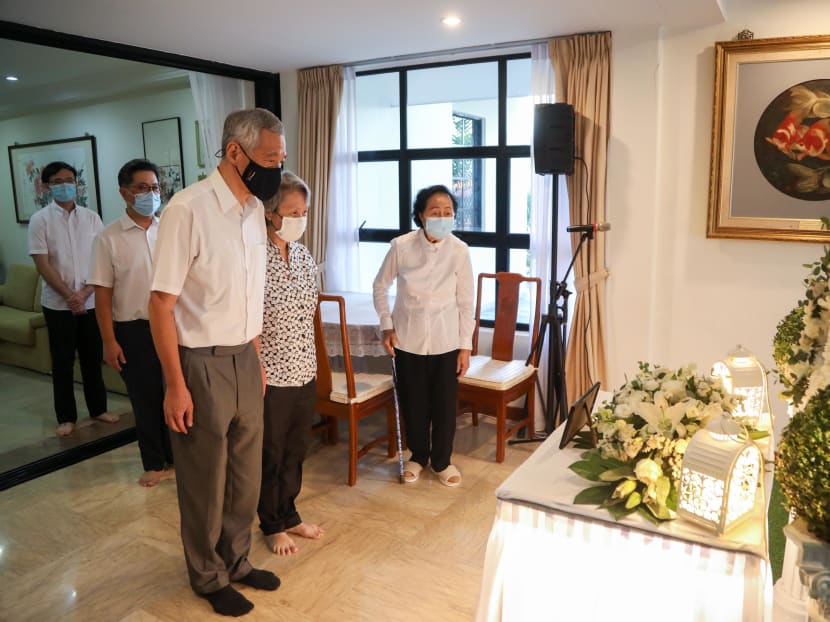
Prime Minister Lee Hsien Loong and his wife Ho Ching paying their respects at the wake of Ngiam Tong Dow on Aug 21, 2020.



- Ngiam Tong Dow left an indelible mark on Singapore for generations to come, Prime Minister Lee Hsien Loong said
- Mr Lee highlighted Ngiam’s work in EDB, HDB and DBS as examples of his lasting contributions to the country
- President Halimah Yacob said that Ngiam had “selfless devotion” to Singapore and believed in the contestation of ideas within the public service
SINGAPORE — The Mass Rapid Transit (MRT) system, the Build-to-Order public housing scheme, the “go-getting culture” of the Economic Development Board (EDB) and DBS bank going regional. Ngiam Tong Dow had a hand in shaping and transforming these projects and agencies during his more than 40 years as a civil servant during Singapore’s nation-building years.
Ngiam, 83, died on Thursday (Aug 20) and Prime Minister Lee Hsien Loong wrote a condolence letter to his wife Jeanette Ngiam on Friday, lauding him as a “versatile and outstanding” civil servant who has left a lasting legacy for generations of Singaporeans to come — both as a civil servant from Singapore’s founding generation and in the private sector later in life.
“(He) helped set Singapore on the path of industrialisation, working tirelessly to woo investors, move Singapore up the value chain and secure its place as a regional business hub,” he said.
One example of his influence today is in EDB, where Ngiam started his career in 1959, the same year that Singapore attained self-governance. He would later become chairman of the investment promotion agency from 1975 to 1981.
“He fostered a go-getting culture in EDB officers that persists even today,” Mr Lee said.
The civil servant had also “served with distinction” in other government agencies and ministries, including the Ministry of Finance, the Ministry of Trade and Industry (MTI), the then Ministry of Communications and the Ministry of National Development.
Recounting his own early years in politics, Mr Lee said that he had benefited from Ngiam’s experience.
Mr Lee was first elected in the 1984 General Election, and became a Minister of State for Trade and Industry the same year, where Ngiam was serving as the MTI’s permanent secretary.
Ngiam also served on a 1985 economic committee chaired by Mr Lee to recommend measures to help Singapore recover from its first economic recession since the country’s independence, Mr Lee recalled, saying that Ngiam’s inputs had “made a major difference” to the committee’s report.
“As a young officeholder, I benefited greatly from his considerable experience and sage advice… After I took over as the Minister for Trade and Industry, he worked closely with me to implement the recommendations and help our companies regain their competitiveness and recover.”
After Ngiam retired from public service in 1999, he continued to serve as the chairman of the Central Provident Fund Board and the Housing and Development Board (HDB).
Mr Lee noted: “Many of the schemes he introduced while at HDB, including the Build-to-Order system and the Lift Upgrading Programme, have stood the test of time and are still continuing today.”
Ngiam also joined the boards of the Singapore Press Holdings, Singapore Airlines, the United Overseas Bank as well as DBS bank.
Mr Lee highlighted how DBS “grew rapidly” in Ngiam’s eight years as the bank’s chairman, allowing it to sharpen its focus, spread its wings into the region and also expand its revenue streams.
“His ethos of discipline and prudence continues to define the bank today.”
Mr Lee also remembered Ngiam as one who “stood out among his peers for his intellect and empathy, and his willingness to speak his mind”.
“His legacy will live on, and his contributions will touch the lives of many generations of Singaporeans to come.”
In a separate letter on Friday, President Halimah Yacob said that Ngiam’s contributions continue to have an enduring impact on Singaporeans today, noting his key role in operationalising the MRT system when he was the permanent secretary at the Ministry of Communications, as it was known at the time.
She added that Ngiam would often speak passionately on public service issues, because he believed in the contestation of ideas within the public service. Ngiam was known to be an outspoken critic of the ruling People’s Action Party and the Government even after his retirement.
Madam Halimah said: “Singapore is deeply grateful to Mr Ngiam for his selfless devotion to our country and people. Mr Ngiam was a shining example of a gentleman who led by example and served his nation to the best of his abilities.”
Related topics
Ngiam Tong Dow Lee Hsien Loong Halimah Yacob civil servant deathStay in the know. Anytime. Anywhere.

Subscribe to our newsletter for the top features, insights and must reads delivered straight to your inbox.
By clicking subscribe, I agree for my personal data to be used to send me TODAY newsletters, promotional offers and for research and analysis.