
No risk of running short of food from short-term disruptions, but climate change poses a greater challenge: Masagos
SINGAPORE — There is no risk of Singapore running short of essential food supplies from short-term disruptions, but climate change will "seriously challenge" the Republic’s food supply strategy, said Minister for the Environment and Water Resources Masagos Zulkifli on Monday (Feb 10).
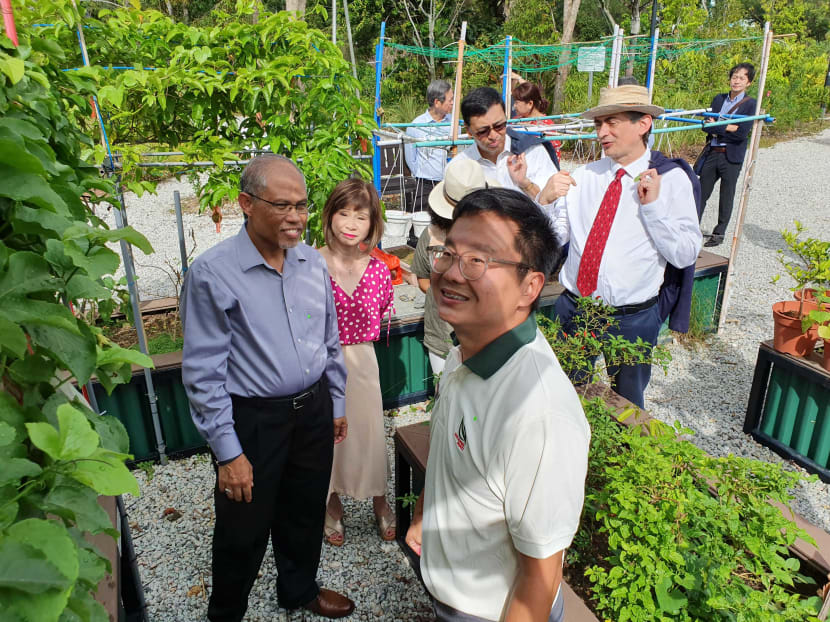
Minister for the Environment and Water Resources Masagos Zulkifli and Senior Minister of State Amy Khor touring community plant beds that grow local produce in Jurong Lake Gardens.



SINGAPORE — There is no risk of Singapore running short of essential food supplies from short-term disruptions, but climate change will "seriously challenge" the Republic’s food supply strategy, said Minister for the Environment and Water Resources Masagos Zulkifli on Monday (Feb 10).
His comments came after a weekend that saw some Singaporeans emptying out supermarket shelves of groceries as the risk assessment on the novel coronavirus was raised to Dorscon Orange.
But while its heavy reliance on food from other countries — more than 90 per cent of food is imported — makes Singapore vulnerable to short-term disruptions, the country has managed to be resilient due to astute planning by its food agencies and its well-connected transport network, Mr Masagos said.
"That is why when some Singaporeans started buying up food last Friday and photos of empty supermarket shelves were circulated, we were able to say with full confidence that there is enough food for everyone," he said at the launch of the 2020 Singapore Food Story at Jurong Lake Gardens.
“There is no risk of us running short of essential food and household items, even items like toilet paper and tissue paper.”
However, Singapore’s food security faces a greater risk posed by climate change and global population growth, he said.
To contribute more to food security, consumers have to do their part to support local produce, he said.
To this end, a new label to help people identify local produce was launched on Monday and will be rolled out in August. Around 70 per cent of 2,200 online votes picked the winning design — a red “SG” seal encircled with the words “choose fresh local produce”.
“Local produce is grown close and at home — it is therefore safer, fresher and lasts longer,” said Mr Masagos.
Besides reducing spoilage and food waste, there is also a lower carbon footprint for food from local farms to reach households in Singapore, he added, noting that some farms are literally at their doorstep such as the Citiponic rooftop vegetable farm in an Ang Mo Kio multi-storey car park.
Said Mr Masagos: “Please look out for (the label), and support local produce when you shop. As we nourish our loved ones, we also help to strengthen Singapore’s future.”
The Singapore Food Agency (SFA), which had worked with farmers, retailers and industry associations to create the logo, will continue collaborating with supermarkets to organise joint promotions and display in-store branding material with key messages to promote awareness of local produce, he added.
The move is part of Singapore’s food security strategy — the 2020 Singapore Food Story, which targets to meet 30 per cent of Singapore’s nutritional needs by 2030 using less than 1 per cent of Singapore’s land area.
He said of this “30 by 30” vision: “This is also the most critical piece, much like enabling Newater was a critical step in our pursuit of a resilient supply of water.”
More plans to achieve this will be announced in the coming debate on his ministry’s budget next month.
Mr Bjorn Low, co-founder of urban farming social enterprise Edible Garden City, said the labelling of Singapore-made produce is a step towards educating the general public about the value of local produce, such as the ability to put freshly harvested products into the market by the next day.
“Studies by our universities have also shown how there are more phytonutrients in local produce so there is a real benefit to buying locally grown vegetables that not many know,” said Mr Low.
“But there will always be challenges in this space and as we practise the free market economy, overseas agriculture sources like Thailand will always be cheaper. It will be hard to tell the aunty buying groceries at the market to buy local when you have all this competition.”
Related topics
food security Masagos Zulkifli climate change coronavirus Wuhan virus panic buyingStay in the know. Anytime. Anywhere.

Subscribe to our newsletter for the top features, insights and must reads delivered straight to your inbox.
By clicking subscribe, I agree for my personal data to be used to send me TODAY newsletters, promotional offers and for research and analysis.






