
Old Guard minister Jek Yeun Thong dies at 88; ‘a deep loss to the nation’, says PM Lee
SINGAPORE — Mr Jek Yeun Thong, who was among the last surviving Old Guard ministers, died at the age of 88 on Sunday (June 3).
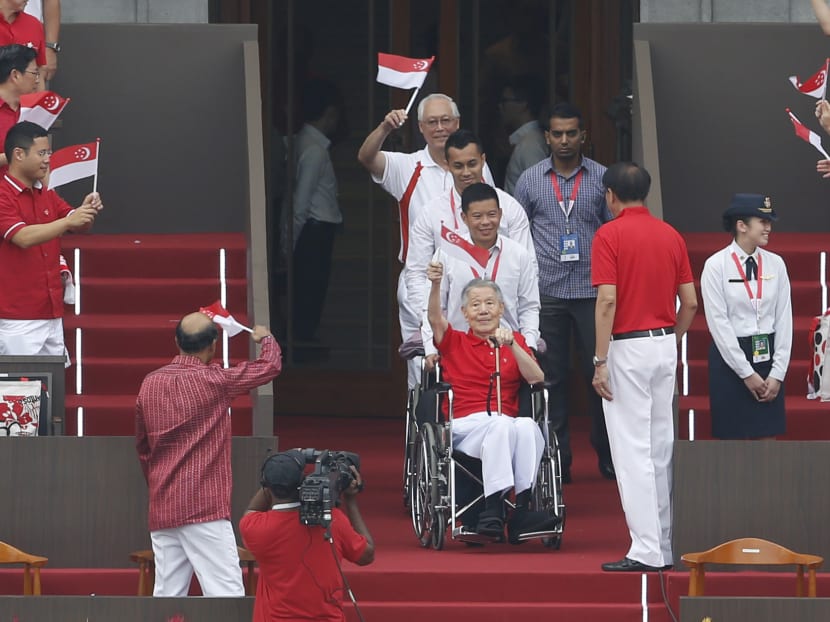
Mr Jek Yeun Thong was last seen in the public eye at the National Day Parade in 2015.

SINGAPORE — Mr Jek Yeun Thong, who was among the last surviving Old Guard ministers, died at the age of 88 on Sunday (June 3).
A private wake and funeral was held on Tuesday by Mr Jek’s family in accordance to his wishes.
In a statement issued by the Prime Minister’s Office (PMO) on Wednesday, the Government extended its deep condolences to the late Mr Jek’s family.
The statement said that Mr Jek “passed away peacefully at home”.
As a mark of respect, and in recognition of Mr Jek’s contributions to the nation, the Government has ordered the State Flag on all Government buildings to be flown at half-mast on Thursday, PMO added.
Prime Minister Lee Hsien Loong called Mr Jek’s death a “deep loss to the nation”.
As one of the first generation leaders of the People’s Action Party (PAP), Mr Jek was among the 10 leaders from the ruling party who signed the Independence of Singapore Agreement in 1965.
In a condolence letter to Mr Jek’s wife, PM Lee said he was a “key member of the PAP Old Guard”.
“Throughout his years in public service, Mr Jek made notable contributions, and demonstrated a strong sense of dedication to the nation,” added PM Lee.
Mr Jek was last seen in the public eye at the National Day Parade (NDP) in 2015. Along with the late Othman Wok — who died in April last year — and Mr Ong Pang Boon, Mr Jek was honoured at the parade for his contributions to the country. Mr Ong, 89, is now the sole surviving member of the group which signed the independence agreement.
Over his 27-year career in politics, Mr Jek helmed the ministerial portfolios of labour, culture, science and technology. He was also the High Commissioner to the United Kingdom and Ambassador to Denmark. In 1990, he was conferred the Order of Nila Utama (2nd class) to recognise his political, economic, diplomatic and social contributions to Singapore.
Born in 1930, Mr Jek was a former student union leader at Chinese High School. In 1954, he joined Chinese newspaper Sin Pao as a reporter, and became a founding member of the PAP in the same year.
When Singapore’s founding Prime Minister Lee Kuan Yew first stood for elections in Tanjong Pagar in 1955, Mr Jek helped draft his Chinese speech.
In his memoirs, Mr Lee recalled how Mr Jek “spent several hours coaching me to read a speech that took only three minutes to deliver”.
In August 1957, Mr Jek was detained under the Preservation of Public Security Ordinance by the Lim Yew Hock government for attempted sedition. He was released eight months later, and subsequently became the secretary to Mayor Ong Eng Guan in January 1959.
However, he soon resigned and joined the PAP, helping the party in its general election campaign.
After winning the election, the PAP formed the government and Mr Jek was appointed political secretary to Mr Lee, who became the Prime Minister.
In his condolence letter, PM Lee said one of Mr Jek’s biggest contributions was during the 1961 split in the PAP, where he stood firmly with the party’s non-Communist leaders, and “mobilised the Chinese speaking ground to support the PAP’s vision of a non-Communist, multiracial Singapore”.
In the 1963 elections, Mr Jek was elected Member of Parliament (MP) for Queenstown, and subsequently appointed the Minister for Labour, where he was tasked with reforming the Communist-led trade unions.
He also helped draft and win support for the 1968 Employment Act, which was a key milestone in building harmonious labour relations here as it allowed the nation to attract investments and industrialise rapidly in the 1970s.
Among the various portfolios which Mr Jek held during his stint as Cabinet Minister, PM Lee singled out his tenure as Minister for Culture (from 1968 to 1979).
Mr Jek raised the profile of cultural activities here, and he “believed that art transcended barriers of race, language and culture, and that traditional art could help keep Singaporeans grounded” when Singapore was quickly modernising, said PM Lee.
Mr Jek, who was also at one point the deputy chairman of the People’s Association, also endorsed and supported the organising of photography contests, art exhibitions, and calligraphy contests.
From 1976 to 1980, Mr Jek was appointed Minister for Science and Technology, a position he held concurrently with his culture portfolio.
PM Lee said he was “particularly happy” that Mr Jek was able to attend the PAP’s 60th anniversary celebration in November 2014, as well as the 2015 NDP.
Recalling his interactions with Mr Jek, PM Lee said: “When I first entered politics in 1984, Mr Jek was still a Member of Parliament for Queenstown constituency. He was friendly and generous to us young MPs, a whole generation younger than him.”
He added: “After he retired as an MP in 1988, he continued to stay in touch with his old comrades, and I was always happy to see him at reunions and gatherings.”
Stay in the know. Anytime. Anywhere.

Subscribe to our newsletter for the top features, insights and must reads delivered straight to your inbox.
By clicking subscribe, I agree for my personal data to be used to send me TODAY newsletters, promotional offers and for research and analysis.






