
Only 4 in 10 S'poreans believe climate change poses 'serious threat' to country, continuing 'worrying' trend: Survey
SINGAPORE — Singaporeans' lukewarm attitude to the urgent threat of climate change has persisted for the second year running, an annual survey has found, reflecting a "worrying" trend shared by many countries in Southeast Asia grappling with inflation.

People in Singapore walking in the rain (left) and in the heat (right).

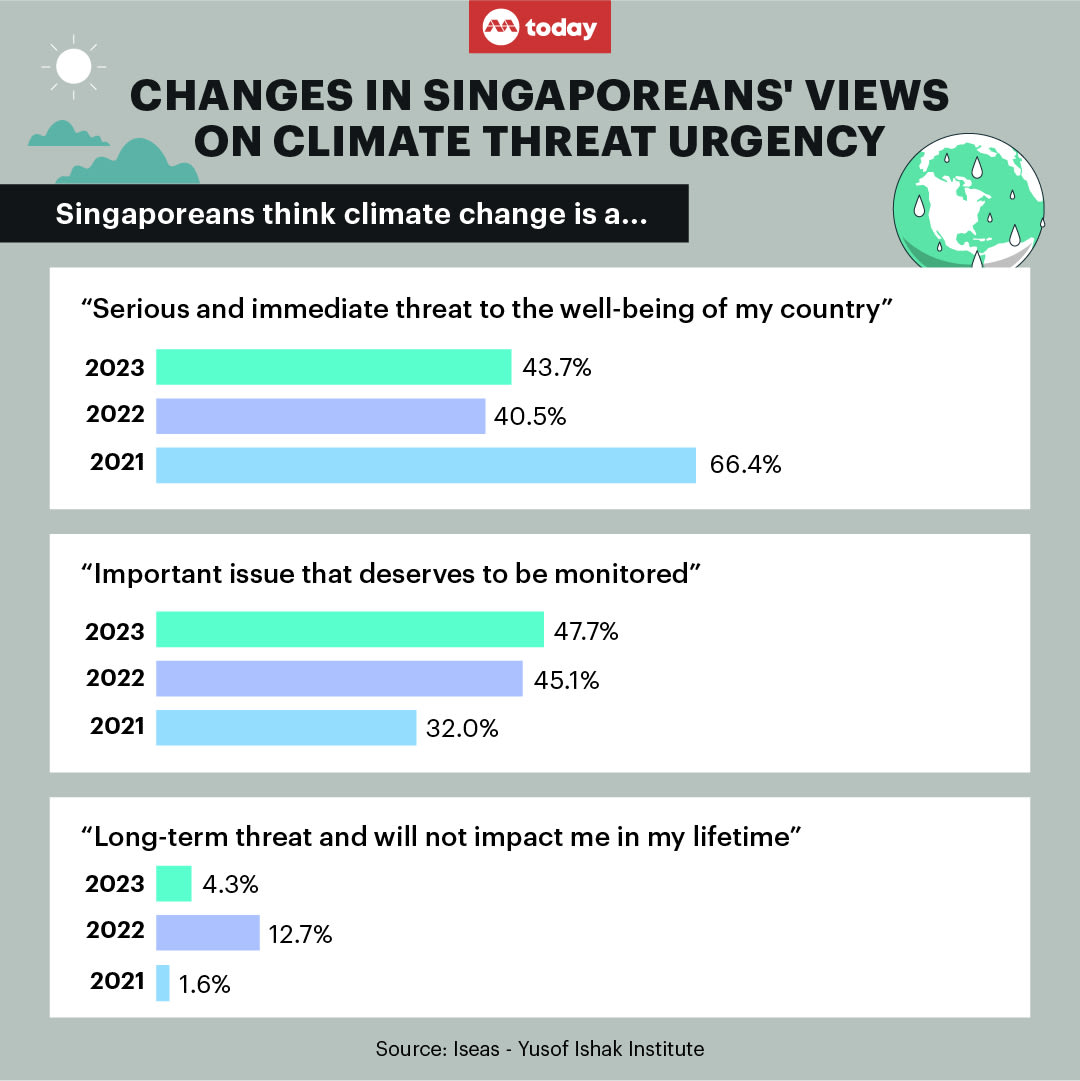
- An annual survey has found that just 43.7 per cent of Singaporeans believe climate change "is a serious and immediate threat" to the well-being of the country
- This is a slight increase over the 40.5 per cent in last year's Southeast Asia Climate Outlook Survey Report, but still significantly lower than the 66.4 per cent in 2021
- This fall in climate change urgency since 2021 came despite recent high-profile adverse weather events globally
- Data collected from respondents of other Southeast Asian countries reflected a similar trend that researchers said is "worrying"


SINGAPORE — Singaporeans' lukewarm attitude to the urgent threat of climate change has persisted for the second year running, an annual survey has found, reflecting a "worrying" trend shared by many countries in Southeast Asia grappling with inflation.
The Southeast Asia Climate Outlook Survey Report 2023, published on Thursday (Sept 21) by the Iseas-Yusof Ishak Institute, showed that the proportion of Singaporeans who believe climate change "is a serious and immediate threat" to the well-being of the country stood at 43.7 per cent this year.
Past editions of the report showed that this figure dropped substantially from 66.4 per cent in 2021 to 40.5 per cent in 2022, before rising slightly this year.
Data collected from respondents of other Southeast Asian countries largely reflected a similar trend — the average for the Association of Southeast Asian Nations (Asean) dropped from 68.8 per cent to 46.6 per cent from 2021 to 2022, before a seeing slight increase to 49.4 per cent this year.
Iseas' researchers said in this year's report that the dip in climate threat urgency, compared to 2021, might be tied to the region’s economic concerns such as rising inflationary pressures, job losses and increasing energy and food prices.
The researchers noted that a larger proportion of Singaporeans (47.7 per cent) did respond that climate change is an "important issue that deserves to be monitored". However, this pointed to a belief that the issue of climate change is "not critical yet" and is "not a top-of-mind issue", they added.
The annual survey, which started in 2020 and is in its fourth edition, was done online over a period of four weeks from July to August this year, and tapped a total of 2,225 respondents from 10 member states of Asean.
Its respondents comprised people from various walks of life including those from academia, businesses, civil society, governments, regional organisations and students.
WHY IT MATTERS
This fall in climate change urgency came despite recent high-profile adverse weather events globally. For instance, this past June to August has been the hottest three-month period ever recorded on planet Earth.
Southeast Asia is also expected to enter an El Nino season — where warmer weather, heatwaves and drought will exacerbate forest fires and haze pollution across Indonesia, Malaysia and Singapore.
The report made reference to Vietnam and Laos, which recorded their highest ever temperatures in May, as well as Thailand in April, when mercury levels exceeded 44°C.
“As the climate crisis grows more serious, the only certainty the region has is that these temperature records will continue to reach new highs,” the report said.
“It is hardly a future the region is prepared for,” it added.
Here are some key insights from the study pertaining to Singaporeans and their views on climate change:
1. FEWER BELIEVE GOVT ALLOCATES ENOUGH RESOURCES TO ADDRESS CLIMATE CHANGE
- The vast majority of Singaporeans (91.4 per cent) believe that it is the Government's duty to tackle climate change
- They also believe businesses (74.6 per cent) and individuals (43.4 per cent) have a role to play
- Slightly more Singaporeans believe that the Government is not giving enough attention to climate change (11.5 per cent), up from 7.4 per cent in 2021
- Fewer Singaporeans (44.1 per cent) believe that the Government considers climate change an "urgent national priority" and allocates sufficient resources to address it, down from 53.2 per cent in 2022
- The proportion of Singaporeans who felt they did not know the Government’s views on climate change dropped from 11 per cent in 2022 to 5 per cent this year
- Interestingly, despite the belief of Asean’s respondents that Singapore is the country with the most potential to be the region’s climate leader (38.7 per cent) — in front of second-placed Indonesia at 12.2 per cent — that figure dropped substantially from 53 per cent in 2022
2. S'POREANS NOT ABOVE CHANGING LIFESTYLE FOR CLIMATE'S SAKE
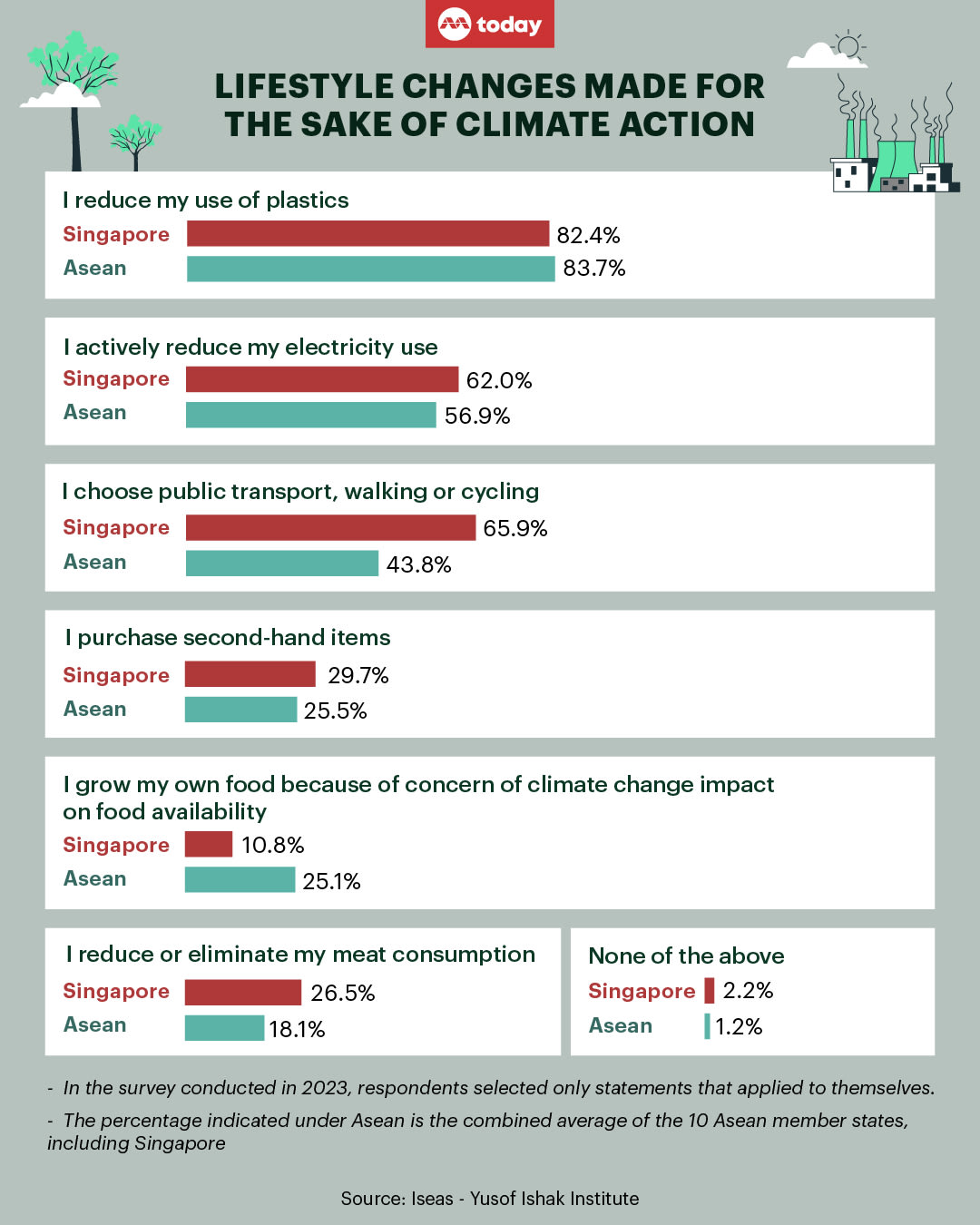
- More than eight in 10 Singaporeans (82.4 per cent) reduce their use of plastics such as disposable containers and plastic bags, similar to their Asean counterparts (83.7 per cent)
- About one in four (26.5 per cent) Singaporeans chose to reduce or eliminate their meat consumption, compared to the Asean average of 18.1 per cent
- Around six in 10 Singaporeans (62 per cent) reduced their electricity usage, for instance, by not using their air-conditioning units, 5.1 per cent more than the Asean average
- A similar proportion (65.9 per cent) chose to take public transport, walk or cycle, as opposed to operating a personal vehicle — which is 22.1 per cent higher than the Asean average
- However, only about three in 10 (29.7 per cent) bought secondhand items
3. S'PORE CLIMATE ADVOCACY BELOW REGIONAL COUNTERPARTS
- On average, only 5.9 per cent of respondents from Asean do not take part in or follow climate change issues, but that figure is 16.1 per cent for Singapore
- Similarly, three in four (75.2 per cent) of respondents from Asean follow news and share information about climate change, but only 57.7 per cent of Singaporeans do
- In terms of leading projects and mobilising support on climate change awareness, only 7.9 per cent of Singaporeans do so, compared to the Asean average of 11 per cent
- Fewer also sign petitions related to climate change (17.6 per cent) and attend protests (3.2 per cent) compared to Asean’s average of 18.2 per cent and 4.3 per cent respectively
- However, more Singaporeans on average believe climate change would "greatly" affect their lives in a negative way (46.6 per cent) than the Asean average (41.3 per cent)
'RACE AGAINST TIME'
Since the first edition of the survey in 2020, its researchers noted that climate ambition has grown in the region, with all Asean countries having communicated their updated climate targets in the form of Nationally Determined Contributions (NDCs), or climate pledges.
“But Southeast Asia can scarcely wait for climate policy and cooperation to inch forward as this survey’s results reveal the public’s pragmatic concerns about climate threats as experienced,” they added.
The United Nations Development Programme defined NDCs as countries' self-defined climate pledges under the legally binding Paris Agreement — detailing what they will do to help meet the goal of limiting the global average temperature rise to 1.5°C above pre-industrial levels.
The United Nations’ Intergovernmental Panel on Climate Change said in a report in 2021 that an extreme heat event that occurred once every decade in a climate without human influence now likely occurs 2.8 times every decade.
It would occur 5.6 times if the global average temperature rose to 2°C — but that figure would be at 4.1 times a decade at 1.5°C of warming.
Commenting on the survey in a press release, Iseas-Yusof Ishak's director Choi Shing Kwok said that the survey has helped researchers understand better the public attitudes and perceptions of climate issues “in the context of the unique circumstances we face in this part of the world”.
“These findings serve as a motivation and guide for policymakers and other stakeholders in Southeast Asia as we all race against time to achieve the global climate goals."
Related topics
climate change Paris Agreement El NinoStay in the know. Anytime. Anywhere.

Subscribe to our newsletter for the top features, insights and must reads delivered straight to your inbox.
By clicking subscribe, I agree for my personal data to be used to send me TODAY newsletters, promotional offers and for research and analysis.






