
City Harvest trial: Ownership of funds in bank account questioned
SINGAPORE — In the face of evidence suggesting that church funds were channelled into the music career of City Harvest Church co-founder Ho Yeow Sun through bank accounts he controlled, Indonesian businessman Wahju Hanafi yesterday maintained that the money belonged to him.
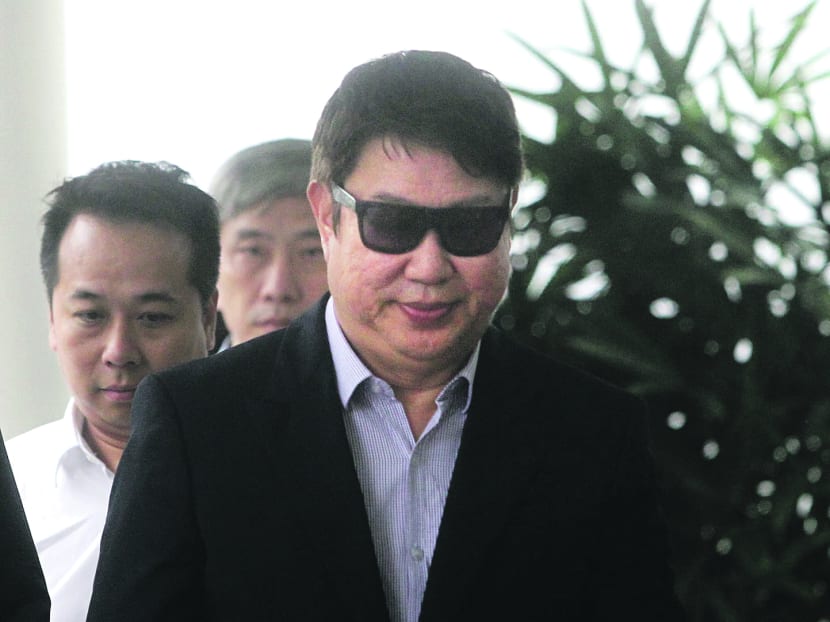
Mr Wahju Hanafi arriving at the Subordinate Courts yesterday. Photo: Ooi Boon Keong

SINGAPORE — In the face of evidence suggesting that church funds were channelled into the music career of City Harvest Church co-founder Ho Yeow Sun through bank accounts he controlled, Indonesian businessman Wahju Hanafi yesterday maintained that the money belonged to him.
The funds in question were S$11 million that prosecutors in the trial of five church leaders and a former leader contend were used by the church for sham bond investments in Indonesian company PT The First National Glassware (Firna), which Mr Hanafi owns.
The purported investments were to disguise the unauthorised use of church building funds for Ms Ho’s career, prosecutors charge.
The bank accounts included that of Mr Hanafi’s company Ultimate Assets. Incorporated in the British Virgin Islands, Ultimate Assets does not have a physical office but has a bank account maintained by UBS in Singapore. Mr Hanafi and his wife are signatories to the account.
Ultimate Assets also managed Ms Ho from August 2008, after her artiste management agreement with audio-visual services company Xtron Productions was terminated.
The prosecution yesterday produced a table of funds movement prepared by one of the accused, Serina Wee Gek Yin. The table showed that S$11 million was transferred to Firna and Ultimate Assets via bonds.
Of this, S$7.55 million was spent on expenses from Ms Ho’s music career, such as advances paid to United States producer Justin Herz. Another S$2.5 million was used for Mr Hanafi’s personal expenses, according to the table. Nearly S$1 million remained with Ultimate Assets and Firna as at Sept 22, 2009.
The table also listed funds amounting to S$1.94 million “due from Wahju”. An email chain showed Wee telling two other accused, Chew Eng Han and Tan Ye Peng, that Mr Hanafi had used “our money” to trade in a real estate investment trust.
Questioned by Deputy Public Prosecutor Tan Kiat Pheng, Mr Hanafi repeatedly said Wee’s statement did not make sense to him. He insisted that he had another S$7 million going into the UBS account from profits made by his Papua New Guinea business, so it made no difference if he first used the money in the account from the church’s bond payments.
The prosecution also questioned Mr Hanafi on why Wee instructed him on when and how much of the Firna bonds to draw down, after the church and Firna entered into a bond subscription agreement in October 2008. Mr Hanafi said decisions to draw down were made by him, Chew, Wee and Firna’s Chief Financial Officer.
A written agreement signed by accused John Lam Leng Hung on behalf of the church management board, undertaking to sell 40 per cent of Firna-issued shares back to the glassware company at US$1 (S$1.27) should the bonds be converted into shares, was also meant to be a “secret letter” between the church and Firna, according to an email from Chew to Wee.
Mr Hanafi’s examination continues today.
Related topics
city harvestStay in the know. Anytime. Anywhere.

Subscribe to our newsletter for the top features, insights and must reads delivered straight to your inbox.
By clicking subscribe, I agree for my personal data to be used to send me TODAY newsletters, promotional offers and for research and analysis.






