
Persistent signal issue worrying and a bad sign: Experts
SINGAPORE — While the authorities and rail operator SMRT have announced steps to try to solve the bewildering signal fault on the Circle Line (CCL) — including manning the trains during evening peak hours yesterday — these are not permanent solutions and nipping the interference at the source is still key, experts said yesterday.
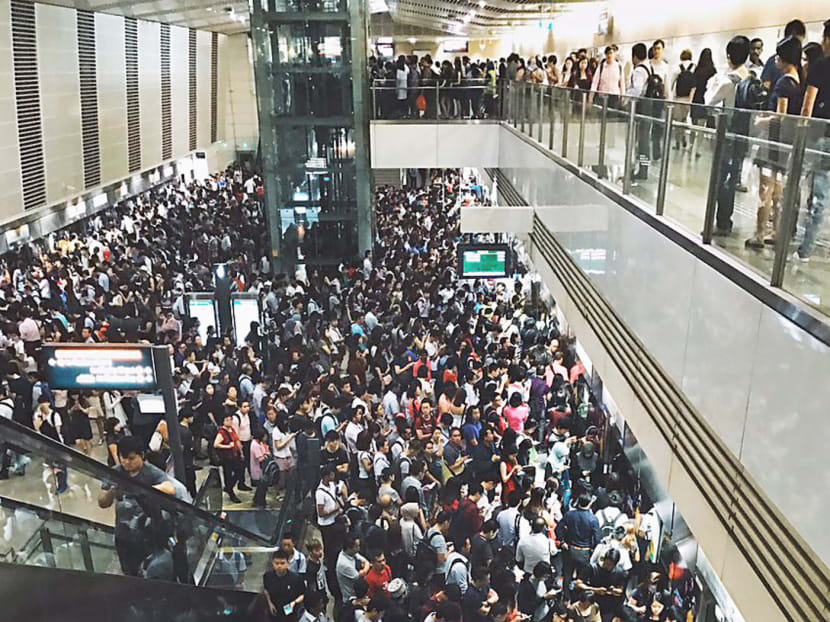
The crowd at Bishan station at about 8.45am yesterday. An interference caused a loss of signal between trains and stations, forcing the trains to come to a halt. SMRT staff had to make their way to the stalled unmanned trains to drive them to station platforms. Photo: n1veda/twitter



SINGAPORE — While the authorities and rail operator SMRT have announced steps to try to solve the bewildering signal fault on the Circle Line (CCL) — including manning the trains during evening peak hours yesterday — these are not permanent solutions and nipping the interference at the source is still key, experts said yesterday.
The intermittent signal interference that triggered delays on the 30-station line from Aug 29 to Sept 2 returned during the morning rush-hour yesterday, crippling services at six stations.
The fact that the source of the faults continues to elude the authorities and SMRT is “a pretty bad sign”, said Professor Lim Teng Joon, a wireless-communications expert at the National University of Singapore.
Singapore Institute of Technology railway signalling control and communications lecturer Andrew Ng said the fact that the problem has persisted for so long suggested that “a combination of sources” could be behind the interferences.
If this is so, Prof Lim said it would be “a very sophisticated attack” and could point to transmitters being placed at several points along the line.
Detecting the source is nevertheless “extremely difficult”, he acknowledged.
Since electromagnetic waves generated by various sources are bouncing off all the walls, “even if you could somehow detect (their) arrival, it doesn’t indicate the direction of the source of the signals”, Prof Lim said, adding that the signals may not be on long enough to be detected.
For now, the only fail-safe solution is to drive the trains manually on the driverless CCL, the two experts said.
Doing so obviates the need for the system to rely on electronic signalling, which typically controls a train’s speed and the distance between trains, Prof Lim said.
Agreeing, Assistant Professor Ng noted that the current set-up means that the CCL is heavily reliant on wireless communications between trains and tracks.
“Having a driver in a driverless line is not practical. It’s very contradicting,” he said, adding that it would be a strain on manpower in the long run and this stop-gap measure is “not sustainable”.
Getting to the nub of the interfering signal remains urgent.
“They have to figure out what the issue is, what kind of signal is causing this problem,” said Prof Lim.
The Land Transport Authority and SMRT have begun feasibility studies, announced previously, to strengthen the signalling communications network, including exploring modifying the system to provide for redundancy, where the train operator can turn to a back-up communication network if the other network suffers from interference.
Prof Lim noted that building in redundancy was “very costly”, if this had not been fused into the system at its design stage.
“It’s not easy … to make such a decision unless they know what’s going on, because if you put up this solution and it still doesn’t solve the problem, then it’s very embarrassing,” he said.
Ms Tin Pei Ling, Member of Parliament for MacPherson, through which the CCL passes, called for a thorough review of the CCL system to find the best solution.
She felt that the trains should be driven manually for as long as the authorities and SMRT “need to determine the root (of the problem) and solve it”.
Tampines GRC MP Desmond Choo said infrastructural improvements must go hand-in-hand with the Government’s push towards a “car-lite” society. Such frequent disruptions impede Singapore’s ability to fulfil its aspirations of being among the “top countries in the world”, he added.
As the authorities search for an answer, mobile signals along stretches of the CCL could be suspended for short periods if similar signalling faults recur.
But such a suspension would be “ridiculous” and “incredibly inconvenient”, said commuter Shermaine Wong, 30, who was caught in yesterday’s CCL disruption.
Nevertheless, this is a sacrifice that international relations undergraduate Lawson Lau, 26, could live with since such a move could help the authorities detect the exact source of the problem.
Stay in the know. Anytime. Anywhere.

Subscribe to our newsletter for the top features, insights and must reads delivered straight to your inbox.
By clicking subscribe, I agree for my personal data to be used to send me TODAY newsletters, promotional offers and for research and analysis.






