
PM Lee in Manila on 3-day visit for Asean Summit
MANILA — Prime Minister Lee Hsien Loong is in Manila until Tuesday (Nov 14) to attend the Association of South-east Asian Nations (Asean) Summit and related meetings, in the run-up to Singapore chairing the group and forum next year.
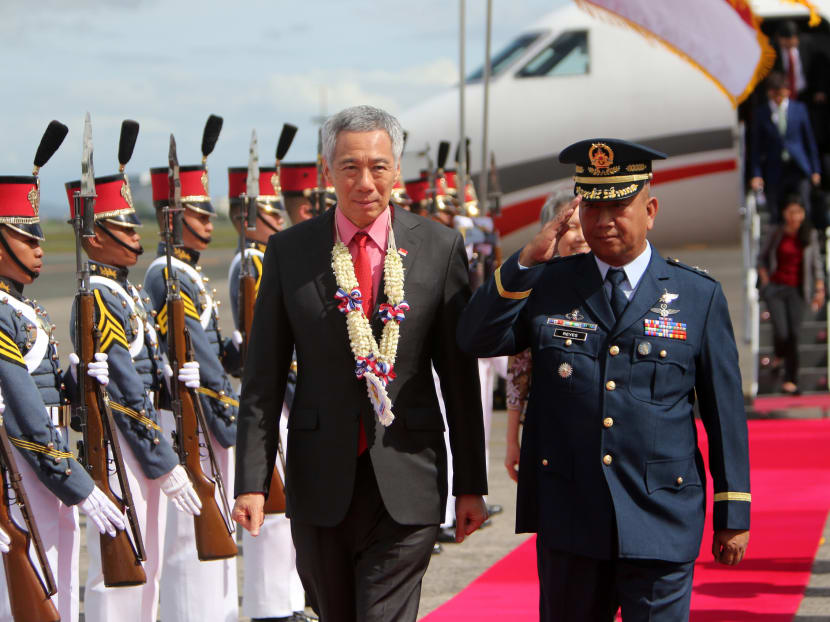
Prime Minister Lee Hsien Loong arrived at Clark International Airport in the Philippines at about 1pm on Sunday (Nov 12) for the Asean Summit and related meetings. Photo: Ministry of Communications and Information



MANILA — Prime Minister Lee Hsien Loong is in Manila until Tuesday (Nov 14) to attend the Association of South-east Asian Nations (Asean) Summit and related meetings, in the run-up to Singapore chairing the group and forum next year.
At this year's summit, leaders of the 10 Asean member-states will sign the Asean Consensus on the Protection and Promotion of the Rights of Migrant Workers, the Prime Minister's Office (PMO) said in a statement.
This is a landmark document seeking to enhance social protection, fair treatment, as well as access to justice and healthcare for the region's migrant workers.
While in the Philippines, the South-east Asian leaders will also announce the official start of negotiations on a code of conduct for the South China Sea.
In August, the Asean nations approved a framework for the code of conduct along with China, which lays claims to much of the disputed waterway.
China's claims have been disputed by neighbouring countries in the region, including Brunei, the Philippines, Malaysia and Vietnam, though tensions have eased somewhat lately.
With Singapore chairing Asean next year, Mr Lee will deliver a speech at the closing ceremony of the high-level regional meetings on Tuesday.
Accompanying him on the visit are his wife, Madam Ho Ching, Foreign Affairs Minister Vivian Balakrishnan, Trade and Industry (Trade) Minister Lim Hng Kiang, and officials from the two ministries.
In Mr Lee's absence, Deputy Prime Minister Teo Chee Hean will be the Acting Prime Minister.
At the meet in Manila, there will be special commemorative summits as Asean marks 40 years of dialogue relations with the United States, Canada and the European Union. US president Donald Trump and Canadian prime minister Justin Trudeau will be attending the event.
Dr Tang Siew Mun, from the Iseas-Yusof Ishak Institute, told TODAY that Mr Trump's attendance at the Asean-US Commemorative Summit and East Asia Summit will set the tone for US policy on Asean.
The head of the institute's Asean Studies Centre noted that South-east Asia has "not featured highly on the US president's political radar".
"His interest with respect to Asia has thus far all been about North Korea and China, and the region would be primed to his views and policy pronouncements on Asean and South-east Asia."
Dr Tang added that a pressing issue Asean must tackle at the summit is the Rohingya crisis in Myanmar. "Myanmar cannot hide behind Asean, and Asean cannot stand idle to allow the protracted humanitarian crisis to fester in its own backyard."
Earlier this week, the United Nations Security Council renewed pressure on Myanmar's government, which has committed itself to ending the violence. More than 600,000 Muslim-minority Rohingya have fled into Bangladesh since ethnic and religious violence erupted in Myanmar's western Rakhine state in late August.
Noting the regional spillover effects, Ms Moe Thuzar, lead researcher in socio-cultural affairs at the Asean Studies Centre, said: "Myanmar's situation, in particular, may occasion further consultations on how Asean can assist in finding constructive pathways, collectively and bilaterally, for a lasting solution."
Dr Tang said that as Asean goes up against rising nationalistic and populist sentiments, the member countries need to work harder and more collaboratively to "keep the regional project afloat".
Saying that Asean is not the "panacea for all of the region's woes and shortcomings", he added that Singapore, as upcoming Asean chair, would not bear the burden of moving the group alone — the task rests with all the nations.
"Singapore could only move at a pace determined and supported by its fellow member-states," Dr Tang said.
The member-states of Asean are Brunei, Cambodia, Indonesia, Laos, Malaysia, Myanmar, the Philippines, Singapore, Thailand and Vietnam.
Stay in the know. Anytime. Anywhere.

Subscribe to our newsletter for the top features, insights and must reads delivered straight to your inbox.
By clicking subscribe, I agree for my personal data to be used to send me TODAY newsletters, promotional offers and for research and analysis.






