
Police seeing re-emergence of purchasing order scam targeting companies
SINGAPORE — The Singapore Police Force has warned that it is seeing a re-emergence of purchase order scams in Singapore, in which scammers pose as procurement officers from local universities and government agencies to trick companies into delivering goods with promises of payment at a later date.
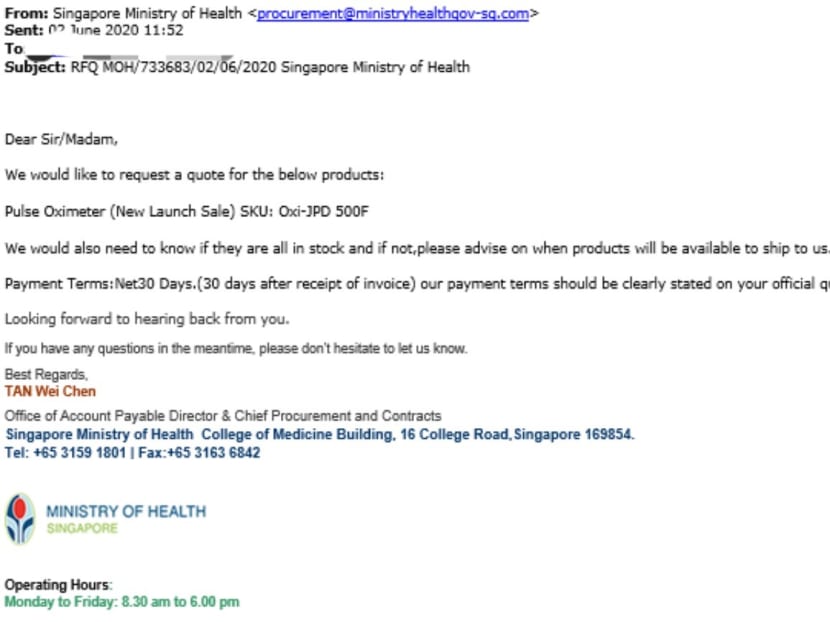
The companies that were scammed said that they received emails from people pretending to be from local universities or government agencies such as the Ministry of Health. The scammers asked for quotations on IT-related items, electronics and medical devices.

SINGAPORE — The Singapore Police Force has warned that it is seeing a re-emergence of purchase order scams in Singapore, in which scammers pose as procurement officers from local universities and government agencies to trick companies into delivering goods with promises of payment at a later date.
The police said in a statement on Friday (June 19) that there have been at least two reports of such scams so far this month, which incurred a total of at least S$160,000 in losses.
The companies that were scammed said that they received emails from people pretending to be from local universities or government agencies such as the Ministry of Health. The scammers asked for quotations on IT-related items, electronics and medical devices.
Once an agreement had been made, a purchase order would be sent to the company via email. The company staff would then send out the goods to the indicated delivery address, typically that of freight forwarding companies that had been engaged by the scammers, which would then ship the goods overseas.
After sending these goods over to the supposed buyer, the companies would not receive any payment in exchange.
To avoid falling victim to such scams, the police said companies should verify that the sender’s domain name is genuine when receiving e-mails and purchase orders.
In such scams, the domain names often closely resemble those used by the universities and government agencies, so that the e-mail recipient is easily tricked into thinking it came from a genuine sender.
Companies should also always verify the authenticity of the request by contacting the universities and government agencies on their official contact numbers, instead of the numbers provided in the email, the police said.
And companies should also look out for tell-tale indicators that the e-mail might be a scam:
The email might be poorly written with grammatical or spelling errors.
The delivery address could be that of a private residence, freight forwarding companies or a self-storage facility, rather than that of the university or government agency.
Related topics
scam goods procurementStay in the know. Anytime. Anywhere.

Subscribe to our newsletter for the top features, insights and must reads delivered straight to your inbox.
By clicking subscribe, I agree for my personal data to be used to send me TODAY newsletters, promotional offers and for research and analysis.






