
Police translator who helped bridge language barrier receives invites to North Korea
SINGAPORE – As a Korean speaker representing the Singapore Police Force (SPF), he was initially viewed with suspicion by North Korean security personnel who accompanied their leader Kim Jong-un to Singapore for the summit with United States President Donald Trump.
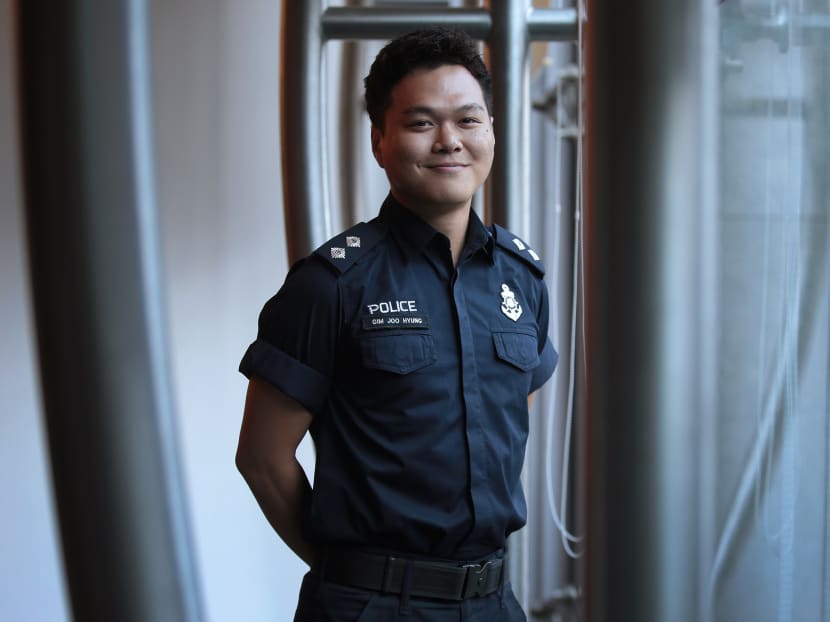
Police National Serviceman Gim Joo Hyung, 25, has received multiple invitations to visit the North Korean capital to eat Pyongyang-style cold noodles.

SINGAPORE – As a Korean speaker representing the Singapore Police Force (SPF), he was initially viewed with suspicion by North Korean security personnel who accompanied their leader Kim Jong-un to Singapore for the summit with United States President Donald Trump.
By the time the summit was over, police National Serviceman Gim Joo Hyung, 25, had received multiple invitations to visit the North Korean capital to eat Pyongyang-style cold noodles.
The Singapore permanent resident, whose parents moved here from South Korea when he was four, was one of several officers who served as translators for the SPF during the summit.
As a native Korean speaker, Mr Gim was tapped more frequently despite having no formal translation experience.
He was present everywhere Mr Kim went and spotted himself in media coverage of the event, such as photos taken during Mr Kim's walk on the Jubilee bridge.
"There were North Korean interpreters, they can speak very good English but they are not obligated to translate for us," he said.
Mr Gim initially doubted if he was competent enough to help bridge the language barrier between the SPF and the North Korean security team.
He speaks Korean to his parents at home and has translated Korean dramas for his friends, but knew the task would be at a different level altogether. "At home, it's just casual conversations, basic Korean," he said.
His parents encouraged him to step forward.
Despite the history of war between both Koreas, "we share the same blood", he said, recounting a story his mother told him about how South Koreans cheered on a North Korean football team in its match against China when no supporters from the North were present.
About a week before the summit, Mr Gim received a call from the Police Coast Guard, where he does his reservist and which knew he could speak Korean.
He had to take a short proficiency test over the phone arranged by the SPF. He answered questions in Korean such as where he was born and his age, and had to make statements such as, "You have been arrested in accordance with Singapore law."
There was a learning curve for Mr Gim, who studied Chinese as a second language in school.
The North Koreans spoke with a different accent and at a different speed. He did not understand some of the vocabulary used and took a day or two to adapt and pick up certain terms, such as "convoy" and military lingo.
"Some words South Koreans don't use as much (whereas) North Koreans use more commonly," he said. For instance, the North Korean security team addressed one another as "comrades".
There was also the high-stakes environment he had to operate in and Mr Gim said his heart went "thump thump" in more stressful and urgent situations.
But he learnt from the challenge and his prior understanding of some cultural differences came in handy.
For example, it is not rude to place his hand on the shoulder of somebody older in Singapore but the Koreans accord more respect to their superiors and seniors, he said.
"In terms of (military) hierarchy, I have learnt so much vocabulary because I have to address everyone," he added.
Before the summit, Mr Gim, a banking and finance student at a private university, said he had thought the North Koreans would be rough and inflexible.
These stereotypes were busted.
The North Koreans would greet him in the morning and ask if he had had his meals.
"Everyone was so flexible, they were so nice," said Mr Gim. "And when they thanked everyone from the SPF, everyone said this: 'I hope to meet you soon in Pyongyang.' That just shows how much they were appreciative of us."
Stay in the know. Anytime. Anywhere.

Subscribe to our newsletter for the top features, insights and must reads delivered straight to your inbox.
By clicking subscribe, I agree for my personal data to be used to send me TODAY newsletters, promotional offers and for research and analysis.






