
New SMRT training centre lets bus drivers learn via life-size simulators
SINGAPORE — A bus driver is about to change lanes to avoid an illegally-parked car when a motorcyclist suddenly speeds by him. Or, while attempting to turn right, a car to the driver’s left beats the red light and cuts into his path.

SINGAPORE — A bus driver is about to change lanes to avoid an illegally-parked car when a motorcyclist suddenly speeds by him. Or, while attempting to turn right, a car to the driver’s left beats the red light and cuts into his path.
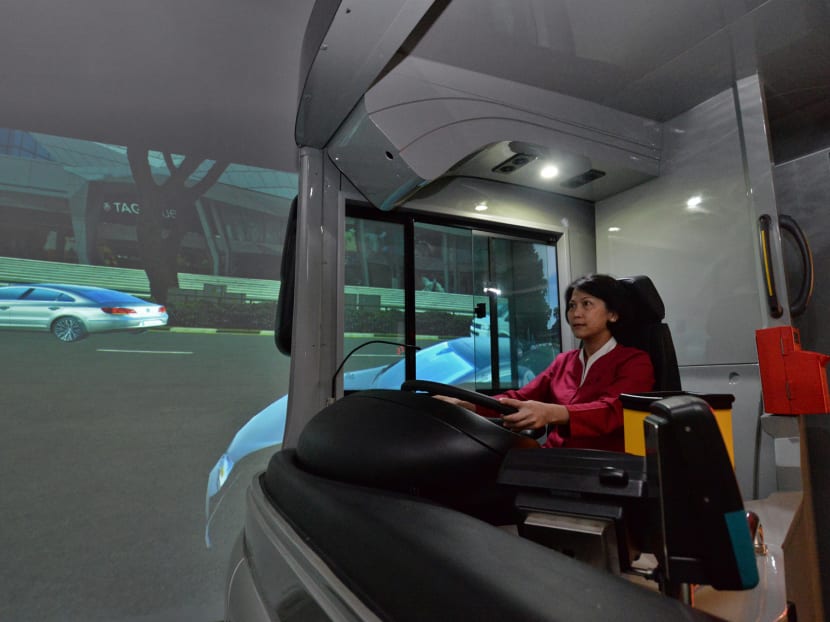
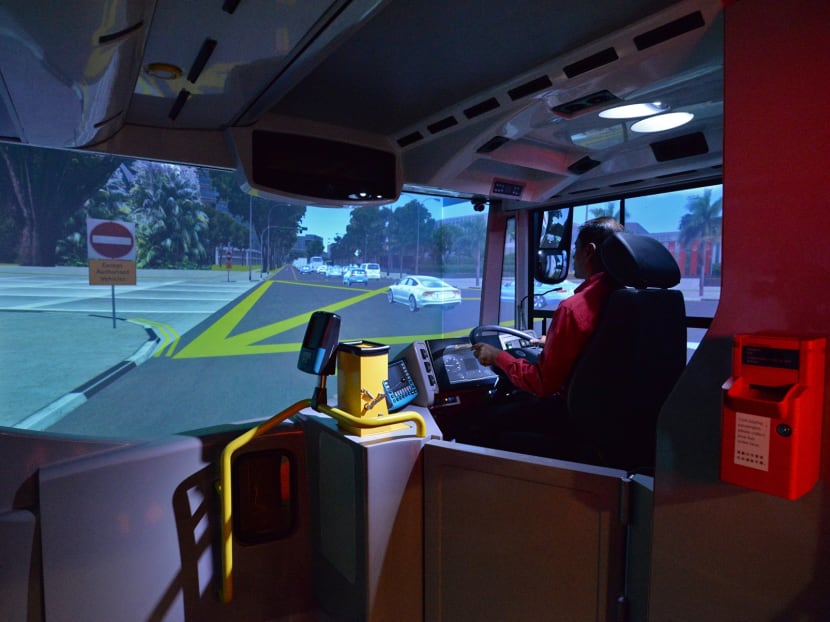
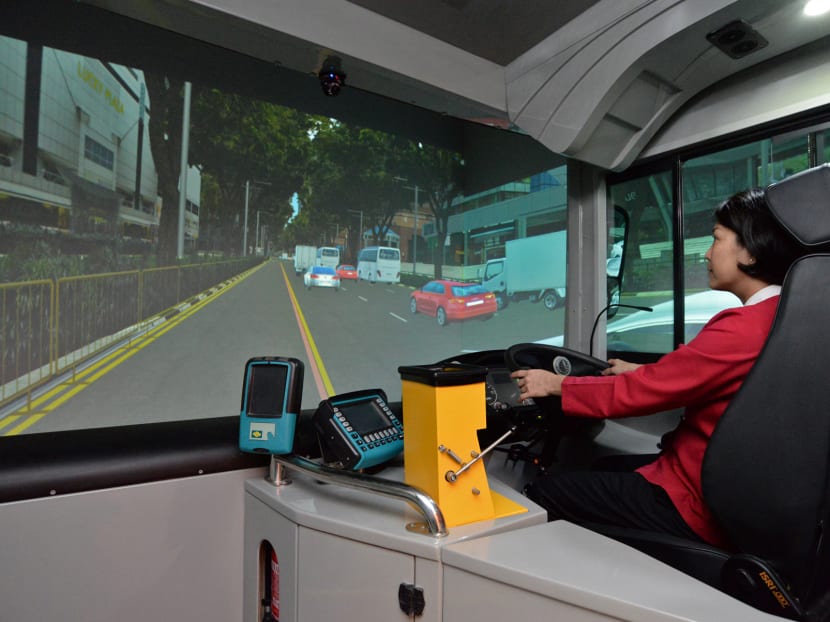
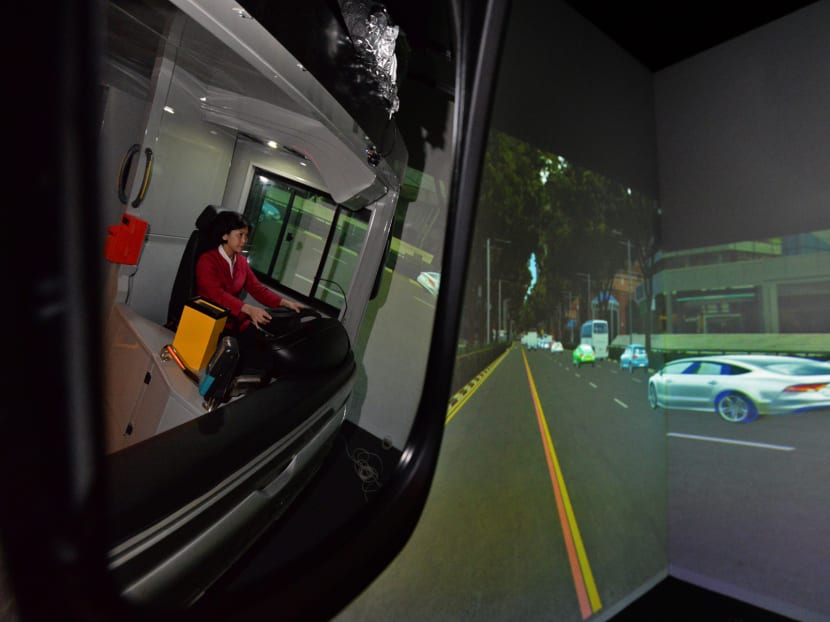
These are some scenarios that will be thrown at bus drivers at SMRT’s new multimillion-dollar bus training centre in Jurong East, which has life-size driving simulators to mimic traffic situations and road conditions, and to monitor driving performance.
Traditionally, drivers are trained on the roads, but have few opportunities to drive under varied road conditions. They also have to complete the bus route under supervision from start to end. If they do not get it right, they have to complete the route repeatedly to address the problems that have cropped up.
The Bus Training and Evaluation Centre, which opened today (July 2), was established in collaboration with the Employment and Employability Institute (e2i) and the National Transport Workers’ Union. Senior Minister of State (Transport) Josephine Teo was among those present at its opening.
Located at the Devan Nair Institute for Employment and Employability, the centre has four cabin simulators — replicas of the different bus models used by public operators here. Four more simulators should be ready in a year’s time, said SMRT.
The simulators come with some 1,000 different scenarios, such as for defensive driving and hazards awareness, and they are fitted with 3D renditions of Singapore’s terrain. Conditions can be customised according to a driver’s area for improvement.
The centre also has eight bus simulator trainers, which help drivers learn basics such as route familiarisation, and two service control stations which monitor services.
All simulators are connected to a network, so 16 bus captains and two service controllers can train together and practise real-time bus operations.
The centre is open to both public and private operators, and e2i said some have expressed interest in signing up. All SMRT’s 2,500 drivers will have a go, said the operator, along with new trainee drivers.
SMRT Buses vice-president Tan Kian Heong said the operator is exploring other bus models for new simulators as they want the centre “to cater to the entire industry, not just SMRT”.
e2i chief executive officer Gilbert Tan said given the increase in the number of buses and the move towards a contracting model, more drivers are needed. He added that there is a need to increase the skills of bus drivers and to standardise them, so that drivers can progress to different employers without much difficulty.
Bus captain Tan Kwee Chu, 49, recalled that training was tiring when she joined five years ago as she had to take service 851 — which she is tasked to drive — multiple times to memorise the route. “Now, you can memorise in the comfort of the centre. We can also go straight to the problem spots and practise that repeatedly, which saves time,” she said.
Chief bus captain Lim Yew Poon, 53, said the system helps with things that cannot be learnt during on-the-job training, such as procedures for bus breakdowns and accidents.
Meanwhile, SBS Transit, another public transport operator, said it is continuing to invest in its bus training systems. Since 2006, nine sets of its training and evaluation system have been installed on training buses, with another 21 planned by year-end.
Using in-vehicle video cameras, sensors and a mapping software, the system captures the bus driver’s driving behaviour while he is on the move, the operator said. It analyses driving competency skills including harsh acceleration, sudden braking, and failure to check blind spots. At the end of each training session, a report is generated on driving performance.
SBS Transit said it also introduced a driver awareness system in 2007, which consists of a smart camera mounted on the bus windshield to monitor road conditions.
Stay in the know. Anytime. Anywhere.

Subscribe to our newsletter for the top features, insights and must reads delivered straight to your inbox.
By clicking subscribe, I agree for my personal data to be used to send me TODAY newsletters, promotional offers and for research and analysis.






