
Rail network to be doubled, with 2 new MRT lines by 2030
SINGAPORE — By 2030, eight in 10 households will be within a 10-minute walk of a train station — up from 57 per cent currently — under “ambitious plans” unveiled yesterday to double the country’s rail network and bring about more connections for commuters.
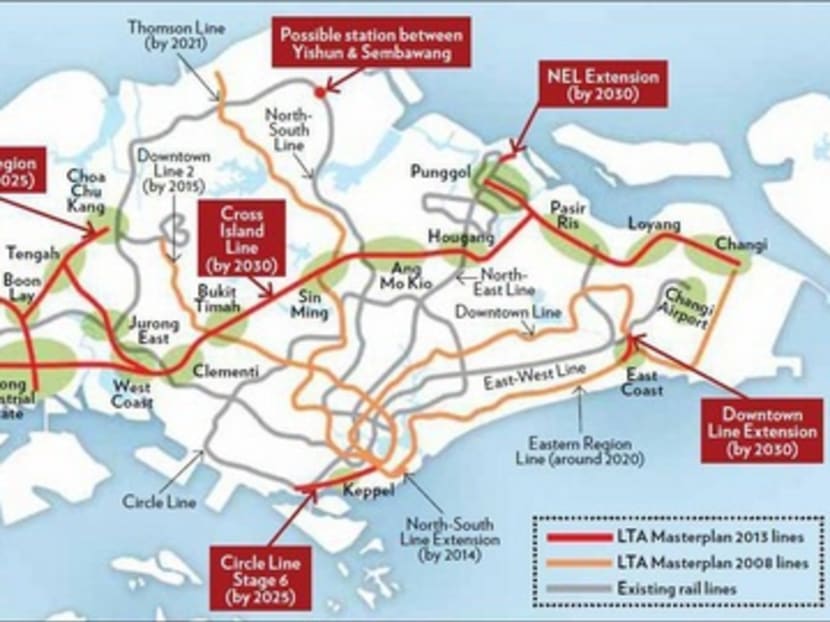
Photo: Land Transport Authority

SINGAPORE — By 2030, eight in 10 households will be within a 10-minute walk of a train station — up from 57 per cent currently — under “ambitious plans” unveiled yesterday to double the country’s rail network and bring about more connections for commuters.
Two new lines, the Cross Island Line and the Jurong Region Line, will be constructed, while the Circle Line, the North-East Line and the Downtown Line (DTL) will be extended.
The Land Transport Authority (LTA) is also studying the possibility of adding a station on the North-South Line between Sembawang and Yishun.
Besides “faster and more convenient travel”, Transport Minister Lui Tuck Yew, who announced the new lines during a visit to the Chinatown DTL Station, also spoke of “a more resilient network that can better mitigate disruptions in our MRT system, and also allow us to shut down parts of the network for longer durations to carry out improvement works”.
“The improvements in rail infrastructure will support Singapore’s long-term development and ensure that the rail network will have more than the capacity needed to meet the expected increase in public transport ridership in the next two decades,” he added.
The plan to double the rail network, up from the current 178km to 360km by 2030, comes after a “fundamental review” of the 2008 Land Transport Masterplan. Mr Lui said he had asked the LTA to undertake the review when he became Transport Minister in 2011 because he “saw further changes in our environment”.
The massive expansion of the rail network also comes at a time when the Government aims to make public transport the preferred mode of transport. A new section of the train network is expected to be opened every year till 2017, and the first five stations of the DTL — between Bugis and Chinatown — is on track to open by the end of this year, he said.
Mr Lui added that he has noted three changes here since 2008. First, as the population and economy continue to grow, it will lead to more people and goods needing transportation and the public transport capacity that would be needed to cater to this demand would “require time to build”.
“It typically takes 10 to 12 years to plan, build and open a rail line, therefore, we must plan well ahead, plan well and implement promptly,” he said.
Second, a “more commuter-centric approach” has to be taken in how the public transport system and policies are planned. The system also has to be responsive to fundamental demographic changes, such as the ageing population, he added.
Mr Lui also spoke of tighter land constraints and difficult trade-offs that would affect land use and carry cost implications. He gave the examples of Pearl Centre and Thomson Post Office that will have to make way for the upcoming Thomson Line.
“Today, the surface land taken up by roads is already at a very high 12 per cent, compared, for example, to 14 per cent for housing,” Mr Lui said. “We need to find other options, such as pursuing a more aggressive de-centralised strategy so that there is a better geographical balance of jobs and people, and being more creative with our use of space in our bus and rail depots.”
Besides having more connections, commuters who took part in the review raised suggestions concerning improving service standards and making the public transport system more user friendly for the elderly and the disabled. Mr Lui said yesterday he would address these areas “in the coming weeks”.
Transport economist Michael Li, of the Nanyang Business School, estimated that it would cost the Government between S$60 billion to S$80 billion to build the new train lines. He felt that a larger train network would not be a burden to the train operators, but in turn help them achieve economies of scale.
“As the system grows, the operators will pick up more expertise and a bigger system would have a bigger budget and more skills will be accumulated by then,” Dr Li noted.
Associate Professor Lee Der Horng, a transport researcher at the National University of Singapore, felt that if the existing two operators are not up to scratch, it may signal for new ones to come in. “I believe there are interested parties in the international community, as there are not many opportunities like this - no other city, other than Paris, is expanding their lines at the moment,” he said.
Stay in the know. Anytime. Anywhere.

Subscribe to our newsletter for the top features, insights and must reads delivered straight to your inbox.
By clicking subscribe, I agree for my personal data to be used to send me TODAY newsletters, promotional offers and for research and analysis.






