
Revised PE curriculum takes more holistic approach to fitness
SINGAPORE — Schools will conduct national fitness tests every alternate year instead of annually, part of the Ministry of Education’s move announced in July to create a new holistic assessment in Physical Education (PE) to be rolled out to all schools by 2016.
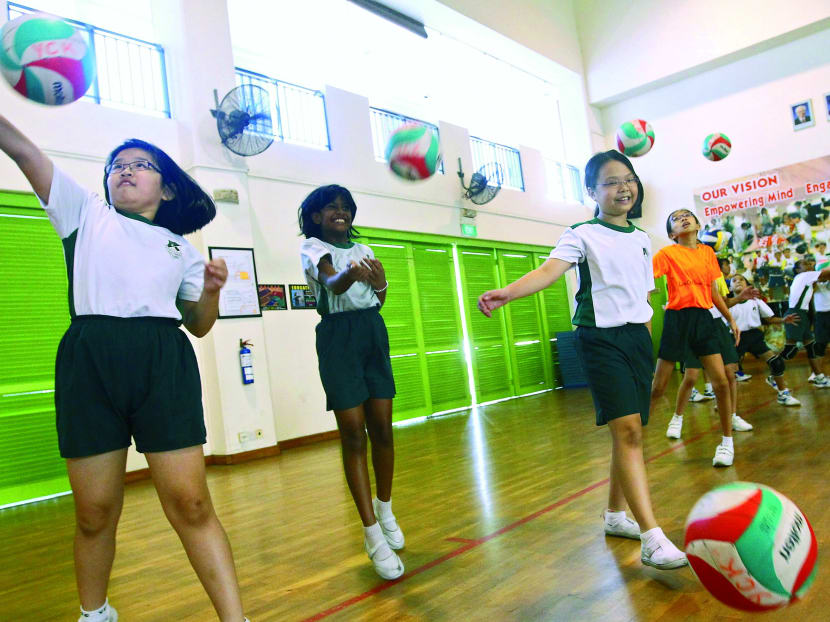

SINGAPORE — Schools will conduct national fitness tests every alternate year instead of annually, part of the Ministry of Education’s move announced in July to create a new holistic assessment in Physical Education (PE) to be rolled out to all schools by 2016.
This will free up curriculum time for students to participate in recreational sports competitions and outdoor education — such as outdoor cooking, camping and kayaking — instead of confining PE lessons to exercises geared towards passing the National Physical Fitness Award (NAPFA) test, such as weekly runs and chin ups.
Starting next year, the NAPFA test will be conducted for students when they are in Pri 4, 6, Sec 2, 4, 5 and JC2. The assessment, which comprises six stations such as sit-ups and standing broad jump, is currently conducted annually from Pri 4. The Ministry, which announced the change yesterday, said it will allow schools to conduct a wider range of physical activities during PE lessons.
New performance bands will also be introduced, instead of the current alphabetical grades given. For instance, instead of giving students a “F” grade for a NAPFA station, they will be told that their performance “Needs improvement”. This is aimed at motivating the child towards self-improvement, rather than just looking at whether they pass or fail NAPFA, said the MOE.
The new PE syllabus, which will be introduced in stages starting next year, will help primary school students to acquire fundamental movement skills. Concepts such as body and space awareness will be taught, alongside athletics, dance, gymnastics and swimming.
The PE syllabus for secondary school levels will focus on developing skills in at least six physical activities and sports, for active participation beyond school. Outdoor education will also be included in PE, so students can understand more about the environment while enjoying the outdoors.
While principals welcomed the move to conduct the NAPFA test every alternate year, some parents expressed concerns that their children’s fitness levels may fall.
Doing well in the national fitness test is especially crucial for males at the JC 2 level, as National Service enlistees who fail to attain at least a silver award in the NAPFA test have to go through a new eight-week physical training programme before starting the nine-week basic military training.
Ms Karen Wong, who has two sons in Secondary 1 and 3, said she preferred an annual NAPFA test. The exercises conducted in the lead-up of the test would help to “train stamina”, she felt.
“I’m just worried that their stamina may not be up to standard if they don’t have the NAPFA test every year because it seems like there is no consistent training for the test if they do it once (in) every two years,” added the 44-year-old finance executive.
The MOE sought to allay such fears, pointing out that male JC 2 students who fail their NAPFA test can retake the assessment, which is the current practice.
Ngee Ann Secondary School Principal Adrian Lim felt the move will give PE teachers “a bigger canvas to try more variety of physical activities”.
“When you spread it out once every two years, that means you’re given a longer runway to achieve the NAPFA bands,” he added.
Teck Whye Secondary School Principal Zach Ong said the new PE syllabus will allow his school to have the flexibility to strengthen its niche area, hockey.
“I would ideally like to spend more time introducing this sport to all my students, not just the competitive players,” he said. “Without NAPFA in the picture, I have a longer time to introduce the hockey programme within PE lessons.”
Stay in the know. Anytime. Anywhere.

Subscribe to our newsletter for the top features, insights and must reads delivered straight to your inbox.
By clicking subscribe, I agree for my personal data to be used to send me TODAY newsletters, promotional offers and for research and analysis.






