
SCDF to tap big data to slash response times
SINGAPORE — To further cut response times, the Singapore Civil Defence Force (SCDF) is looking at tapping big data to predict demand and better deploy emergency resources such as ambulances and fire engines.
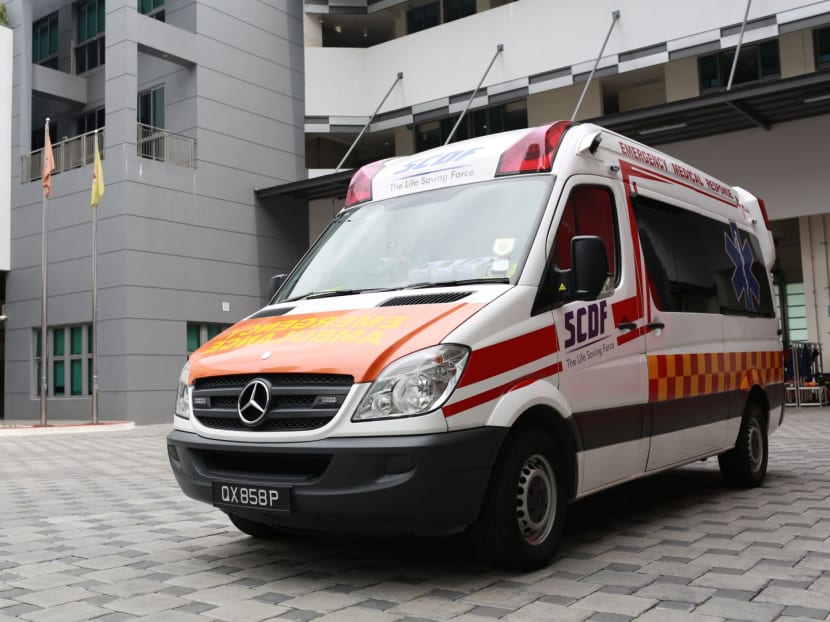
The SCDF is considering having ambulances constantly on patrol, on top of deploying them at its 47 facilities islandwide and other fixed external locations such as hospitals, polyclinics and neighbourhood police posts. Photo: SCDF

SINGAPORE — To further cut response times, the Singapore Civil Defence Force (SCDF) is looking at tapping big data to predict demand and better deploy emergency resources such as ambulances and fire engines.
The SCDF is also considering having ambulances constantly on patrol, on top of deploying them at its 47 facilities islandwide and other fixed external locations such as hospitals, polyclinics and neighbourhood police posts.
Last week, the SCDF put up a Request for Information (RFI) on government procurement website GeBIZ for a Dynamic Resource Optimisation system based on data analytics. “This project envisages the dynamic deployment of resources by drawing upon analyses of the wealth of data collected thus far to further enhance the deployment of the SCDF’s finite resources by accurately predicting demand patterns,” the RFI document said.
It added: “Over the years, the SCDF has enhanced our service delivery and response times through the introduction of the satellite fire post concept, compact emergency vehicles ... computerised despatching and AED (automated external defibrillator)-carrying fire bikers. Despite these efficiency gains, the increases in demand continue to put pressure on response times.”
Currently, the SCDF allocates its resources to fire stations and posts based on “persisting risk parameters” in their locales, including the number of houses, commercial spaces, and whether there are industrial risks, for example.
The document noted that such an allocation system does not address the huge variation in demand for emergency medical services from various areas between different hours of a day and different days of the week. For example, a large number of people are in the Central Business District in the day, but the area becomes a ghost town at night and on weekends. In contrast, population densities in residential estates spike after office hours.
The Singapore General Hospital and SCDF are understood to have been analysing data on demand for emergency medical services.
The proposed “live deployment model” is based on the premise that demand for emergency resources varies according to geographical factors — such as the number of seniors in certain residential estates and proximity to medical facilities — as well as temporal factors, which include changes in human activity between days of the week and volume of traffic on certain roads during peak hours. The model should also be able to distinguish between urgent cases and less serious ones.
While the SCDF plans to increase its ambulance fleet, the proposed model will “partially ameliorate” Singapore’s growing demand for emergency medical services due to its ageing population, the document added.
Last year, the SCDF’s Emergency Medical Services responded to 150,155 calls, a rise of 5.3 per cent compared with the 2012 figure. In particular, there was an 8.2 per cent rise in the number of calls made by those aged 65 and above compared with that in 2012.
Similar systems are in place in other parts of the world. For instance, Oklahoma’s Emergency Medical Services Authority uses a computer program to analyse, among other things, past data of call volumes, traffic speeds at different times of the day and road construction areas, to determine when and where ambulances are needed. The system requires constant real-time adjustment to deployment and staffing patterns in order to meet the needs of the community, the authority said on its website.
Paramedics and firefighters here whom TODAY spoke to noted that a prediction model has its practical challenges. They declined to be named because they were not authorised by their employers to speak to the media.
A firefighter who has been in service for almost seven years said: “If the emergency vehicles and crew are moved around while (the size of) the total fleet remains unchanged, there are bound to be gaps in some areas. Also, the time spent attending to one case is different from another, so the relocation may not be very smooth.”
He felt it might not be feasible to constantly have some emergency vehicles on patrol, given the high volume of calls that the SCDF already has to attend to. “People may also get tired from being constantly shuffled just for coverage,” he said. Under the proposed model, the number of times a crew member can be relocated within a single shift will be capped.
A paramedic said it will help if the public can be educated on what constitutes an emergency. “People often call in for matters that are not serious, even stomach aches. A lot of time and resources are spent, unnecessarily, attending to these calls.”
Stay in the know. Anytime. Anywhere.

Subscribe to our newsletter for the top features, insights and must reads delivered straight to your inbox.
By clicking subscribe, I agree for my personal data to be used to send me TODAY newsletters, promotional offers and for research and analysis.






