
Second Singaporean charged with terrorism financing after giving over S$1,000 to foreign radical
SINGAPORE — A 34-year-old man has become the second Singaporean to be charged with terrorism financing. The Ministry of Home Affairs (MHA) said on Monday (Sept 16) that Ahmed Hussein Abdul Kadir Sheik Uduman had been detained under the Internal Security Act (ISA) in August last year and was charged on Monday with providing money for terrorist purposes.
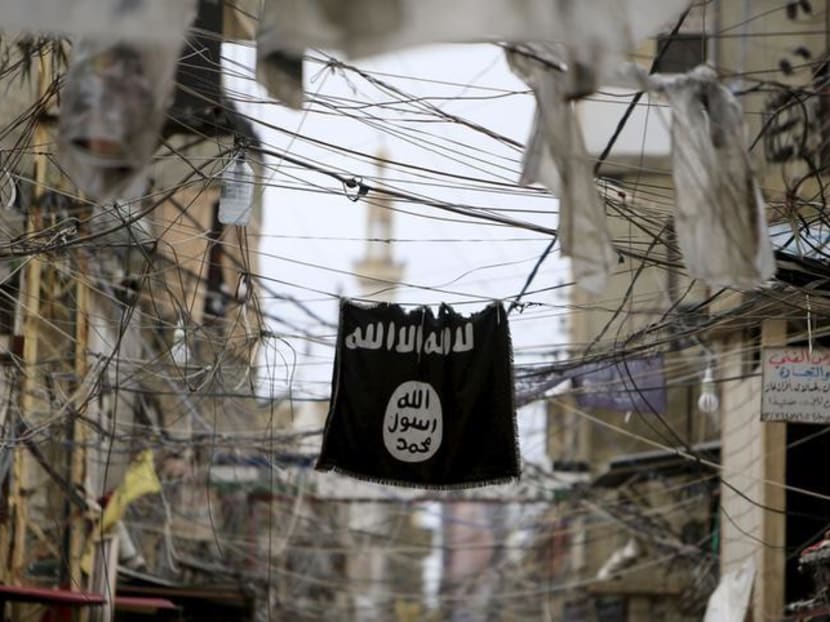
An Islamic State in Iraq and Syria (Isis) flag hangs amid electrical wires. A 34-year-old man has become the second Singaporean to be charged with terrorism financing.



SINGAPORE — A 34-year-old man has become the second Singaporean to be charged with terrorism financing.
The Ministry of Home Affairs (MHA) said on Monday (Sept 16) that Ahmed Hussein Abdul Kadir Sheik Uduman had been detained under the Internal Security Act (ISA) in August last year and was charged on Monday with providing money for terrorist purposes.
The former information technology engineer allegedly gave S$1,059 to an individual overseas who was facilitating terrorist acts on July 29 in 2016, and another US$62 (S$86) to the same person on Sept 3 that year, the MHA said.
He was served two charges under section 4(a) of the Terrorism (Suppression of Financing) Act, Chapter 325. This is the third time the Act — which was enacted in 2002 — has been invoked; the first involved the six Bangladeshi men who set up an Islamic State in Bangladesh cell here in 2016.
And in April, 35-year-old Imran Kassim was the first Singaporean to be charged in court under the Act, having provided money to support propaganda efforts by terrorist group Islamic State in Iraq and Syria (Isis). Imran claimed trial, and the hearing has been scheduled to take place over four days from Jan 13 to 16 next year.
According to court documents, Hussein allegedly sent the money through two middlemen named Patrick Gray and Nzingha Kokayi to benefit a man named Sheikh Abdullah al-Faisal.
Hussein was radicalised and wanted to undertake armed violence in support of Isis, and his financial contributions were discovered as part of a “parallel investigation” by the Commercial Affairs Department, the MHA said.
The MHA said the monetary contributions constitute “serious offences, regardless of the amount”, under the Terrorism (Suppression of Financing) Act here.
If convicted, Hussein could be jailed for up to 10 years, fined up to S$500,000, or both.
According to an MHA statement last August following Hussein’s detention, his path to radicalisation began in 2013 when he turned to the Internet for religious knowledge.
Among other things, he followed the lectures of foreign radical ideologues, such as Anwar al-Awlaki from terrorist group Al-Qaeda and several others who have been arrested or imprisoned for inciting violence or espousing support for terrorism.
Hussein maintained regular contact with foreign pro-Isis individuals on social media to keep up with the developments in Isis, the MHA said, and he also tried to influence some of his foreign online contacts to follow the violent teachings of the radical ideologues whom he had been following, because he wanted them to support Isis.
In its latest statement, the MHA reminded members of the public not to remit money of any amount, or provide any support through the provision of services, supplies or any material to a terrorist organisation, or for facilitating or carrying out any terrorist act. It also reiterated that anyone with information on such activities are to inform the authorities promptly.
“Terrorism and its financing represent a grave threat to domestic and international security, and global action is required to deprive terrorist groups of funding and materials,” the MHA said.
“Singapore is part of this global effort and is strongly committed to combating terrorism financing, regardless of whether the monies are used to facilitate terrorist purposes locally or abroad.”
Related topics
MHA terrorismStay in the know. Anytime. Anywhere.

Subscribe to our newsletter for the top features, insights and must reads delivered straight to your inbox.
By clicking subscribe, I agree for my personal data to be used to send me TODAY newsletters, promotional offers and for research and analysis.






