
Singapore, China establish all round cooperative partnership
SINGAPORE — At the conclusion of President Xi Jinping’s two-day state visit to Singapore today (Nov 7), China and Singapore announced that they will establish an “All-Round Cooperative Partnership Progressing with the Times”.
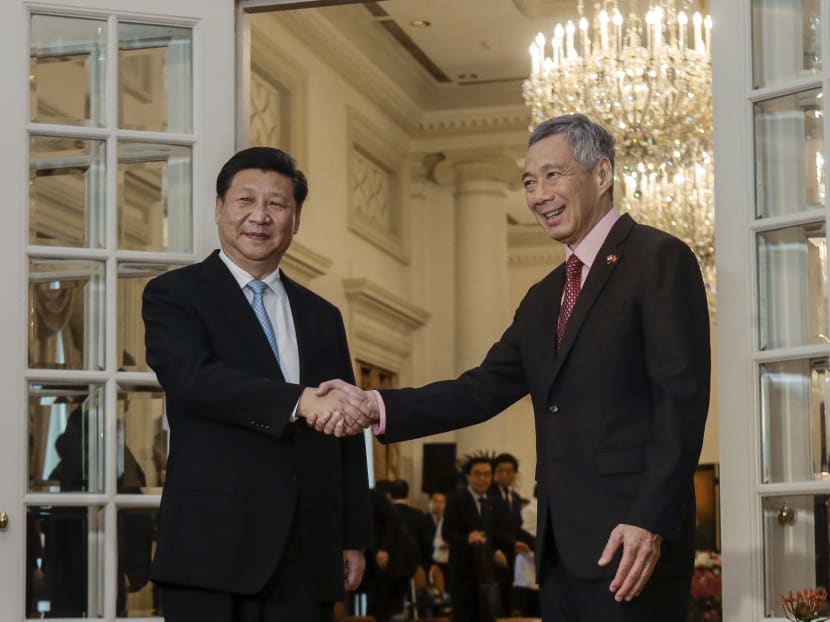
Chinese President Xi Jinping (L) and Singapore Prime Minister Lee Hsien Loong (R) shake hands for the media at the Istana presidential palace in Singapore, Nov 7, 2015. Photo: AP

SINGAPORE — At the conclusion of President Xi Jinping’s two-day state visit to Singapore today (Nov 7), China and Singapore announced that they will establish an “All-Round Cooperative Partnership Progressing with the Times”.
In a joint statement issued by the governments of both countries this evening following the conclusion of Mr Xi’s first state visit to the Republic to commemorate the 25th anniversary of bilateral relations, it was noted that both countries have adopted a “strategic and long-term perspective in charting the course of bilateral relations since China and Singapore established diplomatic relations on 3 October 1990”.
“Both sides will continue to ensure that the relationship progresses in line with the unique strengths and development needs of both countries,” said the statement, adding that over the years, the two countries have engaged in multi-faceted, practical and innovative cooperation across many fields.
During Mr Xi’s visit, he met with President Tony Tan Keng Yam - who visited Beijing on a state visit on July and invited Mr Xi to make a return visit to Singapore - and Prime Minister Lee Hsien Loong.
The joint statement said that the leaders had candid, cordial and in-depth discussions on bilateral, regional and international issues of common interest, and reached broad consensus on many areas.
Singapore also said that it will maintain its consistent “One China Policy”. At the same time, Singapore said that it welcomes China’s “One Belt, One Road” initiative which complements the development needs of the region, said the joint statement. China’s One Belt, One Road initiative is aimed at rejuvenating two ancient trade routes and knitting Eurasia into a single vast market.
Singapore and China also agreed to new areas and initiatives for cooperation that “evolves in tandem with the development needs of both sides”, including promoting more cooperation in the areas of bilateral trade and investments; finance; transport; culture; environment and education among others.
Both countries said that they will strengthen communication and cooperation on regional and global affairs, added the joint statement.
Extending its congratulations on the upcoming establishment of an integrated Association of Southeast Asian Nations (ASEAN) Community by the end of this year, Beijing pledged to continue supporting the principle of ASEAN centrality in regional architecture.
“As next year marks the 25th anniversary of ASEAN-China dialogue relations, China and Singapore will work together with the other ASEAN countries to promote even greater progress in the ASEAN-China strategic partnership, and peace and stability in the region,” said the statement.
China also welcomed Singapore’s early support to become a prospective founding member of the Asian Infrastructure Investment Bank (AIIB) and active participation in the drafting of the AIIB’s Articles of Agreement.
Reflecting on Mr Xi’s visit, Mr Lee posted in Facebook this evening that he had a “fruitful meeting” with the Chinese President. “Singapore enjoys warm and substantial ties with China, and President Xi’s visit has further deepened the relationship,” he said.
“China’s dramatic progress is positive for the region and the world. We are happy that Singapore provided the venue for President Xi’s meeting with President Ma Ying-jeou from Taiwan,” added Mr Lee, referring to talks between the leaders of Taiwan and China held at the sidelines of Mr Xi’s visit - the first time both parties have met following their split after a civil war in 1949.
In a signing ceremony this afternoon, which was witnessed by Mr Lee and Mr Xi, several agreements were finalised. Key among those signed were agreements laying out the framework for the third Government-to-Government (G-to-G) project — also known as the Development of the China-Singapore (Chongqing) Demonstration Initiative on Strategic Connectivity.
First proposed by China in 2013, the third G-to-G project will focus on “strategic connectivity”, and in particular, four sectors of collaboration – financial, aviation, logistics, and ICT.
This follows the existing G-to-G projects of Suzhou Industrial Park set up in 1994, and Tianjin Eco City in 2008.
“The third G-to-G project reflects our mutual commitment to take bilateral relations to a higher level. We will explore innovative measures and policy breakthroughs to catalyse the development of Western China,” said Minister in the Prime Minister’s Office Chan Chun Sing in a statement released by the Ministry of Trade and Industry (MTI) today.
“Given Western China’s strong potential for development in modern connectivity and modern services, this is an opportunity for Singapore companies to share their expertise and expand their presence in China.”
There was also an agreement to launch negotiations on the upgrade of the China-Singapore Free Trade Agreement (CSFTA) signed in 2009 and to conclude the negotiations by 2016.
“The upgraded CSFTA will provide our businesses with enhanced trade facilitation and greater investment protection in China, as well as address investment barriers. Both sides will also explore greater cooperation in areas such as legal services and financial services,” said MTI, which added that the trade pact will also be enhanced with new generation elements such as E-commerce and environment.
“A forward looking, substantive and comprehensive upgrade of the CSFTA will enhance support for on-going and future collaborations between Singapore and China,” said Minister for Trade and Industry (Trade) Lim Hng Kiang in the MTI statement.
MTI said the launch of the CSFTA upgrade negotiations and the third G-to-G project in Western China signal the strong commitment by both countries to strengthen bilateral economic relations.
“These milestone collaborations will serve to break new ground and chart the direction of our relations in the years ahead,” MTI added.
In a speech at the National University of Singapore this morning, Mr Xi also touched on Singapore-China cooperation, saying that China has drawn on Singapore’s practices in addressing tough challenges it encountered in its reforms and development.
“On its part, China’s development has also created tremendous opportunity for Singapore’s development. Today, there is increasing political mutual trust and deepening practical cooperation between the two countries,” he said.
He also paid tribute to Deng Xiaoping and Lee Kuan Yew – whom he described as two great statesmen - for laying a firm foundation for Sino-Singapore bilateral ties. He said he often reflected on his meetings and conversations with Mr Lee, which greatly inspired him. “His voice is still ringing in my ears”.
Mr Xi recalled how on his last visit to Singapore five years ago, Mr Lee and he officiated at a memorial for Mr Deng by the Singapore River. Mr Lee’s presence at the event reflected the friendship between the two man as one based on “intellectual compatibility and meeting of heroic minds”. He said both leaders’ legacy in building strong ties between the two countries should always be remembered.
Stay in the know. Anytime. Anywhere.

Subscribe to our newsletter for the top features, insights and must reads delivered straight to your inbox.
By clicking subscribe, I agree for my personal data to be used to send me TODAY newsletters, promotional offers and for research and analysis.






