
Singapore must never become welfare state, but it can be a 'welfare society': SM Tharman in final Govt speech
SINGAPORE — Singapore must never become a welfare state, but it can be a welfare society where everyone takes responsibility for the welfare of others, Senior Minister Tharman Shanmugaratnam said on his last day of working for the Government.
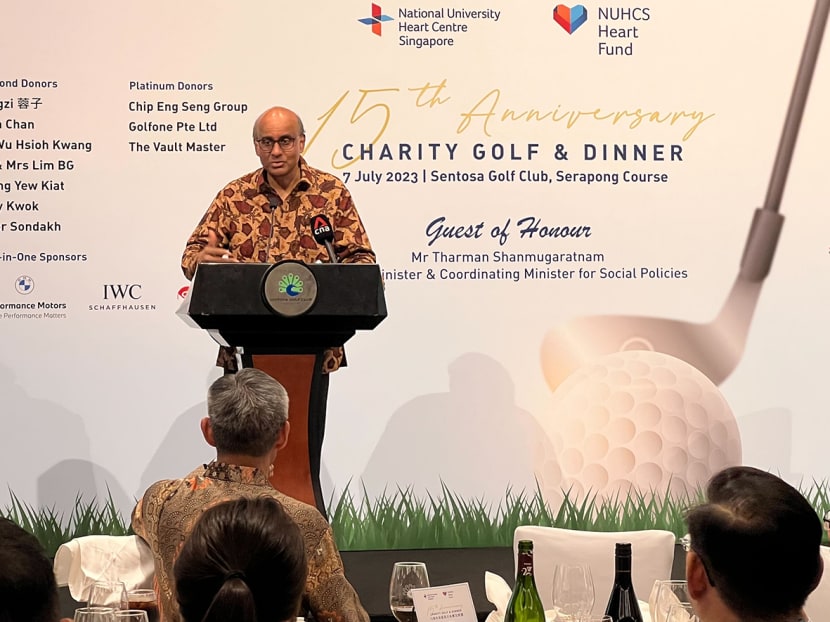
Senior Minister Tharman Shanmugaratnam speaking the National University Heart Centre Singapore's 15th anniversary dinner on July 7, 2023.

- Singapore can be a "welfare society" where everyone takes responsibility for the welfare of others, said Senior Minister Tharman Shanmugaratnam on Friday (July 7)
- He was speaking at the National University Heart Centre Singapore's 15th anniversary, on his last day of working for the Government
- Mr Tharman spoke about the need to make sure that no one with heart disease falls through the cracks
- He also highlighted the heart centre's initiatives, such as its community cardiology clinic and research initiative

SINGAPORE — Singapore must never become a welfare state, but it can be a welfare society where everyone takes responsibility for the welfare of others, Senior Minister Tharman Shanmugaratnam said on his last day of working for the Government.
More than just personal responsibility, there has to be solidarity and social empathy, he said in a speech at the National University Heart Centre Singapore's (NUHCS) 15th anniversary at Sentosa Golf Club on Friday (July 7).
Mr Tharman, who is also Coordinating Minister for Social Policies and Member of Parliament for Jurong Group Representation Constituency, announced on June 8 that he would be officially leaving his government posts to run as a candidate in the coming Presidential Election.
Speaking hours before he became a "free man" — in his own words, to laughter from the audience — Mr Tharman said there will be a lot more people in Singapore with heart disease (about 2.5 times more in 25 years), hence the need to make sure that no one with heart disease falls through the cracks.
"A fundamental effort is to start much earlier with healthy living, good education on what it takes to keep our bodies healthy and our minds healthy," he said.
Mr Tharman said that in Singapore's early years, the ethos of the day was self-reliance and that made sense when the country was a young society.
However, Singapore is no longer a young society and naturally has a maturing economy, where inequalities start to widen when a society gets older.
"As every society gets older, we need something more than self-reliance, more than just personal responsibility that remains across the foundation of our social culture," said Mr Tharman.
He said that in his many years in politics, he has learned that most people appreciate deeply when there are others around them who are willing to help, and this in turn makes them take even more responsibility for themselves without having to be dependent on others.
He said: "There has to be solidarity. There has to be social empathy. Social empathy and solidarity are not at odds with personal responsibility. In fact, they go very well together."
One way of achieving this is to pay more taxes to the Government, which finds a way to subsidise people, Mr Tharman said.
This is a practice in many countries, but it creates a different spirit in society as the ability to hand out benefits becomes transactional, and it would mean higher taxes for everyone, including the middle class, he added.
The Government would, over time, have to collect taxes for healthcare to take care of an older population but it cannot simply be that, Mr Tharman said. This is why it is important for every individual to take responsibility for other people's welfare.
He highlighted NUHCS as a good example where donors and those who have succeeded come together to contribute to a more spirited and resilient society, where everyone takes care of the welfare of others, not just in their own families, but others who have had a setback in life.
NUHCS was established in 2008 to bring together resources, expertise and capabilities in cardiology, cardiothoracic and vascular surgery.
In an effort to help the increasing number of people suffering from cardiovascular diseases, the centre has established the NUHCS Heart Fund to assist financially disadvantaged patients and to support education programmes and continuous medical research.
Mr Tharman also stressed on the importance of early referrals, which the National University Hospital does through a programme started in January this year involving its community cardiology clinics.
The first such clinic is at Jurong Medical Centre which, coincidentally, is situated in Mr Tharman's constituency.
These clinics work together with general practitioners to provide early referrals for patients to see specialists and get advanced diagnostics done.
Mr Tharman also lauded NUHCS for its research initiative that aims to capture billions of data points of lifestyle, physiology and new molecular markers to provide full personalised diagnostics on what diseases individuals might have today and in the future.
This research leverages on artificial intelligence as well, to help prevent early heart disease and make cardiovascular preventive health more accessible to all.
Related topics
Tharman Shanmugaratnam Presidential Election 2023Stay in the know. Anytime. Anywhere.

Subscribe to our newsletter for the top features, insights and must reads delivered straight to your inbox.
By clicking subscribe, I agree for my personal data to be used to send me TODAY newsletters, promotional offers and for research and analysis.






