
S’pore must take full advantage of technology to make people’s lives better: PM Lee
SINGAPORE — Someday Singaporeans could control their appliances from their phones, switching them off and on remotely, they could also call for a self-driving car, and use a watch to pay for items.
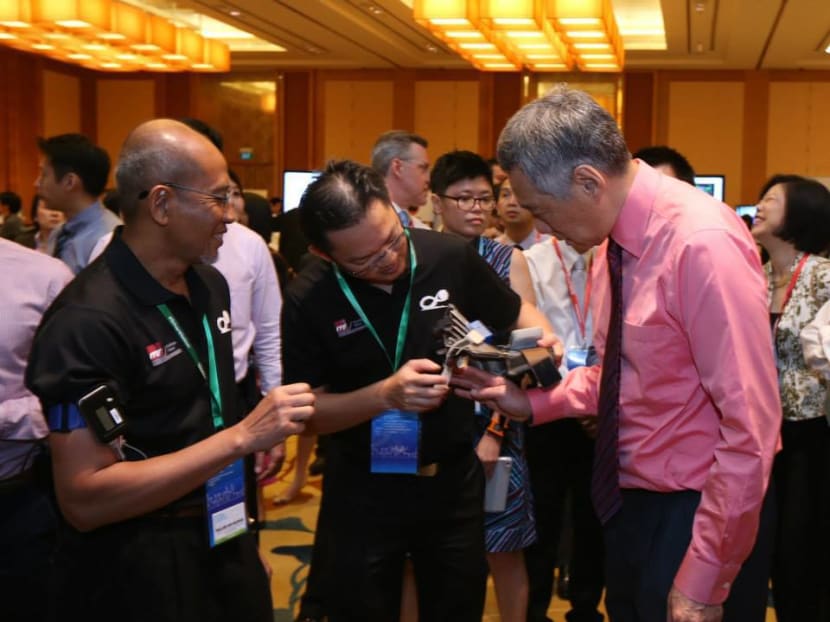
Prime Minister Lee Hsien Loong tries on a robotic glove designed to help rehabilitate upper limb functions in post-stroke patients. Photo: Mr Lee's Facebook page/Ministry of Communications and Information

SINGAPORE — Someday Singaporeans could control their appliances from their phones, switching them off and on remotely, they could also call for a self-driving car, and use a watch to pay for items.
These are some exciting new possibilities, Prime Minister Lee Hsien Loong spoke of in his speech this morning (Nov 24) at the National Infocomm Awards and Smart Nation Launch, where he handed out awards to recipients, including Numoni which nabbed the Most Innovative Infocomm Product/Solution award.
Mr Lee said Singapore has to take full advantage of the use of technology and deploy it not in a piecemeal fashion, but to integrate all technologies in a systematic and comprehensive manner to make people’s lives better and its economy more productive.
The country has already started on this Smart Nation journey, with e-Government services in place and a lively start-up scene as well as tech-savvy people, but the country needs to build on these elements and drive this as a national effort, he noted.
He urged people to have a can-do spirit of experimentation akin to that in Silicon Valley. Right skills and mindsets are needed, and the education system is already equipping students with up-to-date knowledge and skills to use technology. But beyond that, schools need to teach students to create the technology of the future.
Video: Prime Minister's Office, Singapore/YouTube
To realise this “quantum leap forward”, a new Smart Nation Programme Office will co-ordinate the Government agencies, citizens and industries to ensure a whole-of-government approach to build a Smart Nation. It will come under the Prime Minister’s Office under the charge of Minister for the Environment and Water Resources Vivian Balakrishnan.
Mr Lee said the Government will lay a foundation by building infrastructure and facilitating innovation for everyone to contribute, and urged enterprises to provide innovative products as well as for citizens to chip in by participating and providing data.
But even as the nation drives this movement, Mr Lee reiterated that technology will be used in an inclusive manner so that all groups, particularly seniors, can benefit.
Writing in a Facebook post, Dr Balakrishnan said the new Smart Nation Programme Office will engage with all stakeholders over the coming months. He listed various considerations, such as, how can everyone be included in the digital revolution, how can an “open source” society be fostered and where to look for the “best ideas”.
“Certainly, we need to engage the best companies in the world. But we will also innovate, develop, prototype and deploy these ideas locally,” said Dr Balakrishnan. He added: “There will be many failed projects, but we need to learn and persevere in the face of these failures, and not give up in despair. Our attitude to success and failure must change.”
Dr Balakrishnan also listed some necessary “pre-requisite skills” Singaporeans need for the digital age: An aesthetic sense of beauty and design, the ability to build, and the ability to communicate effectively.
“What are the physical and technical pre-requisites? We certainly need world-leading digital infrastructure. Also, we need security, privacy and protection of identity, as the volume of online transactions and data increases. Our systems must be secure by design, not a reactive afterthought; and we all as individuals will need to be aware of the risks and know how best to protect ourselves,” he said.
Stay in the know. Anytime. Anywhere.
Subscribe to our newsletter for the top features, insights and must reads delivered straight to your inbox.
By clicking subscribe, I agree for my personal data to be used to send me TODAY newsletters, promotional offers and for research and analysis.