
Special needs school to start 3D programme
SINGAPORE — Special needs students from Asian Women’s Welfare Association (AWWA) School will be put into a 3D environment simulating real-life situations to teach them social behaviour, self-awareness, communication and motor skills come the end of this month.
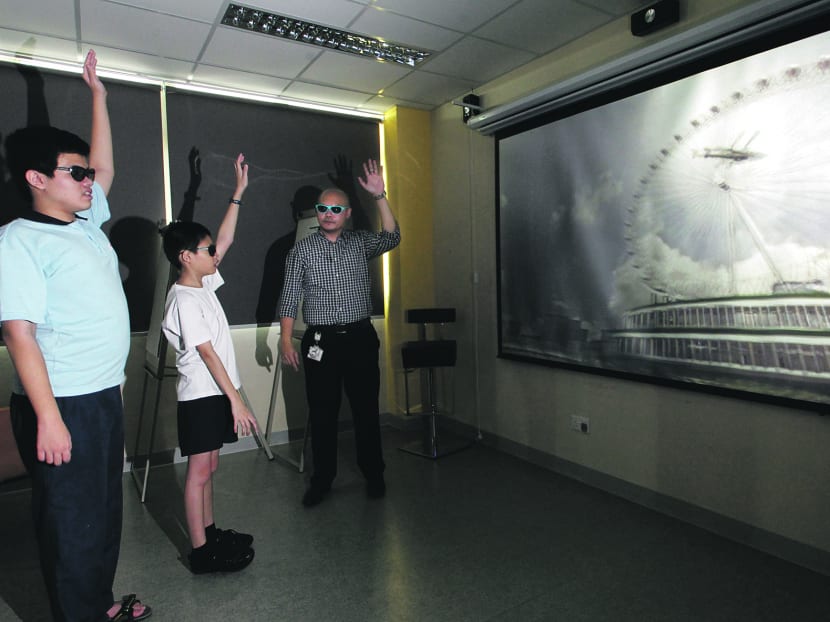
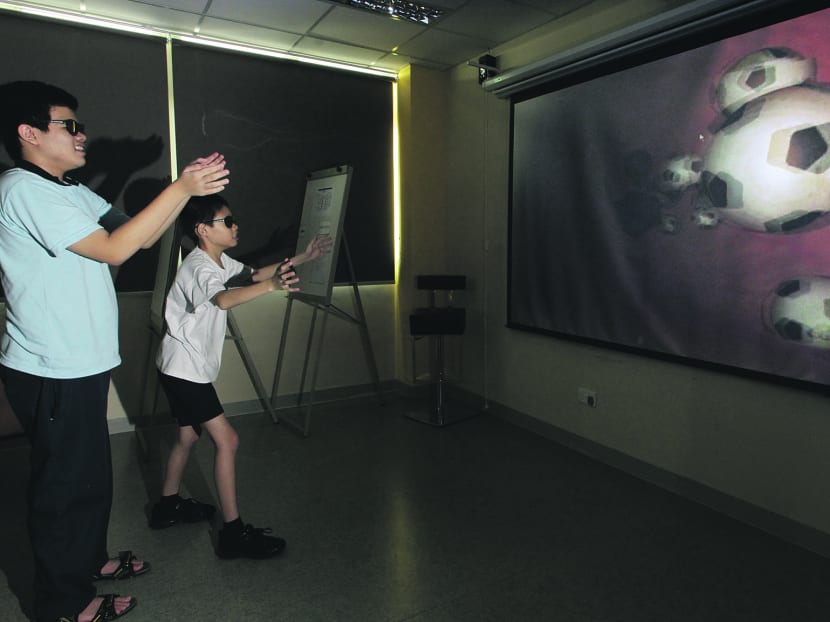

SINGAPORE — Special needs students from Asian Women’s Welfare Association (AWWA) School will be put into a 3D environment simulating real-life situations to teach them social behaviour, self-awareness, communication and motor skills come the end of this month.
For the programme, which is a smaller version of the Nanyang Technological University’s (NTU) Virtual Dolphinarium research project, AWWA School has set up a 3D immersive room, complete with a 120-inch screen and Microsoft’s Kinect for motion sensing.
As TODAY reported last month, the NTU project showed encouraging results in children with autism.
Mr Izad Ghalid, ICT head at AWWA School, said special needs students are very engaged by technology.
The school is one of 12 recipients of the Ministry of Education (MOE)-Tote Board ICT Fund. Launched last November, the fund aims to support special education (SPED) schools in “harnessing ICT to enable differentiated and authentic learning”, said an MOE spokesperson.
AWWA School is currently calibrating the programme’s set-up and training teachers to use its software with the help of professors from the NTU’s Institute for Media Innovation (IMI).
By the end of this month, the school will embark on a one-term pilot with two of their Boost classes, which are classes of six to seven students with higher learning capabilities.
Students will spend an hour a week with the 3D dolphin software, acting as the dolphins’ trainer while picking up communication and leadership skills, and improve their awareness. Subjects outside the 3D lab will also incorporate dolphin elements to leverage on their interests. For instance, students will create e-books of reflections on their dolphin time, label dolphin parts and measure the length of dolphins.
“This is so that students will be able to generalise, and teaching and learning (are) made holistic, supported by other academic subjects,” said Mr Izad.
The pilot will allow the school to examine if any parts of the software need to be tweaked before the programme is rolled out in full to all 250 AWWA students next year, covering six classes each term until 2015.
While SPED schools typically cater to specific needs, AWWA School takes in students aged seven to 18 with multiple disabilities and autism. Mr Izad said while the school has students who suffer from only autism and are in the high-functioning Boost class, it also takes in those with profound disabilities, some of whom require wheelchair support and even feeding tubes.
A 3D environment can prepare those with moderate disabilities for real-life scenarios and give those with profound disabilities an opportunity to experience such situations, which they might not be able to do in real life.
Beyond the 3D dolphins, the school is working with the IMI to recreate other scenarios, such as a 3D virtual supermarket that will teach students about “shopping skills, behaving appropriately at a supermarket and at the same time, teaching them purchasing and money skills”, said Mr Izad.
Other ideas he has suggested to the IMI include software that can teach students about grooming and hygiene, such as how to wash their hands, and a simulated plane cabin environment complemented by a physical passport control booth to ready them for flight boarding. This, Mr Izad said, will allow them to go on holidays with their families.
“A lot of these kids ... need to be very familiar with the setting and the environment,” he added. “Some of them, when they are not ready and you (take) them out, they can have a meltdown and throw tantrums ... They need to be comfortable with the environment.”
Stay in the know. Anytime. Anywhere.

Subscribe to our newsletter for the top features, insights and must reads delivered straight to your inbox.
By clicking subscribe, I agree for my personal data to be used to send me TODAY newsletters, promotional offers and for research and analysis.






