
Straight-A scholars for public service? Time to ‘catch up’ on how to pick talent, forum says
SINGAPORE — The Singapore Government is paying too much attention to academic qualifications in the way it chooses its leaders and assesses the ability of civil servants, panellists at a conference said.
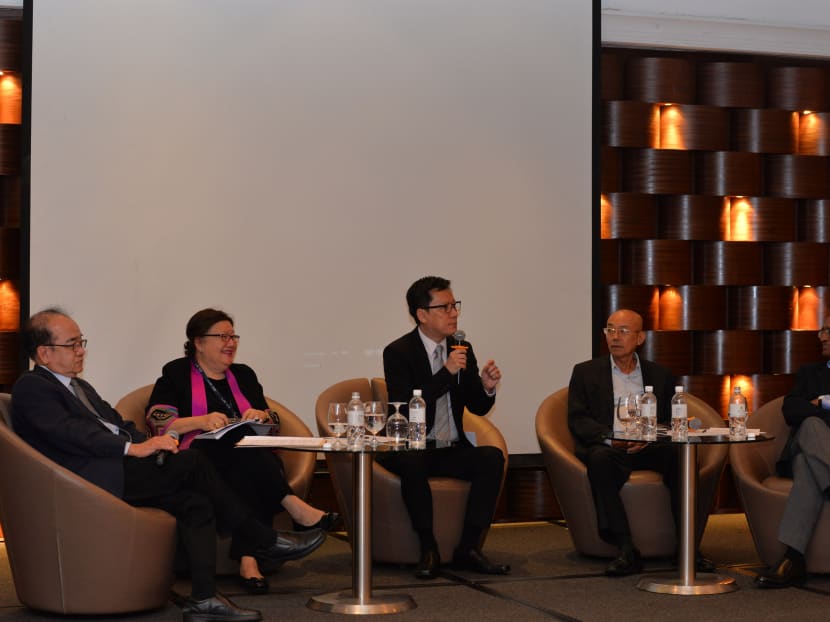
The Behavioural Sciences Institute of the Singapore Management University held a conference to discuss, among various issues, how academic abilities cannot be the only or even most important contributory factor for success.



SINGAPORE — The Singapore Government is paying too much attention to academic qualifications in the way it chooses its leaders and assesses the ability of civil servants, panellists at a conference said.
The conference on Friday (Feb 22), titled Much More Than Academic Abilities, was organised by the Behavioural Sciences Institute of the Singapore Management University (SMU) to discuss various issues. Among them: The level of attention given to academic abilities and non-academic attributes, and how they related to civil society and politics in Singapore.
The panellists included the institute’s director, psychology professor David Chan; Professor Tan Tai Yong, president of liberal arts college Yale-NUS; Mr Laurence Lien, chairman of philanthropic organisation Lien Foundation; consultant orthopaedic and hand surgeon Kanwaljit Soin; Dr Maliki Osman, Senior Minister of State for Defence and Foreign Affairs; and Mr Ng Cher Pong, chief executive officer of government agency SkillsFuture Singapore.
They pointed out that while academic grades could be a good indicator of diligence, structured thinking and conformity, the grades do not determine how leaders are chosen in other practical situations or segments of society. These leaders take risks and bust boundaries, know how to work with people, and vehemently uphold ethics and values.
Prof Chan said that a smart person with poor non-academic traits, such as situational judgement and an ability to tolerate contradictions, could become a “liability” when put in the high places.
Prof Tan, in his own presentation, also lamented the rigidity and undue emphasis on academic abilities in the public sector.
“Civil service, in my view, needs to catch up,” he said, adding that the private sector has become increasingly “enlightened” in the way it recognises talents over grades.
“I have encountered personal cases of students who get into all sorts of issues with their new employers in the civil service because of a class of honours they have graduated with.”
Acknowledging that grades can be an indicator of a person’s abilities, Prof Tan said it is worrying when that becomes the definitive tool of assessment.
“I simply hope that employers in the civil service could look at the students, do all sorts of tests they want to understand their backgrounds… and then look at them as individuals.”
Friday’s conference was attended by about 300 participants including leaders in the public, private, and non-profit sectors, as well as academics.
In their speeches, Mr Lien and Dr Soin highlighted that a study of 81 high school valedictorians, or top students considered by teachers to be the most promising of their cohorts, found that they seldom go on to make a mark in the world.
“Valedictorians typically settle into the system rather than shake it up,” Dr Soin remarked.
To further illustrate the point, Mr Lien presented a list of 10 Nobel Peace Prize winners along with their first academic degree. Other than former United States president Barack Obama who graduated from Columbia University, no one else graduated from an elite university.
Mr Lien also pointed out that two of five first-generation government leaders in Singapore, listed on the ruling People’s Action Party’s website as “founding fathers”, did not hold an academic degree. They are the country’s first foreign minister S Rajaratnam and Mr Lim Kim San, former chairman of the Port of Singapore Authority, who is credited for spearheading the public housing programme here.
On the other hand, leaders who led the United Kingdom through the Brexit referendum and its move out of the European Union “caused a mess because they went to Oxford”, he said, flashing a slide with headshots of British politicians Boris Johnson, David Cameron, Theresa May and Michael Gove.
Straight As, Mr Lien added, are not good indicators of work efficiency, leadership, the ability to break rules, take risks and bust boundaries, develop passion, ethics and values, and to work with people and work with volatility, uncertainty, complexity and ambiguity.
Emphasising the need to build a stronger civil society here to attain better governance, Mr Lien put up a slide showing his photograph placed next to the photos of three Oxford University graduates like him who are active in the civil sphere here.
They are former presidential candidate Tan Jee Say, Workers’ Party member Leon Perera, and economist Donald Low, a former Lee Kuan Yew School of Public Policy associate dean who was once rebuked by Law and Home Affairs Minister K Shanmugam in 2017.
“We do need diversity, and whether you like these people or not, they have given diversity to a lot of the discourse in society, and the society is richer for it,” he said, adding that the diversity can prevent group-think here.
Asked what non-academic quality is most lacking among Singapore’s political leaders, both Mr Lien and Dr Soin said it was the trait of humility.
“Humility is lacking. I think it is too much of hubris, and too much (of) ‘we know what is best, we are always right’,” Dr Soin said.
Expanding on her point, Mr Lien said: “I think part of that is because we are still holding onto this ‘great man’ notion of leadership, that the leader must know it all.
“The populace also puts you there because you have a million-dollar salary, so you must have all the answers. It is a very unhealthy dynamic we do need to break out of. We expect too much of our leaders,” he said.
“For themselves, it makes it very difficult for them to have that humility… so you lose that ability over time to sense what is on the ground.”
Stay in the know. Anytime. Anywhere.

Subscribe to our newsletter for the top features, insights and must reads delivered straight to your inbox.
By clicking subscribe, I agree for my personal data to be used to send me TODAY newsletters, promotional offers and for research and analysis.






