
Surge in summonses for heavy vehicles
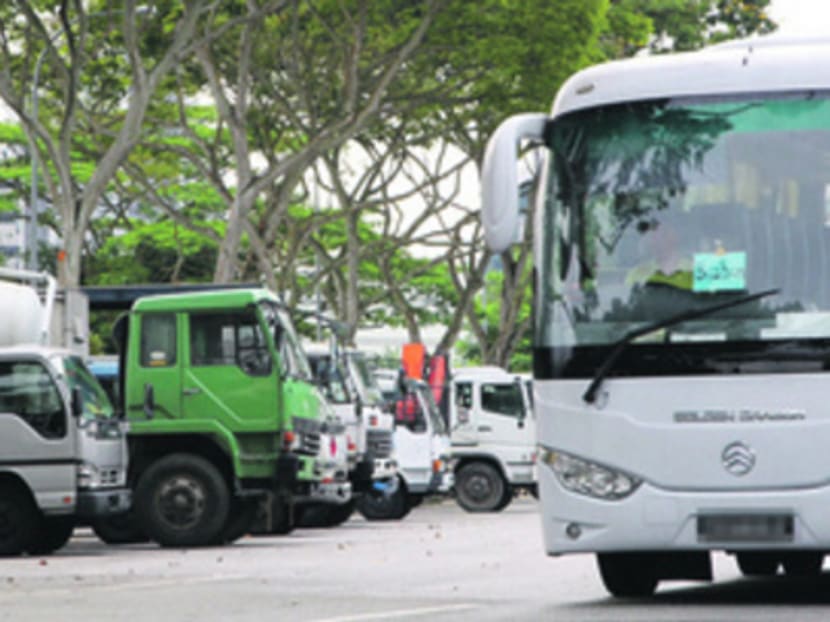
The URA said there are ‘practical difficulties’ in locating heavy vehicle parks close to housing estates, which need land ‘for housing and community uses’, and residents may not welcome the noise and dust. Photo: Don Wong

SINGAPORE — The number of summonses issued to heavy vehicles parked outside their designated lots in the first 10 months this year has surpassed the total number of summonses issued for the past two years.
This figure was despite the requirement under the Vehicle Parking Certificate scheme that owners of vehicles such as buses, lorries and trailers must have a designated heavy vehicle parking space, and must park them overnight in the lot when not in use.
According to the Land Transport Authority (LTA), 5,400 parking summonses were issued to heavy vehicles between January and October, compared to 2,200 summonses each issued in 2010 and last year.
When asked about the spike, an LTA spokesperson attributed the increase in offences this year “in part to more feedback received”.
There are about 39,500 heavy vehicle parking lots islandwide, for the 33,000 heavy vehicles registered on the roads here.
About three quarters of the heavy vehicle lots islandwide are privately operated and located in industrial areas, while the rest, some of which are located near residential areas in the form of kerbside parking, are mainly operated by the Urban Redevelopment Authority (URA) and the Housing and Development Board (HDB).
While the LTA said there is no shortage of parking lots for overnight parking, “some heavy vehicle owners park indiscriminately overnight in residential areas for convenience”.
However, the lack of parking facilities near their homes was a common lament among heavy vehicle drivers.
Mr Faisal, 38, who drives a prime mover, said he would rather risk a S$100 fine by parking illegally along a road, as the nearest heavy vehicle park is at least half an hour away.
The driver, who starts his day at 6am, has also occasionally parked his vehicle under his HDB block, especially when he ends work past midnight. There should be more parking spaces for heavy vehicle drivers closer to their residential areas, he felt.
When contacted, a URA spokesperson said there are “practical difficulties” in locating heavy vehicle parks close to residential estates, which need land “for housing and community uses”. Residents may also not welcome the associated noise and dust, she added.
The HDB, meanwhile, said its approximately 7,000 heavy vehicle parking lots are mostly located in industrial areas, rather than near housing estates, “to reduce disamenities to residents”, and to “preserve the good living environment and ambience of public housing estates”.
Noting that heavy vehicles “are meant for commercial purposes and not as a means of personal transport”, the HDB said drivers should “take other means of transport to and from home”.
But Mr Tahir, 31, who drives a trailer and was once issued eight summonses in a month, noted the longer waiting lists for parking at sites closer to residential areas. He said some colleagues have waited as long as a year for parking, as there could be 50 others on the waiting list.
The HDB’s lots — allocated on a first-come basis — are at S$185 per month for season parking, while the URA’s lots are at between S$120 and S$185 per month for season parking. The URA’s lots are available for S$1 per hour for short-term parking, from 7am to 7pm on Mondays to Saturdays.
Private operators have been known to charge as much as S$300 a month for their lots, depending on the type of heavy vehicle.
Noting that some heavy vehicles leave their parking lots as early as four or five in the morning, with most vehicles out of their parking lots by 7am, one private vehicle park operator described siting lots away from residential areas as “highly impractical”.
Given their long and odd working hours, most drivers use their company vehicles as a form of personal transport, the operator said.
While it is continually looking to expand the number of its heavy vehicle parking sites, “in general, to find empty plots of land and turn it into parking space is difficult”, and plots near to residential areas are more “difficult to come by”, the operator added.
Stay in the know. Anytime. Anywhere.

Subscribe to our newsletter for the top features, insights and must reads delivered straight to your inbox.
By clicking subscribe, I agree for my personal data to be used to send me TODAY newsletters, promotional offers and for research and analysis.






